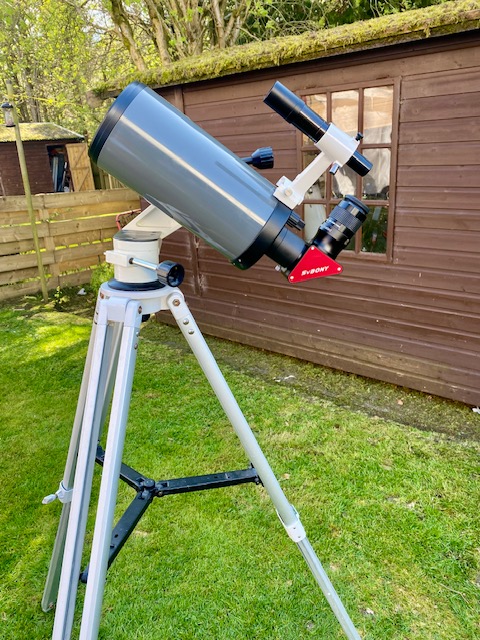
A Work Commenced April 27 2026
Product: Svbony MK 127
Country of Manufacture: China
Focal Length: 1500mm
Focal Ratio: F/11.8
Central Obstruction: 36%
Focuser: Dual Speed
Weight (OTA): 2.94kg
Accessories: 1.25 & 2-inch Adaptors, 0.65 Focal Reducer, lens cleaning cloth
Price: (UK); £409
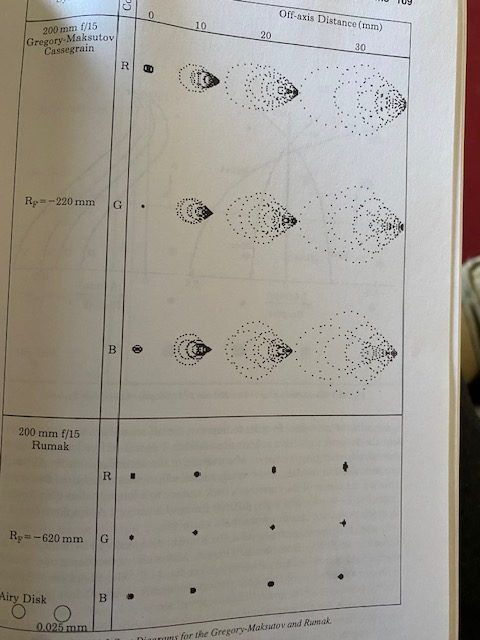
In their now classic papers published back in the 1940’s, Dimitri Maksutov and Albert Bouwers independently published their designs for a meniscus camera, in which they suggested that the same camera could be modified into a new kind Cassegrain telescope. But it was not until 1957 that the American optical engineer, John Gregory, published his designs for a F/23 meniscus telescope. His prototype F/23 instrument had a spherical primary mirror matched to a spherical meniscus of the opposite power. Gregory added an aluminised spot on the inside surface of the meniscus but this design had too much residual chromatic aberration. A year later, Gregory published a revised design for a F/15 Maksutov Cassegrain with improved colour correction by aspherising either the secondary or primary mirror. The Gregory Maksutov characterised by a deeply curved meniscus with a central aluminised spot still suffers from significant coma and astigmatism moving off axis. The Dutch amateur astronomer and optical designer, Harrie Rutten, hit on the idea of introducing a separate convex mirror to the centre of the meniscus which added another degree of freedom to the Maksutov Cassegrain design, allowing for much improved off axis performance and a much flatter field. Moreover, adding a secondary operating independently of the meniscus and primary mirror allows shorter focal ratios to employed (F/8-12) compared with the typical F/13-15 adopted in many Gregory Maks.
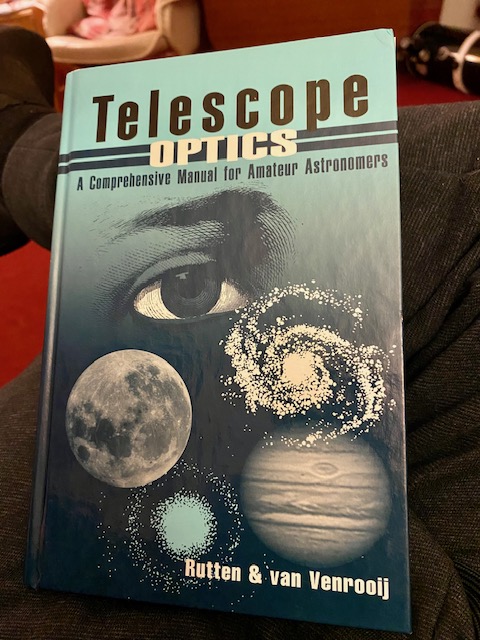
His ‘Rumak’ design first appeared in the 1988 book, Telescope Optics, where on page 111, the authors compare spot diagrams of a conventional 8-inch F/15 Gregory Mak to a similar Rumak, clearly showing how much better the latter is moving off-axis:
The Rumak design quickly turned into reality when companies like Intes, Intes Micro, Santel, LOMO, Orion Optics UK and TEC began to offer Rumaks in apertures from 5 inches up to 8 or 10 inch monsters. But these were quite expensive. Things began to change a few years ago however, when Bosma marketed a 6-inch(150mm)F/12 Rumak which proved popular with lunar and planetary imagers and visual observers alike. To my mind, the Maksutov Cassegrain is among the most elegant optical designs, combining high optical performance with extreme portability.
In this review, I’ll be showcasing an exciting new Rumak telescope marketed by the Hong Kong-based company Svbony: enter the MK 127: a 5-inch F/11.8 optical tube assembly.
What’s in the Box?
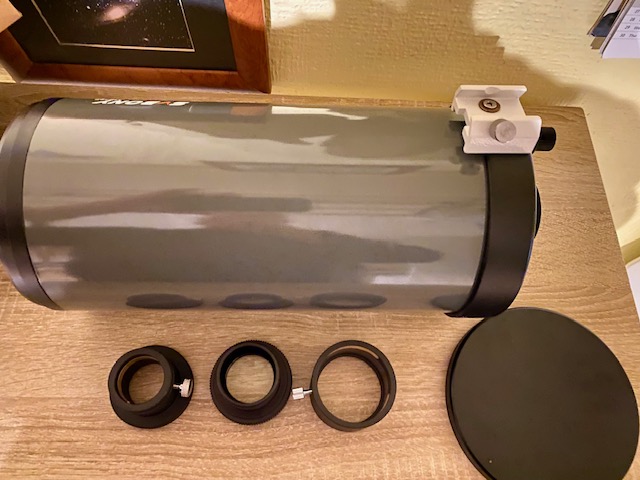
The telescope arrived securely inside a snugly fitting box with foam cutouts. As well as the optical tube assembly, you get both 1.25 inch and 2-inch adaptors which are very nicely machined and screw directly onto the back of the telescope. Unlike cheaper adaptors that use a side screw that can scratch cameras or eyepieces, these have brass compression rings. You also get a dedicated 0.65x focal reducer that decreases the focal ratio to F/7.68. The reader will note that this cannot be used visually.
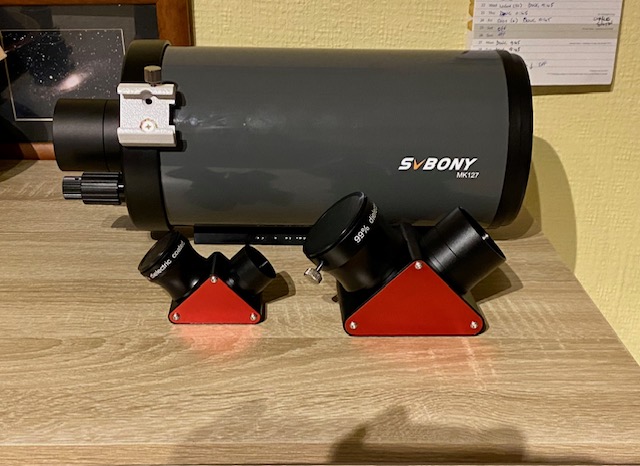
The optical tube is a handsome grey colour and has two brackets attached to attach a finder or guide scope. It’s reassuringly light, tipping the scales at under 3 kilos. The focuser is dual speed: an excellent feature that allows the user to coarse and fine focus. The meniscus cover is all metal and fits snugly in place protecting the optics from dust and damp. A Vixen-style dovetail plate allows it to be mounted on most any mount.
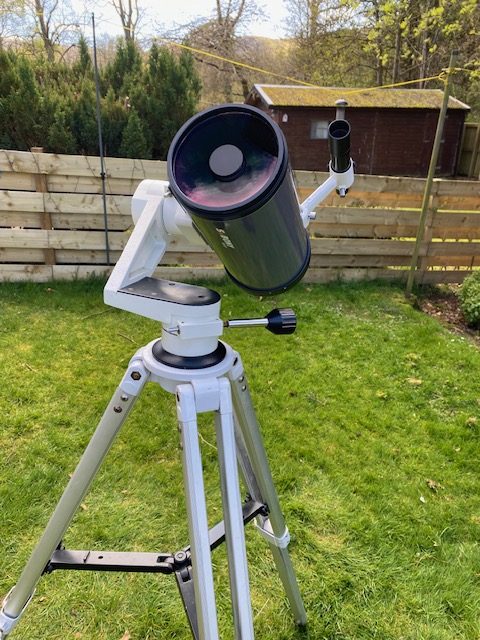
The glass meniscus is fully multicoated and is less curved than a Gregory Mak. Defocusing an artificial star provides the easiest way to measure the central obstruction which turned out to be about 36 per cent: a good result for this relatively fast(for a Maksutov) focal ratio. This is larger than the perceived obstruction from the front of the meniscus as the secondary baffle tapers out a wee bit. That said, it’s still smaller than a Celestron C5 and the 5 inch Synta Gregory Maks, for example.
A telescope like this deserves a decent finder. But I hit a small snag when I tried to mount my 6 x 30 finder scope to the brackets on the MK 127. It was not wide enough to allow the foot to slide inside. I got round the problem by mounting a Skywatcher bracket instead.
Some reports online mentioned the stiffness of the cover on the secondary adjustment screws, but my unit had no such issues. It screwed off without any problems.
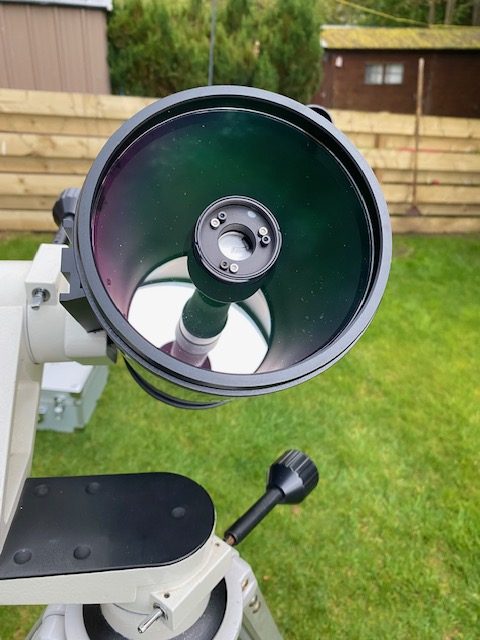
Looking inside the tube, I noted how clean and dust-free it was. It could certainly do with internal flocking though to maximise image contrast. All in all, I garnered the distinct impression that this was a robust, well-made telescope: certainly a step up from the Synta-branded 127mm Mak.
Daylight Tests
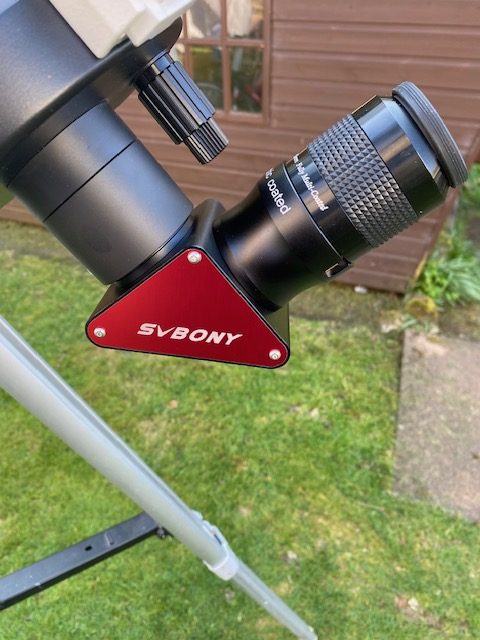
I elected to use a 2-inch Svbony dielectric diagonal to garner the best images from the telescope. I used a variety of 2-inch and 1.25 inch eyepieces to conduct my daytime tests.
I first checked collimation using an artificial star and was relieved to see it was perfectly aligned with nice concentric diffraction rings.
The MK 127 makes for an exceptionally powerful spotting scope. Its short length but robust design allows it to dampen out vibrations very quickly(less than a second) on my Vixen Porta II mount. Charged with an inexpensive GSO branded 30mm 2-inch eyepiece yielding 50x and a 1.36 degree true field, I was genuinely astonished how crisp and contrasty the daytime views were. The superior optical design and high focal ratio of the Rumak served up images that were sharp from centre to edge. Indeed, using the company’s SC001 imager, I took some photos of young leaves emerging from deciduous trees some 80 metres in the distance. For example, the image below was taken in bright Spring sunshine and the small CMOS sensor is roughly the equivalent of a 6mm eyepiece yielding an effective magnification of about 250x. I think the result speaks for itself!

I would actually go so far to say that the MK127 makes for a better spotting scope than a regular lens-based instrument with its low mass, small size, brighter images and complete lack of colour fringing, not to mention its ability to use different eyepieces. The image is upright but flipped left to right which is perfectly acceptable. Indeed, any IPhone can reverse the image with one click.
How close can the MK 127 focus? Well, with a 1.25 inch diagonal I could focus as close as 18 metres but when I switched to a 2-inch diagonal I could reduce this to just shy of 11 metres!
Under the Stars
A 5-inch Maksutov makes for a great companion under the stars and the Svbony MK 127 did not disappoint. For optimum performance, the instrument was kept in a dry, unheated outhouse so that it equalises quickly with the outside air. And while some do not consider a 5-inch Maksutov to be a grab ‘n’ go instrument, some basic planning can flip that perception on its head. Conducting my tests on April evenings when Scotland experiences its largest diurnal temperature swings, the MK 127 never had any issues tracking outside air temperatures at night.
The MK 127 delivered in spades under the starry heaven. Under calm, steady atmospheric conditions, Polaris showed a tiny, round Airy disk with a bright first diffraction ring. Textbook perfect in fact! I noted little to no image shift during focusing.
For low power sweeps, I charged the instrument with an inexpensive 30mm GSO super-wide eyepiece generating a 1.36 degree field at 50x. Stars focused down to fine pinpoints against a dark background sky. Centring the bright star Capella in the field of view and panning off axis, I was pleased to see that it did not show distortions until reaching the last 15 per cent of the field, where some mild coma and field curvature became evident. This was very reassuring, as the MK 127 can be used with budget eyepieces. Comparing the views at a similar power with my high-quality 130mm F/5 Newtonian, I immediately noticed the superiority of the Rumak in controlling off-axis coma.
Turning the telescope to Jupiter, now well past opposition and sinking fast into the western sky, a 10mm Sirius Plossl eyepiece providing a power of 150x delivered very nice views with the main bands clearly in view. Adding a Baader Neodymium filter further enhanced low contrast features. The telescope easily picked up the Great Red Spot and I enjoyed numerous shadow transits of the Galilean satellites. The fine focus knob greatly increased the precision of finding the crispest focus point as the planet fell in altitude after dark.
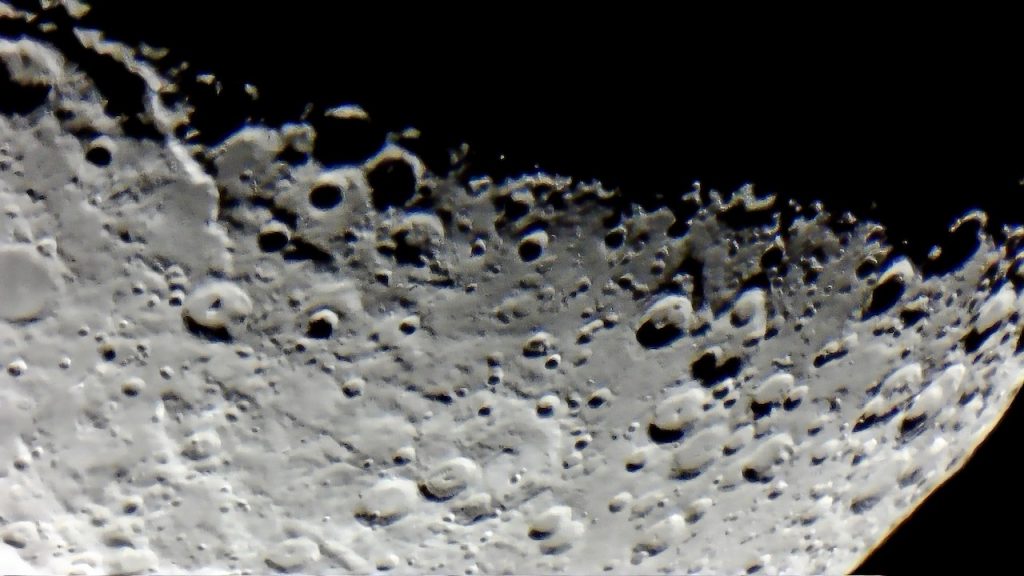
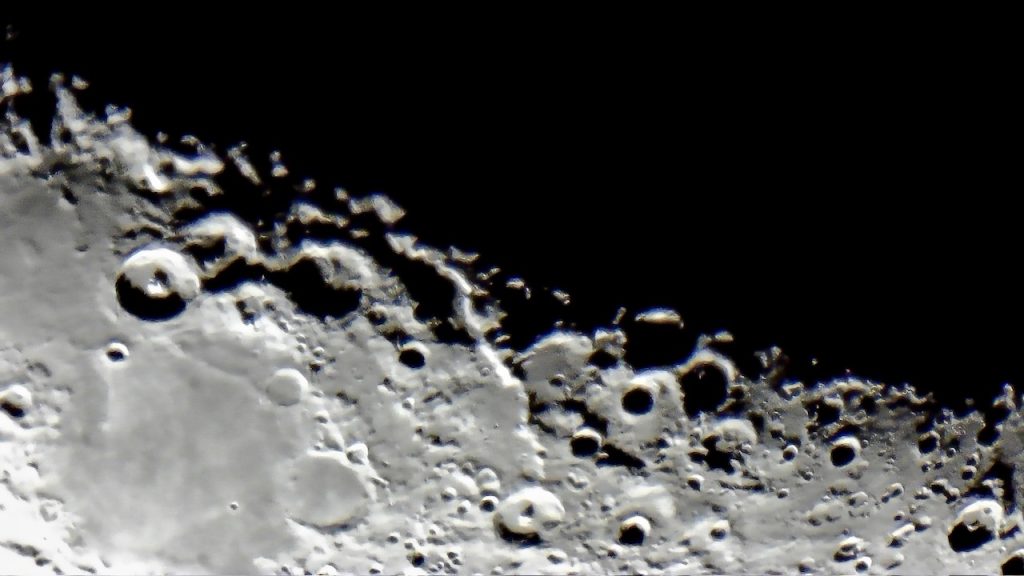
The Moon is awesome in the MK 127. Following its phases from slender crescent to just after first quarter Moon, the MK 127 revealed impressive levels of detail in the battered southern lunar highlands. The Apennine Mountains showed very fine detail at powers up to 250x. The shadows cast by peaks around crater walls were mesmerising to watch. I used the SC001 imager to capture a few shots of the Moon as it drifted through the field of view: two of which are shown below. The reader will be aware that these are single shots and not stacked or processed in any way.
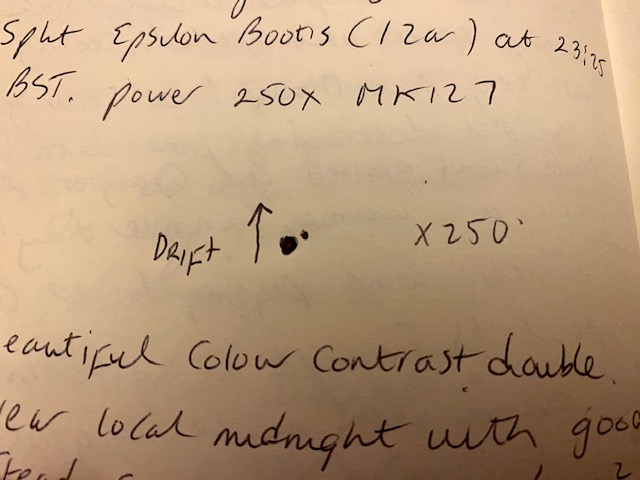
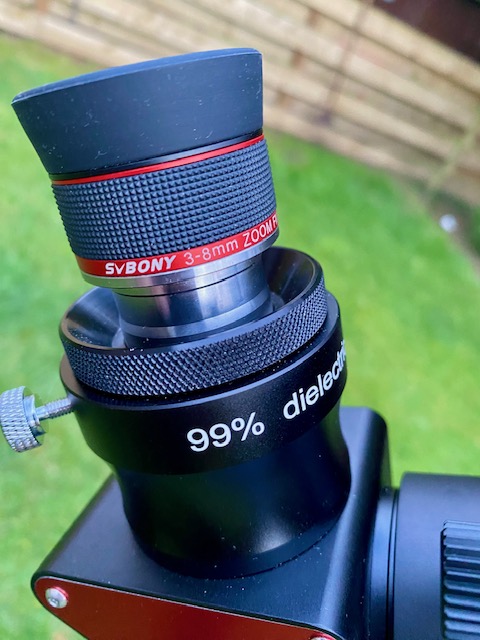
Maksutov Cassegrains have earned a solid reputation as fine double star scopes. And here, yet again, the MK 127 delivered the readies. Using Svbony’s excellent SV 215 3-8mm zoom eyepiece, I managed beautiful splits of Castor A & B, Alula Australis, the twin golden suns of Algieba(Gamma Leonis). Epsilon Bootis (Izar) was also a terrific sight in the MK 127. On the clear night of April 28 I sketched this tight but lovely, colour contrast pair as it drifted through the field at 250x.
Later in the night when the summer constellations of Cygnus and Lyra climbed higher in the northeastern sky, I enjoyed excellent views of the celebrated Double Double( Epsilon 1 & 2 Lyrae)at 217x. Albireo was stunning at 150x, its blue and orange components providing an utterly engaging view. Feeling a bit more adventurous, I tried my hand at more difficult pairs: Delta Cygni in the east and Theta Aurigae in the west. Using my single polarising filter and cranking up the power to 250x I resolved both under steady seeing conditions. I also tried my hand at the delicate triple system, Iota Cassiopeiae, quite low in the north after dark, and was pleased to resolve it very cleanly.
I have no doubt that when Cygnus rises higher in the summer sky, the MK 127 will resolve the sub-arc second pair Lambda Cygni under high powers and steady skies.
Finally, returning to lower powers and wider fields of view, the MK 127 served up lovely views of the Double Cluster at 50x. M13 looked great in the wee small hours once the constellation of Hercules rose to a decent altitude in the eastern sky. The Beehive Cluster and M35 were also beautifully presented in this telescope. I’m very much looking forward to sweeping the summer Milky Way with the MK 127 when dark skies return to our shores in August.
Conclusions
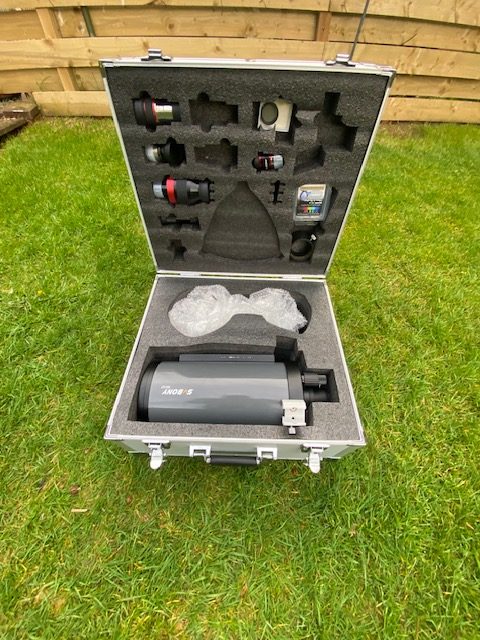
While the internet is awash with YouTube videos (I’d recommend watching the video showcased in my preamble above) demonstrating the imaging capabilities of the Svbony MK 127 using its dedicated 0.65x focal reducer, my emphasis in this review was to illustrate its capabilities in a visual capacity. The handsome Svbony MK 127 certainly offers impressive optical performance for its very modest price tag. Even inexpensive eyepieces perform well, thanks to its large focal ratio. And while I would never consider such a telescope as a main observing instrument, preferring larger apertures in routine use, the MK 127 certainly makes for an excellent portable, travel scope that can be enjoyed equally by day and by night. And for that, it fully deserves a good travel case!
Highly recommended!
As a new Svbony Affiliate, you can use this link to get $50 0ff purchasing the MK 127 package using code Neil50.
Dr Neil English is the author of the widely acclaimed history of visual astronomy: Chronicling the Golden Age of Astronomy