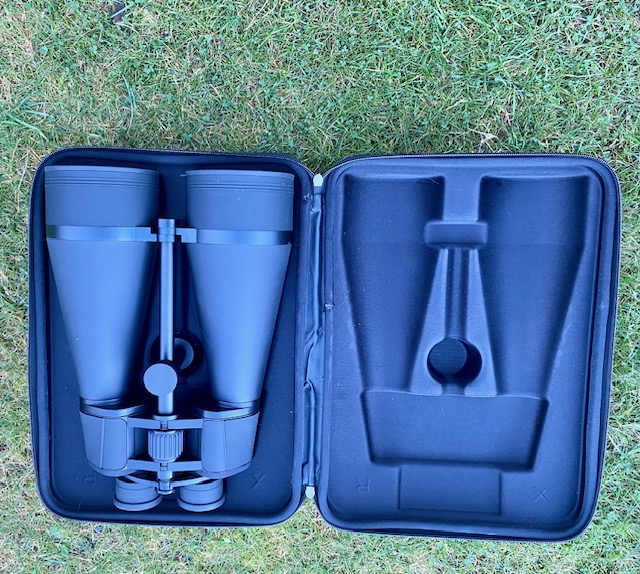
A work Commenced November 27 2025
Product: Opticron Oregon 20 x 80
Country of Manufacture: Chins
Field of View: 57m @ 1000m (3.2 angular degrees)
Exit Pupil: 3.75mm measured
Close Focus: ~20m
Eye Relief: 17mm
Interpupillary Distance (IPD) Range: 56-73mm (2.2-2.9 inches
Prism Type: Porro I
Coatings Fully multi-coated
Waterproof: No
Weight: 2185g
Accessories: Hard case, neck strap, instruction manial and lens cleaning cloth
Price(UK:£150
Over the last year, I’ve been testing out various large aperture binoculars with a goal to selecting the most powerful instrument I could profitably use either with or without a monopod. That led me to investigate various formats: 15 and 18 x 50 Canon IS binoculars, an Oberwerk ED Ultra 15 x 56, various 15 x 70 models from Celestron and Helios, as well as a quick brush with the Opticron Oregon 20 x 80. These experiences were both enjoyable and rewarding, as I was able to compare and contrast their performance under a dark night sky.
After conducting this study, I reached a startling conclusion: the instrument that ticked all the boxes was the budget priced Opticron Oregon 20 x 80, producing the best deep sky views of all the models tested. So, I ordered up another 20 x 80 unit to conduct more tests and concluded that I had made the right choice. What follows is a more detailed review of my ‘second light’ experiences with this binocular.
A Tried & Trusted Design

The second, new Opticron Oregon 20 x 80 arrived in great shape. Collimation was excellent and the focus wheel worked smoothly and precisely. Ditto for the right eye dioptre compensation ring: which moved with just the right amount of traction as well as holding its position well.
Like I reported with an earlier unit, I noted a small restriction in aperture owing to the small Porro I prisms utilised in the design which reduced its aperture to 75mm. To my mind, this was a perfectly acceptable compromise given its modest price tag. And losing 5mm proved to be no big deal in the scheme of things.

Testing the binocular out on some bright street lights after dark, I was delighted to see little in the way of internal reflections. The same was true when I turned it on a bright October full Moon.


Mounting it on a heavy-duty Oberwerk 2000 monopod, day time views were very impressive: very sharp, nice contrast, vivid colours, with very modest amounts of chromatic aberration. But in truth, what I really looked forward to is giving this beast a good test drive under a dark country sky where it delivered in spades!
Testing on a variety of my favourite deep sky objects including M31, the Pleiades, the Belt Stars and Sword Handle of Orion, M35, M33, Kemble’s Cascade, The Alpha Persei Cluster and nearby Double Cluster, Albireo, the circumpolar galaxies M81 & M82, and the Coathanger asterism, I was immediately struck by the brightness boost of the large 80mm objectives. The central bulge and spiral arms of M31 stood out much better than any of the smaller instruments. The young, blue and white hot stars of the Pleiades sparkled much more prominently compared with the view delivered by both a 15 x 70 or a Canon IS 18 x 50, which appeared much more lacklustre in contrast. M35 was much better resolved in the 20 x 80 than any of the other binoculars I turned on it. Albireo was much more impressively resolved in the large, Opticron Oregon owing to its greater resolution and magnification. The three prominent Belt Stars of Orion could just fit inside the 3.2 degree field of the 20 x 80, with several dozen fainter stars(Collinder 70) peppering their hinterland. M42 in the Sword Handle presented prominently with a greenish hue: a colouring the smaller instruments failed to show.
The Double Cluster was stunning in the 20 x 80 showing fainter stars and more vivivid colours than any of the other instruments I had used.
Sure, the Opticron Oregon 20 x 80 doesn’t have a flat field like the Oberwerk ED Ultra 15 x 56 or the Canon 18 x 50, but its small field delivers acceptable results even at the field stops- much better, for example, than the Celestron Astromaster binoculars. Do you really need ED glass for such deep sky work? I would say no! It makes very little difference in my opinion. Even a bright first quarter Moon shows an acceptable level of fringing at the limbs, is quickly forgotten when the level of crater detail immediately stuns the eye.
In a nutshell then, aperture wins!
Neil English is author of Choosing & Using Binoculars
… the cliffhanger “what I really looked forward to is giving this beast a good test drive under a dark country sky where it delivered in spades!” sets me in dire need of the final part!!
Excellent initial review.
I have just bought myself the Opticron 20×80. I am looking forward to giving them their first proper ‘first light’ once the weather clears up – But even after an initial setup test, and aiming them at my usual test subject (a distant TV ariel), checking collimation, resolution and CA, it is all shockingly well under control. There’s actually a teardown video on YT, of a scruffily used and damaged set of these, and it is indeed very well constructed. Ample metal & the prisms are indeed coated, Giving truth to the claim of FMC.
https://www.youtube.com/watch?v=TEUhQKnDbhA