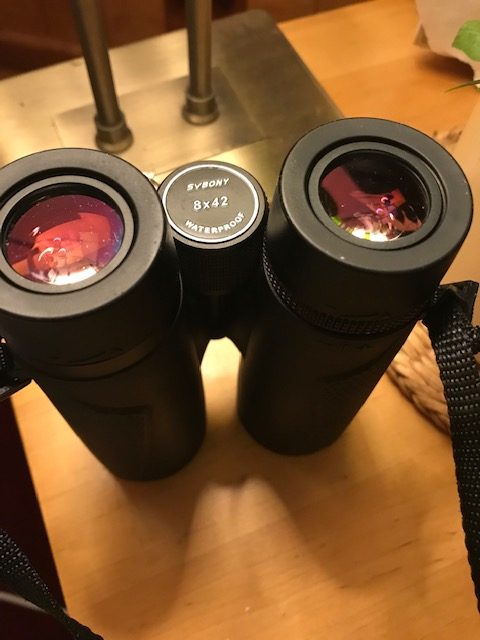
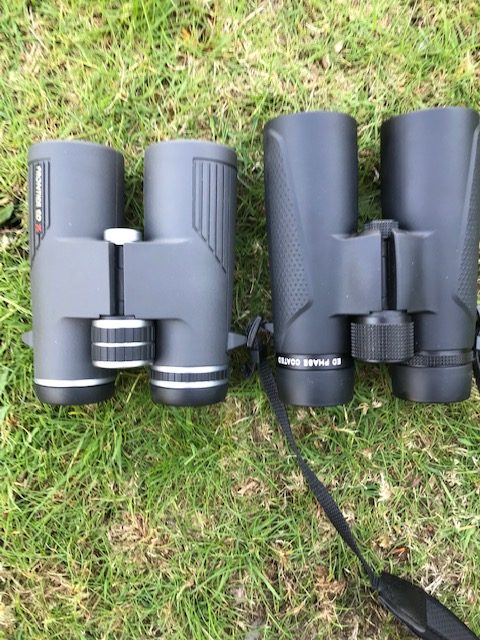
Coatings: Full Broadband Multicoated, Dielectric coatings on BaK4 prisms
ED Glass: Yes FK-61
Waterproof: Yes
Nitrogen Purged: Yes
Dimensions: L/W: 14/12.5cm
Weight: 671g advertised, 728g measured
Warranty: 2 years
Price: $329.95
In previous reviews I expressed my great admiration for the new Oberwerk SE Porro prism binoculars, which offer exceptional optical performance for their modest price tags. These experiences got me very intrigued about the company’s Sport ED roof prism binoculars, offered in the popular formats of 8 x 42 and 10 x 42. Could these deliver the ‘Wow Factor’ I had experienced while using the SE Porros?
Admittedly, this was going to be a tall order to pull off, especially in light of the many similarly priced models now available to the consumer offering many of the same features, at least on paper. Moreover, my love of high-quality Porro prism binoculars had somewhat dampened my enthusiasm for roof prism binoculars in general. But after putting the 8 x 42 Sport ED model through its paces in a variety of favourable and adverse lighting conditions, I think the answer is a confident Yes!
Ergonomic Features
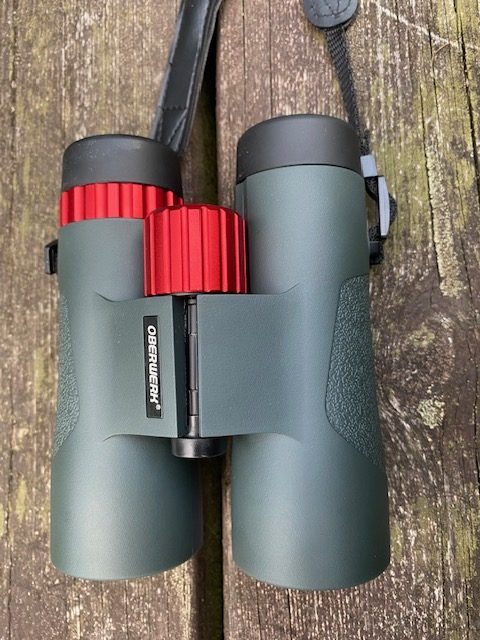
An exceptionally handsome binocular.
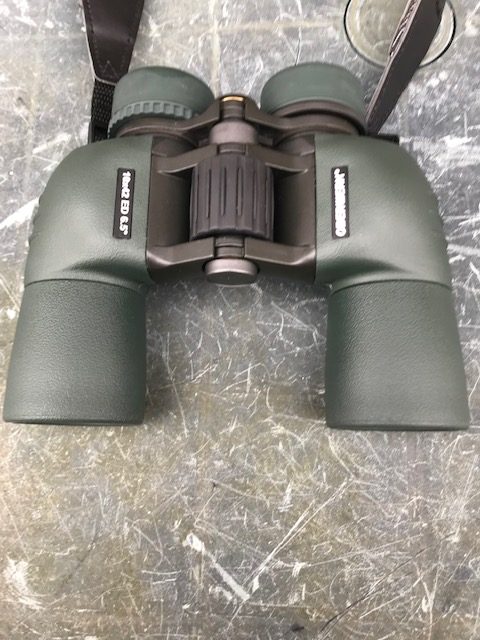
I contacted Oberwerk owner, Kevin Busarow, who agreed to send me a unit for review. The instrument arrived well packed and double-boxed together with its standard accessories. My first impressions were certainly very favourable. While I’m not a fan of garish colours, I have to make an exception for this binocular. This is one handsome instrument, with its very fetching dark green rubber armouring and black, twist-up eyecups complemented by the cherry apple red anodized aluminium focus wheel and right eye dioptre ring.
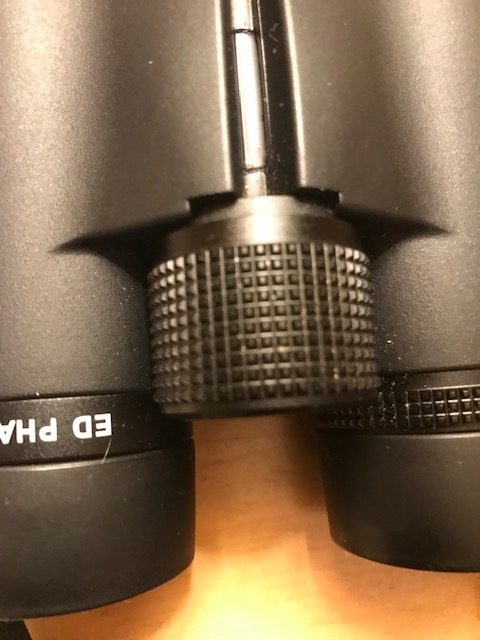
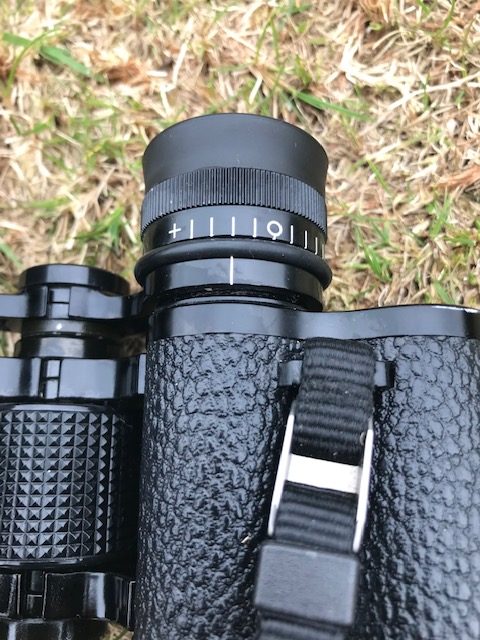
The textured rubber armouring is exceptionally grippy without being overly thick, keeping its overall weight down. Even in wet weather, your fingers will not slip up. The focus wheel is truly excellent. The deeply knurled edges make it exceptionally easy to turn with one finger, rotating smoothly in both directions with zero free play. Indeed, this is probably the very best focus wheel I’ve personally encountered in a roof prism binocular! 1.75 turns anticlockwise takes you from closest focus to beyond infinity.
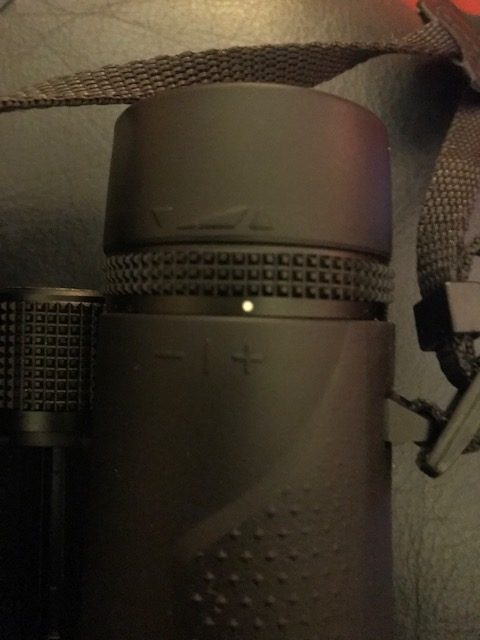
Ditto for the right eye dioptre ring. It’s very hard to rotate but you get there in the end. Once set it will stay in place!
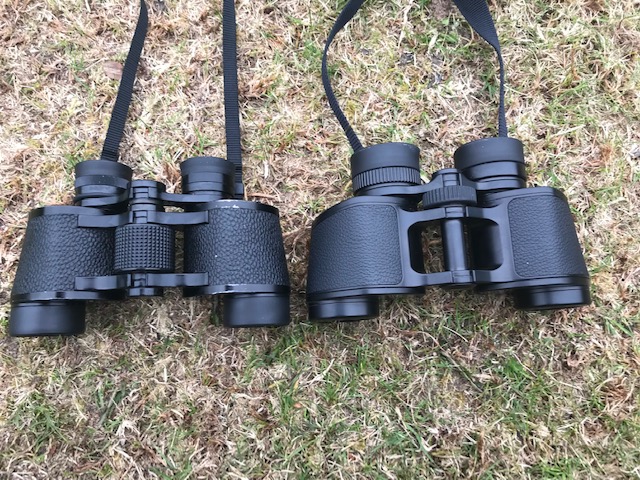
Belly side up.
The rubber-clad metal eye cups have two intermediate positions between fully retracted and fully extended. Moreover, after clicking into place, they hold their positions very firmly indeed. And there’s plenty of eye relief for the bespectacled among us too. I was easily able to engage with the entire field while wearing ordinary eyeglasses.
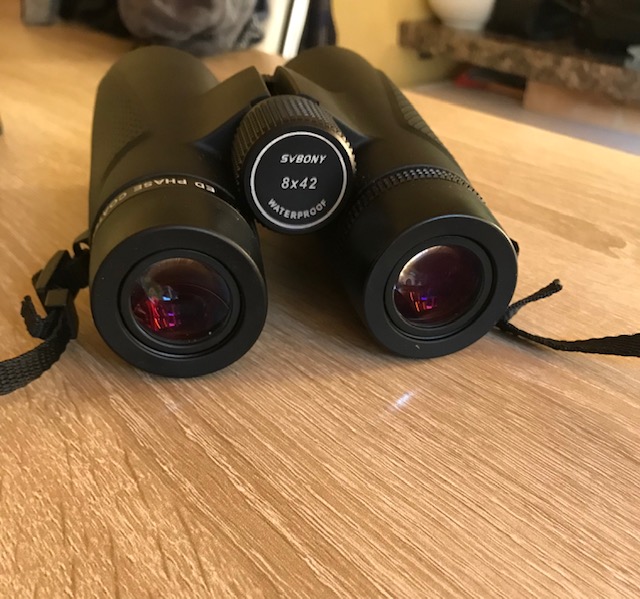
The objective lenses are unusually well recessed(~12mm) from the end of the barrels, helping to protect the coatings from the vagaries of the weather as well as acting as a protective barrier against stray light. The large(23mm) eye lenses make centring your eyes child’s play.
Note the very deeply recessed objective lenses.Large eye lenses make for very easy centring of your pupils.
Being very compact at just 14.5cm long and 11cm wide, the Oberwerk Sport ED 8 x 42 feels great in my medium sized hands. My right-hand fingers comfortably fall on the bridge and can wrap around the right barrel, while my left index finger naturally rests on the large focus wheel rendering an exceptionally secure handling experience. All-in-all I would rate the ergonomic features of the Oberwerk Sport ED as superb; easily as good as anything I’ve seen from the top European manufacturers.
Optical Assessment
I began my optical testing by looking for internal reflections and diffused light around an intensely bright light source. Setting my iPhone torch to its brightest output, and examining the image from across a room, I got an excellent result. I detected only a couple of very feeble reflections, no diffused light around the light source and no diffraction spikes. The same was true when I turned the binocular on a bright sodium streetlamp after dark.
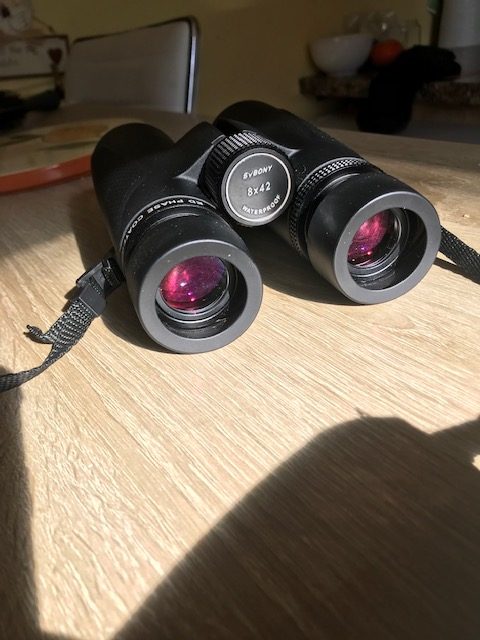
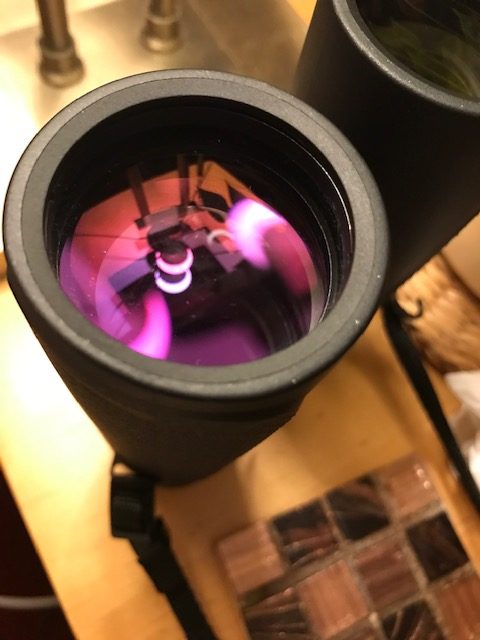
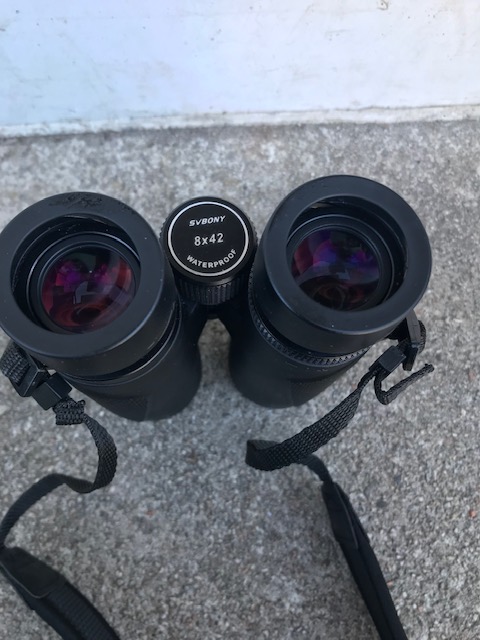
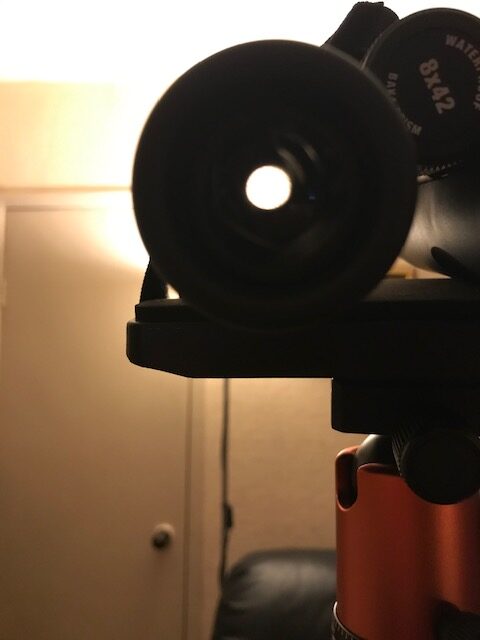
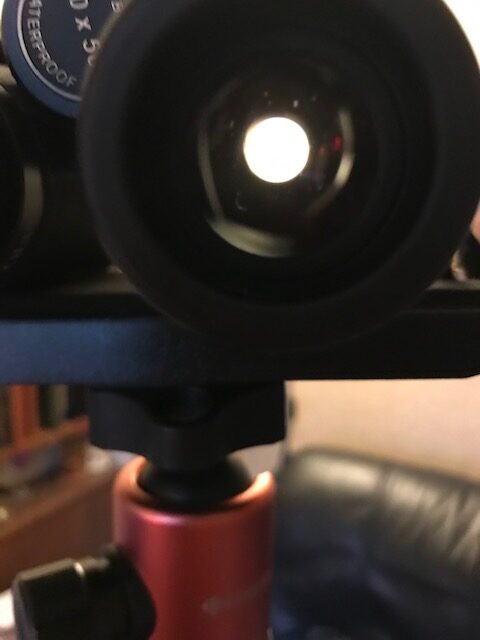
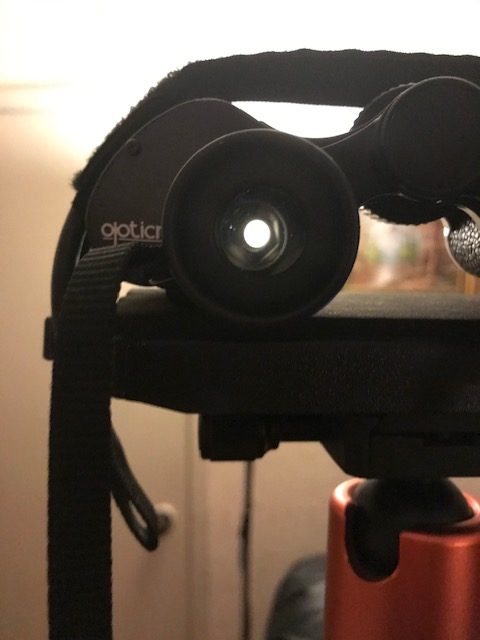
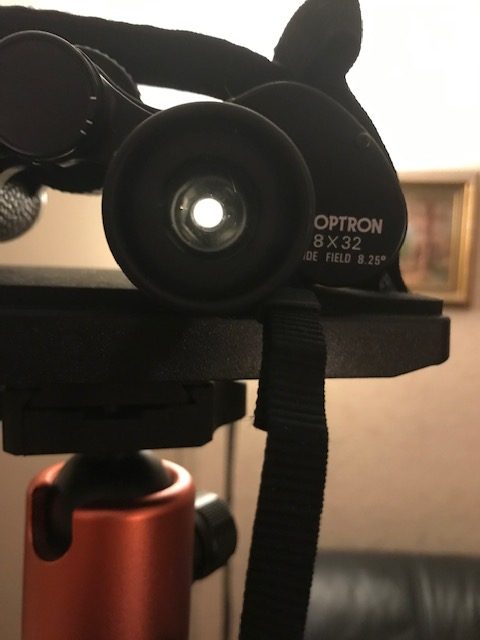
Next, I photographed the images of the exit pupils. As you can see below, the results are very good; perfectly circular with plenty of darkness immediately around them. There is some light leakage set well away from the pupils but even with fully dilated eye pupils, you’re unlikely to be affected by it.
Left Pupil.Right Pupil.
Now for the juicy bits. When I first set the Sport ED 8 x 42 to my eyes, I assumed the optimal position of the eye cups was in their fully extended position, as they usually are. But that yielded a slight tunnelling effect which prevented me from viewing the field stops clearly, but I quickly found my ideal setting by retracting the eyecups one notch down.
How are the views? In a word; excellent! But to elaborate, the Sport ED served up tack sharp images from centre to edge. Indeed, testing the binocular alongside my Svbony SV 202 8 x 42 ED ‘control’ I was able to resolve finer grain detail on the wooden beams on a climbing frame located about 80 metres in the distance. This instrument has a remarkably large sweet spot, and while the field of view is already generously large(8.1 degrees), it feels even more expansive by virtue of the sharp field edges. This is a remarkable result given that the instrument does not employ field flattening optics! Pin cushion distortion is also very well controlled in this instrument being noticeably milder than that observed in the Svbony control instrument. Colours are bright and true to life with a slightly warm tone which I very much enjoyed.
Glare control is decent in the Oberwerk Sport ED 8 x 42. Only in the more severe lighting situations did I detect some. Colour correction is also WAY above average, even for its ‘ED’ billing. Indeed, after conducting many hours of testing on a variety of high-contrast targets, I could only detect the merest trace of off-axis chromatic aberration, and only at the extreme edges of the field of view. Those who find colour fringing annoying will find the Oberwerk Sport ED to be a refreshing break from the norm!
Notes from the Field
A wonderful companion in the great outdoors
One of the first tests I performed was to check collimation under the stars. This is easily done by turning the right eye dioptre so that it defocuses a bright star in the right barrel while the left barrel keeps the star tightly focused. The focused star stayed in the centre of the defocused anulus, not only in the centre of the field, but also when the star was moved around the field, checking as I did for possible detachment. The star remained centrally placed, irrespective of where the anulus was positioned inside the field. This confirmed that the instrument was very accurately collimated.
Excellent collimation also explains why I’ve been able to enjoy prolonged panning activities with this binocular, its soft eyecups being very comfortable to place your eyes against. The view is very immersive, almost as if you’re sitting in the image. Contrast and resolution are excellent, especially over longer distances. For example, I could easily pick off the variegated colours of a Goldfinch in flight over 150 metres away. The Sport ED 8x 42 has that crystal clear clarity reminiscent of high-end European binoculars like the Zeiss Conquest HD but with a significantly larger field of view.
Just a half a turn of the ultra-smooth focus wheel covers the vast majority of targets from about 8 metres out to infinity. Closest focus was measured at 2.36m, a little longer than advertised but plenty close enough for viewing insects or other targets at proximity.
The excellent sharpness of the image was abundantly in evidence when I turned the Oberwerk Sport ED 8 x 42 on the stars. Aiming the binocular on the Alpha Persei star cluster, I immediately noticed the very fine pinpoints of starlight served up by the instrument. The stars making up this celebrated cluster were incredibly fine, with the subtle colour differences among its members easily discernible. The fineness of the stellar images were unquestionably better than any roof prism binocular I’ve tested in this price class.
My subjective impressions of a large sweet spot were also confirmed under the stars. In a sense, the eye can deceive during daylight hours. The ‘trickery’ of visual accommodation and all that….. Centring Altair and moving it across the field, I noted that the image of the star stayed tight and pinpointed most of the way to the field stop. To my eye, it only showed noticeably bloating in the outer 15 per cent of the field, where slight refocusing restored the image to a tight pinpoint of white light. Conventional wisdom has it that field flattening optics are necessary for observing pristine star fields right out to the edges but the very mild field curvature in the Sport ED show that excellent results can be achieved without such optics.
Conclusions & Recommendations
Sweet.
Test driving the Oberwerk Sport ED 8 x 42 has been nothing short of a revelation. Just when you thought you’ve seen it all, along comes an instrument like this that upsets the apple cart. Oberwerk has really hit the ground running with the Sport ED roof prism binoculars, as the many other reviews also attest. This is a seriously good piece of kit. For a very reasonable price you get an extremely well-made instrument that functions beautifully in field use. It has superb resolution, contrast, ergonomics, and engineering, and in my opinion, there’s nothing to touch it in this price class with a fit and finish more reminiscent of a £1k instrument. But that seems to be the siren call of Oberwerk in general. Not only has it made its name in high quality large aperture binoculars, the company’s new lines of compact binoculars are also making heads turn. And that’s great news for the consumer and the hobby in general.
Dr Neil English explores the fascinating world of binoculars in his up-and-coming book, Choosing and Using Binoculars: A Guide for Stargazers, Birders and Outdoor Enthusiasts due out in late 2023/early 2024.
At the end of June 2021, after months of hype all over the internet and a string of sensationalized reports by the main stream media, the Pentagon released a 9 page report1 on the subject of 144 Unidentified Flying Objects (UFOs)or Unidentified Aerial Phenomena(UAP) documented in recent years by the US government. Millions of people all over the world anxiously awaited the findings from that report but were ultimately left disappointed and frustrated because the same report was completely inconclusive and never even mentioned the word ” extra-terrestrial” or ” alien.” Instead, the report merely stated that,
“Most of the UAP reported probably do represent physical objects, given that a majority of UAP were registered across multiple sensors, to include radar, infrared, electro-optical, weapon seekers and visual observation1.
But the Pentagon report was presaged by further hype fuelled by Harvard Astronomer, Avi Loeb, who released a sensational book, Extra-terrestrial: The First Sign of Intelligent Life beyond Earth2, in February 2021, in which he claimed that an asteroid nicknamed Oumuamua, which passed through the outer solar system in a highly unusual orbit in late 2018, displayed signs of artificiality, both in terms of its of movements and physical properties. Since then, several natural explanations have been forwarded by scientists to explain the behaviour of Oumuamua, but predictably, those were largely ignored by the media. A few months earlier in December 2020, Haim Eshed, a retired army general and former head of Israel’s Defence Ministry’s space directorate, claimed in an interview that Earth has been contacted by a “galactic federation” of extraterrestrials,3 and that “they have been waiting until today for humanity to develop and reach a stage where we will understand, in general, what space and spaceships are.”
Then on July 26 2023, the US Air Force officer and former intelligence official David Grusch appeared before the House Committee on Oversight and Authority, giving testimony on the government’s alleged coverup of evidence of Unidentified Anomalous Phenomena (UAPs), relating to the congressional committee that the US government were in possession of physical alien spacecraft since the 1930s, with evidence that included not only large components of the spacecraft but “biologic material” as well.
Stories such as these form the basis of a multi-million-dollar industry in the form of books, documentaries, the internet and Hollywood Sci-Fi blockbusters, entertaining countless millions of curious individuals across the world. But why are some people captivated with UFOs and extra-terrestrials and on what basis do they believe in their existence? Furthermore, how should we, as Christians, respond to such events?
Test everything; hold fast to what’s good4
That famous quote from St. Paul, writing to the Church in Thessalonica, provides a great place to start. The secular world has been fed a staple diet of evolutionary ‘science’ that powerfully affects the way many people think. The reasoning sounds both rational and straightforward, at first glance; life evolved on Earth and our planet is one of countless quadrillions scattered across the Universe. Life therefore must have taken hold on many worlds, and in many epochs, so it’s reasonable to expect that intelligent spacefaring aliens exist. Unfortunately, though, the latest science is casting severe doubts on this worldview.
For one thing, there are now serious doubts that evolution, as described by biologists, really happened. The origin of life is a profound mystery and given the astonishing complexity of even the simplest living cells, there is effectively zero chance that it happened by accident5. Indeed, it is arguably true that understanding how the first living cells came into being represents the greatest scientific problem of all time. Added to this, the explosive origin of most of the advanced animal body plans in existence today which emerged within a geological ‘blink of an eye’ in an event called the Cambrian Explosion, has still not been explained to any degree of satisfaction by evolutionary biologists. Furthermore, the fossil record, which scientists have now unearthed in great detail, doesn’t show any evolutionary progression over the 3.8 billion years or so since its inception. Instead, it reveals many extirpation events followed by equally rapid speciation episodes, in contrast to the expected gradualism of Darwinian evolution. Simply put, we can be reasonably confident that if a scientific theory approaches the truth, the uncertainties become smaller over time. The problem with the evolutionary paradigm is the opposite – the error bars are increasing… and rapidly.
Coupled to this is the growing realization that most of the planets orbiting other stars, both within our galaxy and in myriad other galaxies scattered across the cosmos, are now considered very unlikely to harbour habitable worlds. For example, as much as 80 or 90 per cent of all the stars that exist are cool red and brown dwarfs that would require their habitable planets to be located far too close to their surfaces to be warm enough to allow liquid water to exist. Yet the same stars are highly unstable, firing off dangerous high energy flares and ferocious stellar winds that would damage fragile living systems5. What’s more, when you factor in all the other requirements for a viable biosphere, Earth stands out like a proverbial sore thumb as being very special indeed!
We therefore suffer somewhat from what scientists call observational bias; because we see our planet teeming over with life, we naturally assume the same thing happened on countless other worlds. But, as the distinguished organic chemist, James Tour, quipped.
“Life should not exist. This much we know from chemistry. In contrast to the ubiquity of life on Earth, the lifelessness of other planets makes far better chemical sense5.”
In addition to these problems, there are real issuestrying to explain how physical beings could traverse the vast distances of interstellar space, as well as surviving the enormous forces they would encounter in manoeuvring in the spectacular ways they do in recorded video footage. Indeed, there is a real possibility that these recordings are part of some greater, overarching deception.
Biblical Guidance
If there is life out there, and intelligent life in particular, it must have been placed there by God. Yet the Biblical narrative gives us other clues about whether space-faring ETs exist or not. The secular world view posits that humans emerged from other lifeforms accidently, but the Bible makes it clear that the Earth was first prepared before humankind was placed here. Living things made Earth habitable for humans and continue to provide a life-support system for human flourishing. Would God create worlds packed with life without placing sentient beings on them? That’s a good question, but I suspect not.
Similar conclusions are reached by the Christian astronomer and young earth creationist, Danny Faulkner(PhD Astronomy Indiana University), in his book, UFOs & ETs; a Biblical and Cultural Exploration of Aliens.6 Faulkner squarely lays the blame with the brainwashing of the general public in accepting evolutionary thought:
“We must realize that nearly all discussion about such matters has been within an evolutionary framework. That worldview assumes the plurality of worlds-that life has arisen on many other planets in the universe, and that life on at least some of those planets is intelligent. Hence, in the evolutionary worldview one might expect that extra-terrestrial aliens will visit Earth from time to time. However, Christians ought not to adopt an evolutionary worldview. Instead, we ought to base what we think about on the Bible, not the ideas of men. Evolution is clearly contrary to Scripture, and so life only exists where God created it. While the Bible does not explicitly state that God created life only on Earth, the clear implication from Scripture is that God made life only on Earth and that man is the centre of God’s attention. Therefore, within a Biblical worldview, one would reject the plurality of worlds idea and would not expect extra-terrestrial aliens to have visited Earth(or even to exist)6.”
Furthermore, we read in the passages of Scripture that Jesus died “once for all7.” If there are other civilizations out there, did Jesus die for them too? Some theologians have suggested that these beings might have not fallen, as Adam and Eve did in the Garden of Eden, and so were in no need of a Saviour. But we read that the entire creation is groaning8 and that God has reserved this current Universe for a fiery destruction9. If those putative civilisations exit elsewhere in the Universe, they too will perish and that would make God a monster, which is clearly a theological non sequitur!
Occult Connections
But there appears to be a more sinister façade to UFOs(or UAPs) and ETs. Many in-depth studies conducted over many decades have shown a strong connection between these phenomena and the occult, and which often involve narratives that serve to undermine Christianity in particular. In their now classic work, Lights in the Sky and Little Green Men: A Rational Christian Look at UFOs and Extraterrestrials9, astronomer Hugh Ross, theologian, Kenneth Samples, and political scientist, Mark Clark, showcase many studies linking the obsession of the New Age movement with extra-terrestrials and flying saucers. They conclude that, while most of these sightings can be discounted by natural phenomena, hoaxes or human-made technological devices, a small number of residual cases cannot be explained away and display properties that suggest that they are real but non-physical in nature, that is, these events are demonic in nature and represent deceptions by fallen angels who can move inter-dimensionally, at one moment looking real and the next, vanishing into thin air. In this capacity, The UFO phenomenon could well be part of an End Times deception.
To my mind, our culture’s fascination with spacefaring aliens merely represents a post-modern form of pagan idolatry, a convenient distraction from the things we ought to think about. Unwilling to accept the reality of an omniscient Creator, they resort to imagining beings far in advance of our own as new gods who will solve all of humanity’s problems. Yet, as I’ve explained earlier, this is little more than fanciful thinking that has no basis in scientific reality. In short, we simply don’t expect such agencies to exist! I suspect that, in the end, the only aliens we’ll ever meet are our human neighbours. So, as Jesus taught us, we ought to love our neighbours as ourselves!
English, N., Origin Stories, Why Life is Beginning to Seem Very Special Indeed, Salvo #50
Faulkner, D., UFOs & ETs; a Biblical and Cultural Exploration of Aliens, 2015, Answers in Genesis Press.
Romans 8:28
Romans 6:10
2 Peter 3: 7
Ross, H, Samples, K., and Clark, M., Lights in the Sky and Little Green Men: A Rational Christian Look at UFOs and Extra-terrestrials, Nav Press, 2002.
Dr Neil English has a wide academic background in biochemistry, physics, astronomy and classical studies. He’s the author of seven books in amateur and professional astronomy. His new work, Choosing and Using Binoculars: a Guide for Stargazers, Birders and Outdoor Enthusiasts, hits the shelves later this year.
“What on earth were these instruments designed for? “
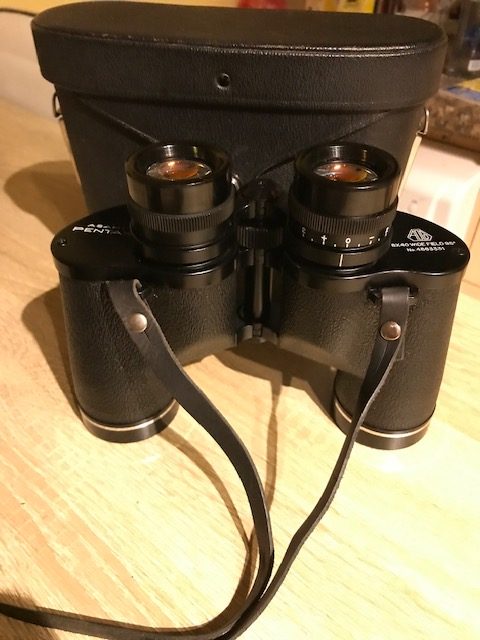
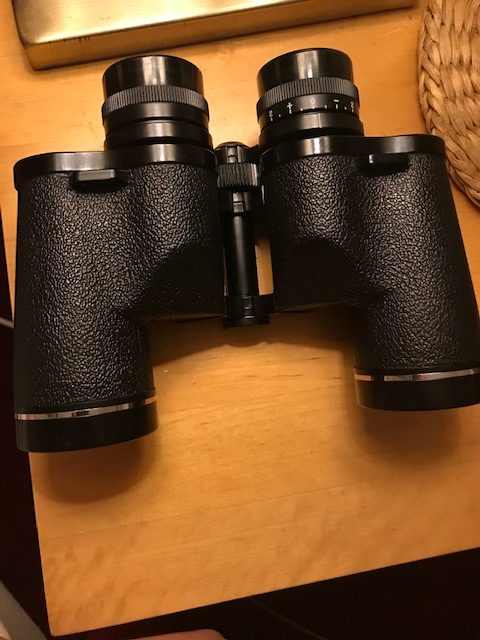
That was the question I posed to myself as I first brought this old classic Japanese-made Asahi Pentax 8 x 40 wide field binocular to my eyes for the first time. The view had a very sharp central image and a huge 9.5-degree field of view for an 8x glass, but the image was tinged in a weird greenish cast. A quick google search brought up a few possibilities but the most common answer was that the special coatings applied to the ocular lenses acted like polaroid sunglasses cutting down on glare, especially on sunny days. But if that were so, what was the green tint all about? I mean, I’ve never had sunglasses that imparted a greenish tint to everything!?
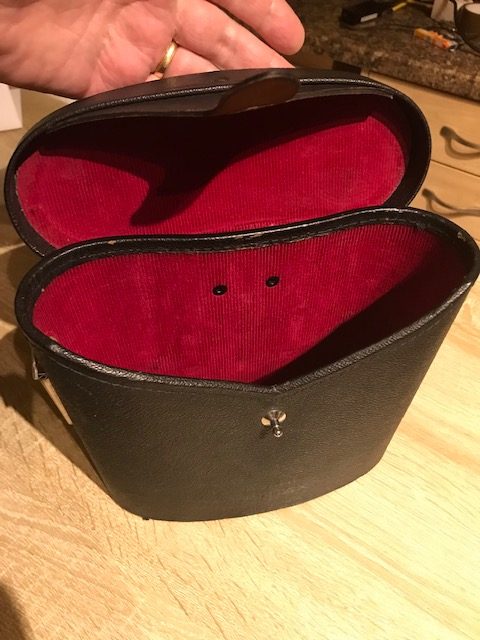
A original leather case with a gorgeous rose-coloured lining.
I picked the instrument up from a chap on fleabay back in early March for £65 plus £6 shipping, so £71 all in. The condition of the instrument looked immaculate, especially for a 1970s vintage glass. The original leather carry case is beautifully made with a rose-coloured lining. When I received the instrument, I was amazed how pristine it was; really like brand new. This must have been stored somewhere warm and dry for decades Indeed, the only reason I could think of to explain its tip-top condition was that it was hardly used at all!
The fine leatherette armouring is pristine for such an old glass.
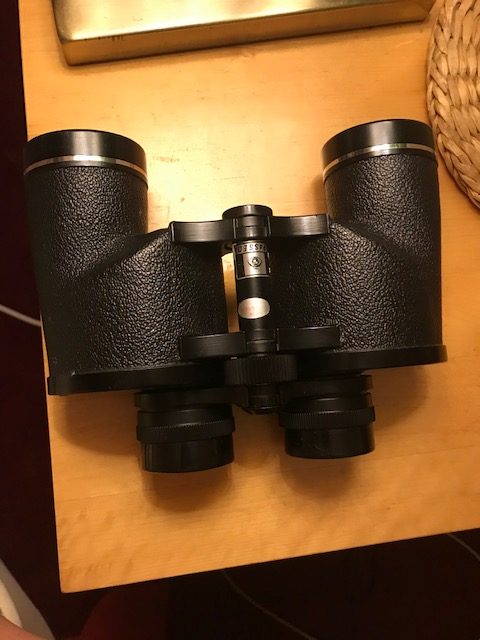
The build quality of this Asahi Pentax is very impressive. Good big prisms, with a nicely tensioned central focus wheel moving very smoothly after all these years. The objectives looked singly coated with the standard bluish glint of magnesium fluoride anti-reflection coating. The right eye dioptre moved very smoothly but with great resistance to accidental displacement, with an easy-to-read +/- scale. The eyecups are made from hard plastic and so can’t be adjusted to improve eye relief for the bespectacled, but I suppose some resourceful person could shim them down to access more of the field.
Belly side up.
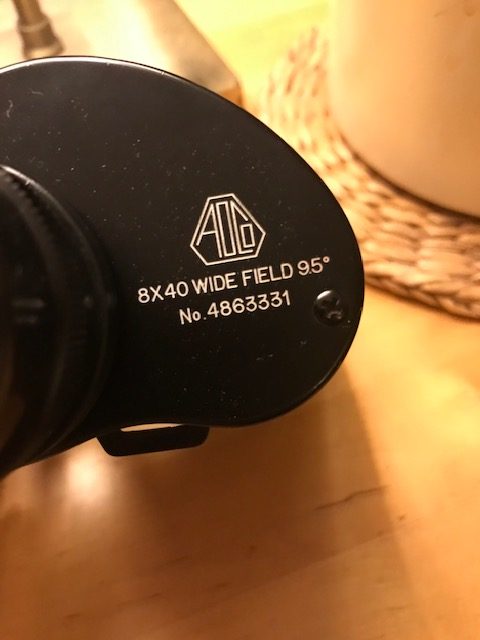
The instrument is extremely chunky, tipping the scales at 979g without a neck strap. I guess this was one of the instruments that helped stereotype the classic Porro as being big and bulky, although that’s not really true today I’m glad to say. I measured close focus at 6 yards – again stereotypical of glasses from this era but also no longer necessarily true today either. Using it for a few minutes,you really do come away with the impression that this was a quality instrument, especially when it saw first light all those decades ago. Based on the stampings on the front cap, this was manufactured by Zuiho Kogaku Seiki Co, Tokyo.
Serial # and angle of view.
The eyepieces are coated with a substance that reflects golden light to the eye. It’s not gold however, in case you’re wondering. The wavelength of the reflected light (~600nm) only depends on the refractive index of the coating and its thickness. I’ve heard of some folk who have removed these coatings using acetone and a bit of elbow grease with varying degrees of success. Some reported that the colour cast of the resulting images are more natural but also that it exposed more internal reflections and glare in the images they served up.
The strong colour shift renders the Asahi Pentax almost useless for birding excursions. Accurate identification relies on the binocular delivering colours that are faithful to the natural image. It’s not especially good at cutting down on glare either. Turning the binocular on some strongly backlit scenes showed up significant glare in this instrument, as it also did when I turned it on a sodium streetlamp after dark. But what’s remarkable about this instrument is the expansive field of view with very good sharpness across most of the field. As an astronomical instrument, it also does quite well but the low light transmission and colour shift renders the images a bit dimmer than a modern instrument having superior coatings.
A well-corrected 9.5 degree field is very impressive for an 8x instrument though. It’s actually larger than my Nikon EII 8 x 30(~9 degrees) and my Nikon Action 7 x 35 ( 9.3 degrees). But when I began to study a variety of older Porro prism binoculars, especially in the 7 x 35 format, I was shocked by what I discovered. Paul Wehr, a keen binocular collector based in New York was kind enough to share some images of his extensive collection of classic Japanese-made 7 x 35s with me. It turns out that 9 or even 10-degree fields were rather on the small side. Take a look at some of the models in his collection.
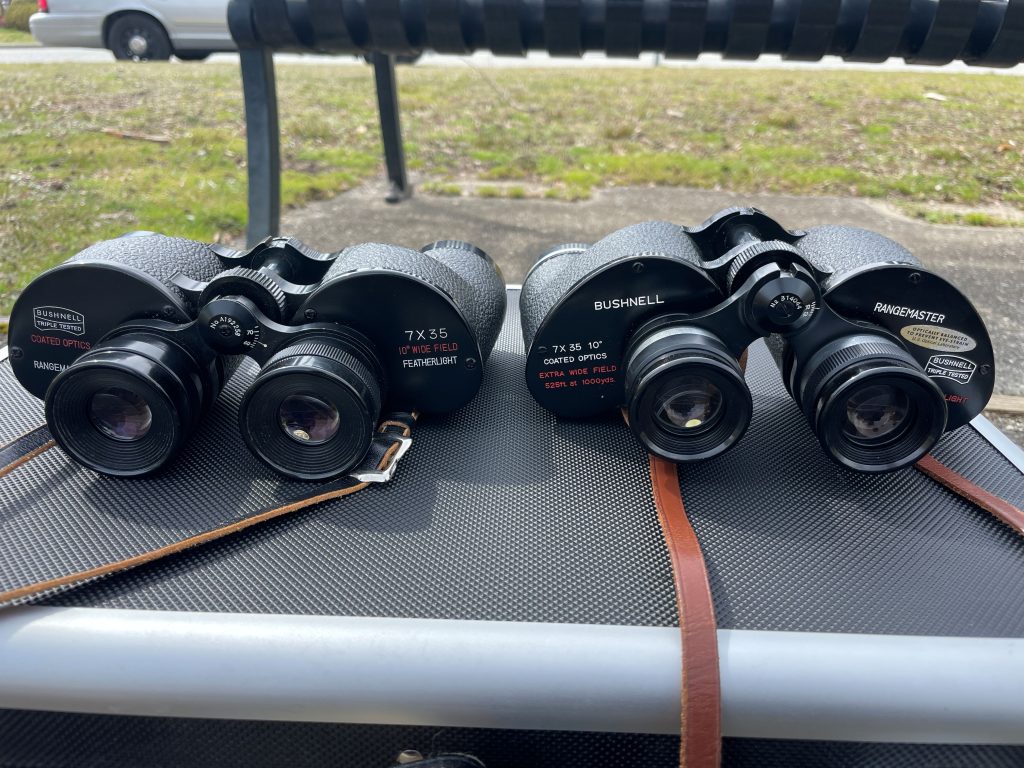
Here are a couple of vintage Bushnell 7x 35 Rangemasters sporting 10 degree fields:
The vintage Bushnell Rangemaster 7 x 35 with 10 degree field. Image credit: Paul Wehr.
But they come significantly wider again. Take a look at this Swift Holiday Mark II with an 11 degree field:
The Swift Holiday Mark II 7 x 35 with its 11 degree field. Image credit: Paul Wehr.
Or how about this Sans & Streiffe 7 x 35 model with a whopping 13 degree true field!
The Sans & Streiffe 7 x 35 with a 13 degree true field! Image credit: Paul Wehr.
My conversations with Paul made it obvious that he’s very impressed with these classic widefield binoculars. I would be too! Ultra wide fields like this are not unique to Porro prism models either. Take the Leica Amplivid 6 x 24, for example, sporting a 12 degree field.
Back to the Future
My personal ‘discovery’ of the existence of these ultrawide compact binocular models from yesteryear raises interesting questions in my mind. In 2023, leading binocular manufacturers like Swarovski and Zeiss wax lyrical about their wide-angle flagship models, like the NL Pure range and Victory SFs, sporting fields of the order of 9 degrees. Owners rave about their huge fields seemingly unaware that much bigger fields were available to binocular enthusiasts a half century ago.
There’s an important lesson to be learned here. Resurrecting these classic Porro prism designs with enormous fields could be done at much lower costs than those commanded by today’s top wide-angle roofs. Can you imagine what could be achieved by applying state-of -the-art multilayer coatings to the optical surfaces of such designs? Adding a field flattening lens would also make them very sharp nearly to the edge. Re-designing the eyepieces with greater eye relief wouldn’t go amiss either. Adding seals would render them water proof and purging them with dry nitrogen gas would keep them from fogging up in cold /humid weather.
Some of these sentiments are echoed in Holger Merlitz’s excellent article linked to in the preamble above. In particular, he makes the point that by incorporating modern, wide-angle eyepiece designs into these classic models, they would deliver wider and better corrected fields of view.
Just imagine what could be achieved!
It would surely usher in a revolution in binocular technology, and open the hobby up to more people if they’re offered at a significantly lower cost than the current top tier roof models now on the market.
We can only dream!
Thanks for reading!
Neil English’s new book: Choosing & Using Binoculars: A Guide for Stargazers, Birders and Outdoor Enthusiasts, will be published in late 2023 by Springer Nature.
I would like to sincerely thank Paul Wehr for sharing images of his classic wide-angle models, as well as his enthusiastic conversations about their potential.
It’s been nearly two years since I first hit on the new high-performance Svbony SV202 ED binoculars. It was pure serendipity on my part; I was drawn to the list of features the 8 x 32 model possessed with an eye to discrediting the claims. Why? Because the price was simply too good to be true. I found out however that far from being marketing hype, these instruments delivered in spades, with excellent coatings, brilliant images and superb ergonomic construction. Thus far, I’ve tested all four models; the 8 x 32, 8 x 42, 10 x 42 and 10 x 50, but I settled on the newest addition to the series; the formidable SV202 8 x 42 ED; an instrument that has become one of my favourite field glasses in over five years of optical testing and evaluation involving hundreds of models across all price ranges. Indeed, I’d go so far as to say that these amazing instruments have set in motion an unstoppable revolution that’s bound to continue in the coming years, as European manufacturing enters a self-inflicted, suicidal death spiral owing to the wicked green agenda that is destroying industries for the sake of the pseudoscience of anthropogenic climate change. Our school teachers have become activists, brainwashing and indoctrinating our children with lies. There is no discipline and no boundaries. No wonder they’re so ill-equipped to cope with life in the modern world. It’s a recipe for disaster.. Our universities too are churning out ignorant, woke‘graduates’ who simply can’t compete with the academic excellence coming from Chinese technological universities. They’d eat ours for breakfast. Small wonder, therefore, that Chinese optical quality is rapidly approaching the so-called alpha class of western-made binoculars. For me, the SV202 line of roof prism instruments are on the cutting edge of that revolution.
Optical Quality
An optical and ergonomic marvel.
I’ve owned and used the SV202 8 x 42 ED now for about six months. It’s been a reliable companion in all weathers the Scottish climate can throw at you: rain and hail, snow and ice, wind and sun. My journals reveal that it’s clocked up about 100 hours of service. And in all that time it’s behaved flawlessly, delivering pin sharp images within a large sweetspot. Brightness and contrast are second to none. It’s sharper and better colour corrected than my Nikon E II 8 x 30- my favourite Japanese-made Porro prism binocular – and has served up some incredible views of birds, trees, hills, rivers, ponds, valleys, flowers, insects, and other wildlife. It’s got great close focus too at just over 2 metres, and exhibits superb control of internal reflections and glare. Indeed, the Svbony SV202 ED quickly became my control instrument when testing and evaluating many other roof prism models featured in my up-and-coming book. I’ve tested it against very high quality binoculars costing many times more, up to and including the likes of the Swarovski EL 8.5 x 42 and I’ve never felt like it was pulling much behind; it’s just that excellent!
Check out those excellent antireflection coatings!
Ergonomic Excellence
The SV 202 8x 42 ED is, without a doubt, built to last. I was horrified by the response of some individuals on Birdforum who continuously expressed their doubts that such instruments simply couldn’t last the test of time. Such individuals are speaking in ignorance, of course, as they’ve never actually bothered to test these instruments out for themselves. I was particularly delighted to hear of one recent poster who decided to buy the 10 x 42 model out of curiosity as well as the excellent price with which they are now selling on sites like Amazon and AliExpress. He provided his honest opinion of it, reporting that it delivered 90 per cent of the image and build quality of his 10 x 42 Nikon Monarch HG. This was especially poignant given that the same individual bought the Svbony SV202 for just £70 with a coupon. The Monarch HG, in comparison, retails in the region of £1000 UK. He’s absolutely correct in making that claim; the Svbony wonder binoculars are really that good!
Happy is the man whose dioptre ring never wanders.
The instrument has a basic, no-frills design, with a sensibly located right eye dioptre compensation ring that has not budged one iota since I first adjusted it. It’s very tight; just set it and forget it. The focuser moves with silky smoothness and exhibits no backlash or free play. The multi-position twist-up eyecups are of identical quality to the Monarch HG and lock rigidly in place. They have never let me down. I’ve tested the instrument’s waterproof status(IPX7 rated) and it’s lived up to those promises.
A brilliant focus wheel.
I’ve also observed on many occasions over the winter that it’s fog proof. Condensation builds on the outer lenses when brought in from the cold but the interior always remained bone dry. The excellent non-oxidising rubber armouring is possibly unique. It’s incredibly easy to grip and is an absolute pleasure to hold in my hands, weighing in at just over 700g. All in all, the 8 x 42 has been an absolute powerhouse of optical and ergonomic virtue, so much so that it’s the only full-size roof prism binocular I now use. Furthermore, I consider all European brands to be a profligate waste of money.
Roamin’ in the Gloamin‘
The Gloaming.
May 9
The evening light of May is arguably the most beautiful of the year. The setting Sun drenches the trees with their young leaves, creating spectacular light shows – known colloquially as the gloaming. The SV 202 8 x 42 ED is the ideal companion for soaking up the riot of detail in full view. Forests walks are especially thrilling, where I routinely glass busy Chaffinches foraging on the forest floor. The brightly coloured males are especially frisky this time of year. Indeed, I’ve seen them mating on many occasions over the last few weeks Like Robins, they’re quite at home with humans. Indeed I’ve been able to get within a few metres of many of them and use the 8x glass to admire their beautiful plumage. Their fearless nature endears me to them.
The spring rains cause dandelions to flourish in the more exposed parts of the forest and where they grow, colourful Goldfinches are never far away. Rarely do I observe these in isolation. Where there’s one, there’s usually two or three nearby. The males have bright yellow feathers on their heads, necks, and chests, while their wings and tail are black with white markings. Their backs are a light brownish-grey colour, and they have a distinctive black patch on their foreheads. The females, in contrast, have similar colouring, but their plumage is more muted, with less yellow on their heads and chests. I like to stand and watch them from a distance of about 5 or 6 metres, where the 8 x 42 provides exceptional views of these striking birds. Later in the season, they’ll concentrate on eating the seeds of thistles in the open fields around my home.
After heavy rain showers, the air becomes laced with the smell of wild garlic growing on the forest floor. Its leaves are ripe for the picking. We crush them into a fine paste with a pestle and mortar creating delicious salad pesto. It’s always worth while glassing these temporary explosions of green. Little Wrens are often found scampering among them, especially near burns that meander their way through the forest. Sometimes a sunbeam would break through when the wild garlic begins to glisten in the gloaming, its leaves drenched with life-giving rainwater. Such light shows are to be cherished, spectacles provided us by our Creator, the fountainhead of all that is beautiful and true.
Elon Musk is Everywhere!
May 10
I ventured out shortly after local midnight, May 10, to enjoy a few minutes under the stars. The 8 x 42 accompanied me on the vigil. Lyra and Cygnus had risen to a decent height above the northeastern horizon, Bootes was approaching the meridian and the Big Dipper loomed large nearly overhead. Scanning the sky with my 8 x 42 revealed some shocking results; nearly everywhere I pointed my binocular I could see a satellite racing through the field of view! “Elon Musk!” I exclaimed. His Star Link satellites are everywhere, changing the character of the night sky utterly and forever. I can’t imagine astro-imagers would be too happy with these developments. The visual telescopic astronomer; not so much.
Personally, I don’t mind it. It’s inevitable anyway; technological progress to be sure, linking up more people from every corner of the globe. Indeed, it’s even prophetic. I remembered the words of our Lord and Saviour Jesus Christ:
And this gospel of the kingdom will be preached in all the world as a witness to all the nations, and then the end will come.
Matthew 24:14
Musk’s armada of satellites will help bring the gospel to even the remotest people groups of the Earth, just as Jesus had foretold. Judging by the state of our world with all its wickedness and immorality, we’ve got to be close!
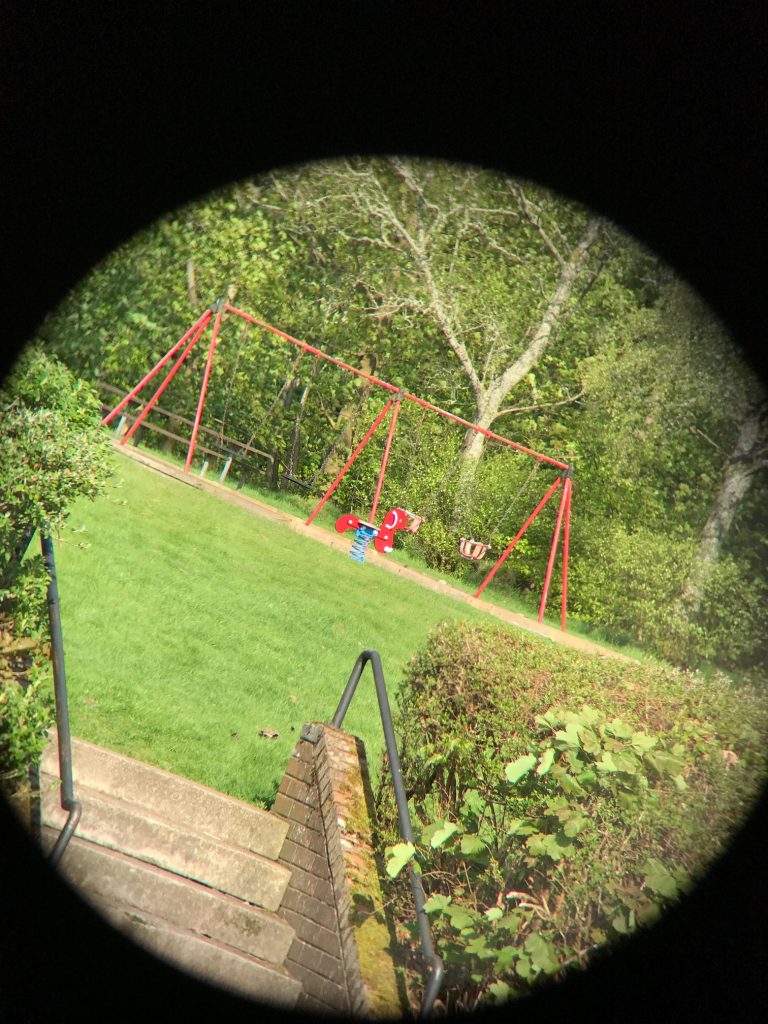
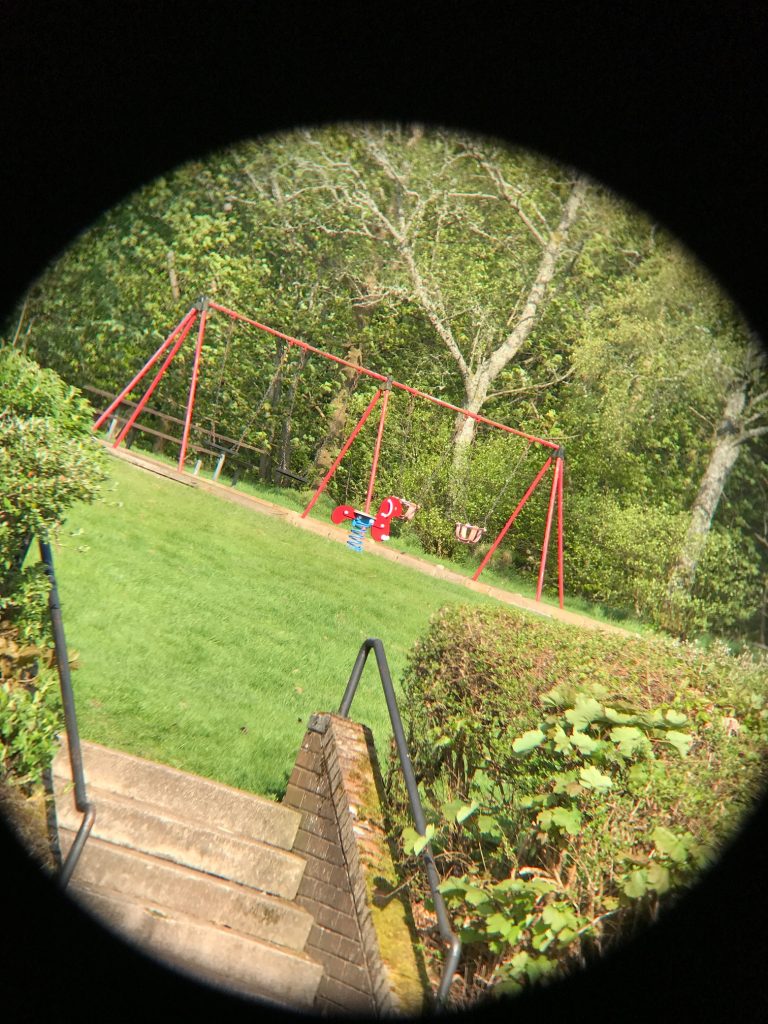
The afternoon of May 14 was grand and bright, allowing me to capture some images with my cell phone of the Svbony SV 202 8 x 42 and the Hawke Frontier EDX 8 x 42.The images are unprocessed and the same file size, so they’re quite comparable.
The SV 202 8 x 42 EDThe Hawke Frontier EDX 8 x 42.SV 202 8x 42 ED.Hawke Frontier EDX 8 x 42.
While the Hawke Frontier EDX 8 x 42 has a slightly larger field than the Svbony, I think you’ll agree that the images through both instruments are quite comparable. What’s more, the Hawke retails for about three times the price of the Svbony and has already garnered an excellent reputation from birders and binocular reviewers alike, so why not the SV202 also?
It just doesn’t seem fair to me!
The Hawke also suffers from more glare than the Svbony. And while it’s a very capable binocular, the Svbony glass is just as sharp and fits in my hands better. Just some of the reasons why I chose the SV 202 as my go-to mid-size roof prism binocular.
May 17
Observing at Dusk
Sunset on the Castle Drive.
Now that I’m on my long summer vacation from teaching and writing commitments (yes, the first draft of my book has now been submitted), I’ve extended my glassing to later in the evening and sometimes well into dusk. This is when the benefits of a 5mm exit pupil really comes into its own. While I do most of my daytime glassing with smaller 8 x 30 and 8 x 32 instruments, their smaller aperture and smaller exit pupils limit the amount of detail you can see when the Sun falls out of the sky. This time of year, twilight encroaches, extending the time of dusk, enabling me to make use of the 8 x 42 SV 202 more extensively to watch for owls, badgers, deer and even the odd fox. Standing still under the cover of bushes, I’ve been enjoying watching badgers roam about in the gloom, sniffing the ground and uprooting plant tubers. One of the local farmers told me he has had lambs lost to badgers but is powerless to act because they’re protected under UK law. They seem quite cute to me but get in their way and they can unleash great ferocity with those powerful jaws..
I’ve tried other 5mm exit pupil formats for this kind of ‘on the move,’ low-light observing, including a 10 x 50 and a smaller 7 x 35, but neither of those cut the mustard compared with my Svbony. The former is too too large to carry about for extended periods and has too narrow a field of view to boot. And the latter doesn’t gather nearly enough light during these challenging lighting conditions. Moreover the 7x lacks the reach of an 8x glass. The 8 x 42 format, with its nice wide field, excellent light transmission and moderate weight, makes for the ideal tool for such activities.
May 28
Serendipitous Sightings
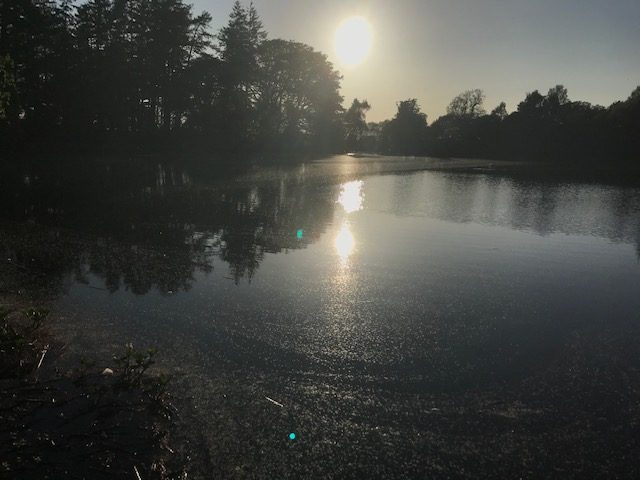
Culcreuch Pond, late evening May 25. Note the veneer of pollen near the shore.
This is the height of the pollen season. The air is chock full of it from all the trees and bushes bursting into bloom, bringing misery to many hay fever sufferers. Thankfully, that’s not me. The surface water at Culcreuch Pond gets covered in a scum from it as it accumulates over the days and weeks. And it gets on everything -clothes, lenses, tripods, you name it! When you think of the amount of genetic and epigenetic information stored in these tiny structures, the mind boggles. It must be orders of magnitude greater than all of mankind’s digital code combined. The Lord God is a masterful designer!
On the evening of May 28, I took myself off again for a saunter up the country road towards Cuclreuch Castle. As a keen beginner birder, I’ve been learning where to scan with my binocular for interesting birds that might come into the area. One endlessly fruitful activity in this regard is to glass the fences on either side of the road. I’ve learned to scan them intently since many small passerines seem to rest there from time to time. This is where I’ve successfully spotted Goldfinches, Chaffinch, Stonechats, Robins and Wagtails, to name but a few species.
The castle road, looking west towards Dunmore hill, with fences on either side.
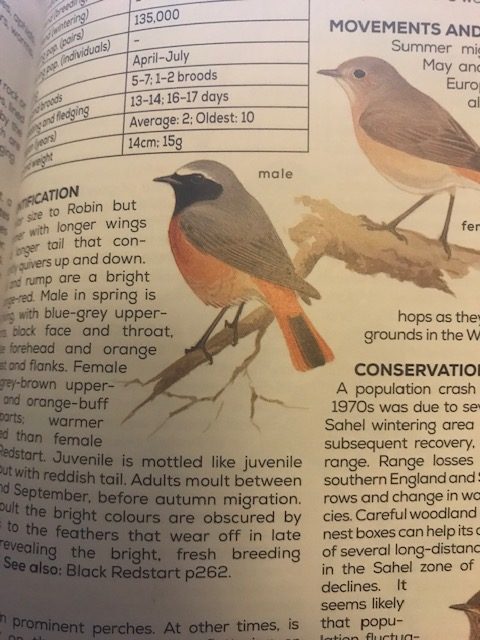
I had little luck this evening and turned to walk back towards the house. In the distance, I saw my eldest son and two of his mates approaching me, and stopped for a brief chat. But over their shoulder, I saw a small bird, no bigger than a Robin fly in and land on the fence about 30 yards in the distance. I quickly brought my SV 202 to my eyes and noted its colours, which were very easy to discern, as the setting Sun strongly illuminated it. At first glance, I thought it was a male Bullfinch, but there was something distinctly odd about it. Yes, it had a bright orange belly and flank, but its beak was long and slender, not muscular like most finches I’d observed. Its lower head was jet black but above its eyes it was white with a grey cap, and bluish grey wings. Excited, I asked the boys to quieten down as I took another steady look. This was a bird I’d never seen before but I memorised its appearance as best I could. And I had no idea what it was until I got home and leafed through my RSPB book. Finally, there it was in all its glory on page 263; a beautiful male Redstart! The first of its kind I had ever seen!
A male Redstart, as depicted in my RSPB book of British birds.
As I later reflected on the the sighting, I realised just how lucky I was to get a glimpse of this summer migrant to the British Isles, amber-listed in the handbook. Apparently they are more common in Wales and the West Country, but the accompanying map illustrating its distribution also showed that some sightings have been made here, just north of the Scottish central belt.
When it comes to birding, you make you’re own luck.
Chance favours the prepared birder!
Sodom 2
Cities & Towns Are No-Go Areas
The wicked month of Sodom is now upon us and that means one thing for me. I avoid the cities and big towns where they ‘celebrate’ these depraved lifestyles. I refuse to enter any premises flying the rainbow flag and give them no business. There will be all sorts of lude behaviour at these gatherings; drink and drug-fuelled orgies, men pretending they’re women and women pretending they’re men, and chemically castrated children, not to mention a complicit general public pronounced guilty(in the eyes of a holy God) by association. Monkey pox, herpes and other STDs will be spreading. As the Bible teaches:
I will set nothing wicked before my eyes; I hate the work of those who fall away; It shall not cling to me.
Psalm 101:3
Redstarts
Since my first sighting of the male Redstart, I’ve since glassed it several more times, and always in the same location; at the top of the castle drive before the pond and between two great oak trees. Methinks it’s rearing young and that requires a female. I’ve tentatively made one observation of a possible female(mate). I spotted a small bird, rather like a Robin, but without its intense red breast. At this stage I can’t be sure though.
The SV202s Going from Strength to Strength
Volks Bino
I took a look over at Amazon this afternoon to see how the SV202s were doing. I’m delighted to report that there are now80 reviews; a huge increase over the last time I looked with an average score of 4.5 stars out of 5! I’ve said it before and I’ll say it again; these are amazing binoculars! Indeed, it’s really all you could possibly want in a roof prism binocular.
The notion that you can’t get excellent ergonomic and optical quality at a price that is now affordable to many. Why pay more? These instruments will grow the hobby, allowing many more folk to get out and enjoy the creation, in all its glory!
Sodom 14
A Redstart Family
Since first sighting the male Redstart at the top of the castle drive, I’ve now observed it many more times since. Indeed, on almost every evening I take a walk there I catch a glimpse of it. What’s more, I’ve also spotted a female, with its more subdued colours. The clincher for me was identifying their nest site – a grand old oak tree. That comports nicely with the details given in the RSPB handbook which states that they indeed like to nest in oak trees. They’re incredibly graceful birds, being capable of hovering in mid-air in search of insects. I’ve often seen them foraging in the grassy kerbs at the side of the road, just like Goldfinches.
Discovering these birds so close to my home inspired me one afternoon to set up a spotting scope to study them in more detail and to maybe capture some images of these handsome creatures. I’ve been test driving a really nice spotting scope manufactured by Svbony; the SA405, an 85mm ED model with a zoom magnification range from 20x 60x. It works like a dream, delivering crisp images throughout the zoom range. While you really don’t need ED glass below about 30x, it sure does help reduce colour fringing beyond these powers. I’ve been very successful getting great close up visual views of both the male and female Redstarts, but imaging them is an entirely different matter. Because the CCD camera has a larger image scale than even the 60x setting on the zoom eyepiece, its more challenging to get the birds centred on the CCD chip. What’s more, these highly-strung birds never stay put for long; once you think you’ve got them framed, they fly off making the whole enterprise an exercise in frustration more than anything else.
The excellent Svbony SA405 85mm 20x 60x ED spotting scope.
Consistency
My up-and coming book on binoculars has given a well-deserved pride of place to the SV202 ED binoculars. While reflecting on their success, I realised that they all seem to have excellent control of internal reflections; right up there with the very best European models in fact. Take the appearance of the exit pupils, which I’ve photographed in the past as part of my reviewing work. Here they are again for interest:
8x 42.10 x 50.10 x 428 x 32
Now, that’s what I call consistent!
Good round pupils with an extensive area of darkness surrounding them. And no false pupils either!
Sodom 25
Superior close focusing properties.
Horses for Courses
Though I’m a big fan of high-quality Porro prism binoculars, there are tasks that roof prism binoculars just excel at. One of these is comfortable close focus ability. I say ‘comfortable’ because although my beloved Nikon E II 8 x 30 actually focuses closer than my SV 202(1.95m versus 2.2m), glassing anything closer than about 5 or 6 metres is quite uncomfortable in the E II, necessitating an adjustment of the interpupillary distance downwards below my natural 65mm. In contrast, the SV202 delivers images that are much easier on the eye. This advantage really comes into its own viewing small birds at close distance, such as Willow Warblers and Treecreepers. My experiments in forests with both roof and Porro prism binoculars have also compelled me to favour the former over the latter in such environs.
Seeing the Light
The images served up by the SV202 8x 42 are very bright and sharp. I’ve compared it side-by-side with much more expensive binoculars with high(~90 per cent) light transmissions and have failed to see any significant differences in low light conditions. When I first began my binocular studies, I often came across statements which claimed that binoculars with ED glass deliver brighter images and words to the effect of, “the ED glass gives you an extra five minutes when the light really begins to fade.” Now, I’ve compared models of exactly the same specification, with one having ordinary crown-flint glass and the other possessing an ED element under rigorous low light tests and not noticed any differences. I wondered where this false meme originated from, since there is always a grain of truth to most of these ideas. It was after studying some of the physics of Augustin-Jean Fresnel(1788-1827) that I got a lead. His equations provided important advances in computing how much light is transmitted and reflected with materials possessing different refractive indices.
Many of the Fresnel equations are quite complex, as they involve light incident upon a surface at different angles. Let’s look at one particular equation:
R = Cos x – (n2 – sin2x)1/2/Cos x + (n2 – sin2x)1/2
Where R = the amount of reflected light from an optical surface
x = the angle of incidence and n= the refractive index of the material.
We can simplify this greatly by considering light arriving directly along the normal( i.e. looking at the centre of the lens head-on, so x =0), from which we obtain the much simpler equation:
R= [1-n/1+n]2
So the amount of reflected light only depends on the refractive index of the optical glass used. Now consider regular crown and flint glass having a refractive index of about 1.5. The amount of light reflected off such glass for normal incidence is
R = [1-1.5/1+1.5]2 = 0.04
Note: This is the origin of the 4% figure often quoted in telescope optics texts for uncoated glass.
Next consider extra low dispersion (ED) glass like fluorite or FPL 53 or some such, with a refractive index of 1.44. Plugging this number for n into the Fresnel equation delivers a value of 0.03 or 3 per cent.
This means that regular crown or flint glass transmits 96 per cent of the light incident upon it compared with 97 per cent for ED glass.
This is a very small difference but considering that only one or two elements in the optical train employ ED glass, and the applications of multiple layers of antireflection coatings further reduce the light losses for both types of glass, the visual difference in brightness will be all but indistinguishable.
So there you have it! Although the Fresnel equation allows for a one per cent difference in transmission, it amounts to effectively negligibledifferences in overall transmission, all other things being equal.
In Part I of my review, I described the general optical and ergonomic features of the Svbony SA405 20x-60x 85mm ED spotting scope. In Part II I would like to reveal more about its ability to incorporate different eyepieces as well as its imaging capabilities.
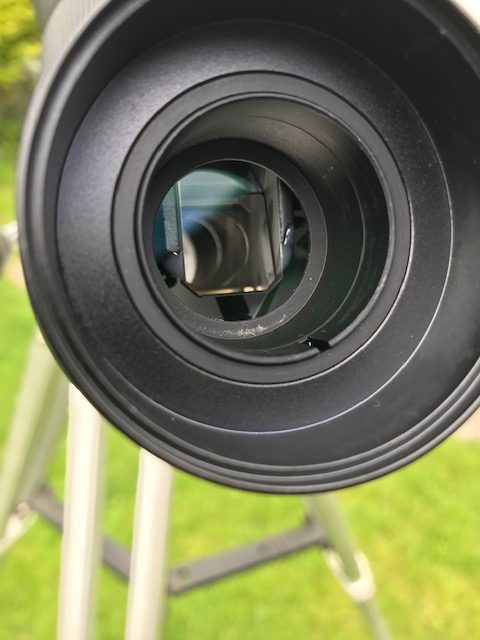
The zoom eyepiece accompanying the SA405 is removed simply by rotating the rubber sleeve at the base of the eyepiece housing anticlockwise which loosens the grip on the zoom, allowing it to slide up and out of the ocular interface. The photo below shows the rectangular face of the Porro prism just beneath an anti-reflection-coated optical flat situated immediately above it, which effectively seals off the optics from the ambient environment.
The eyepiece interface of the SA405. Note the optical flat and prism edge.
The nicely designed stops prevent any direct contact between the inserted eyepiece and the flat so there’s no chance of it cracking or scratching the glass. After inserting the new 1.25” eyepiece it can be tightened via a helical mechanism by rotating the rubber sleeve clockwise until its tightly fixed in place.
In the next series of photos, I‘ve attached a Sirius Plossl 7.5mm and a Celestron X-Cel 25mm- to the scope.
The 7.5mm Sirius Plossl attached to the scope.The Celestron X-Cel LX 25mm inserted into the ocular interface.
But by far the most versatile eyepiece I found for this scope is the Svbony SV 191 7.2-21.6mm zoom eyepiece offering a magnification range between 22.3x to 67x, so a modest gain in magnification over the original 20x- 60x. More on this zoom later.
The Svbony SV 191 7.2mm-21.6mm zoom eyepiece.
Determining the Maximum Field of View Available to Ordinary Eyepieces using the SA405
The provided zoom serves up a maximum field of view of just under 2 angular degrees. I determined to establish whether I could expand this field by using fixed focal length eyepieces. In this capacity, I set up some experiments using both a Celestron X-Cel LX 25mm with a 60 degree AFOV. In theory this should have served up a true field of 3.1 angular degrees. In addition I tested a 32mm Skywatcher Plossl eyepiece which should serve up a field of 3.45 angular degrees(52 degrees AFOV). However, the effects of vignetting would likely come into play, restricting the true size of the fields generated by these long focal length eyepieces.
Performing the star drift test on the SA405 to determine true field size.
Accordingly, I measured the fields of these eyepieces by conducting a star drift timing test. In the wee small hours of a late May morning, under decidedly twilit conditions, I centred the bright star Altair with a declination of +8.87 degrees, so just above the celestial equator(well within the +/- 20 degrees required for accurate results), I timed how long it took for the star to reach the field stop and used these values to calculate the true field( times were actually doubled). The results I got were as follows:
25mm Celestron X-Cel LX – 3.05 degrees
32mm Skywatcher Plossl- 2.93 degrees
Comments: The Celestron eyepiece served up a field size in good agreement with its specifications. The Skywatcher, as expected, vignetted the field, delivering a field size pretty much indistinguishable from the shorter focal length Celestron. Since there is no material advantage to having a lower magnification with the same field size, the Celestron is the better eyepiece for dedicated low-power widefield viewing.
Experiences with the Svbony SV 191 7.2-21.6mm Zoom Eyepiece
The excellent SV 191 7.2-21.6mm zoom eyepiece mated to the SA405 spotting scope.
The SV 191 7.2-21.6mm zoom is a very nicely designed eyepiece. The zoom motion is extremely smooth and continuously variable. It has twist up eyecups with excellent eye relief. Unlike the 20x-60x zoom that comes as standard with the SA405, the SV 191 can be used comfortably with eyeglasses throughout the entire magnification range. Another really neat feature of this zoom eyepiece is that it’s parfocal – or very nearly so. That means that only very minor tweaking is necessary if you decide to change magnification. Moreover, the SV 191 zoom tips the scales about 100g lighter than the supplied zoom, reducing the overall weight of the scope – surely a good thing when portability is to be considered.
Optically it’s very nice too. The image remains tack sharp all the way through the full magnification range. Contrast is very impressive with accurate colours coming through. The SA405 remains very well corrected for false colour using this eyepiece, as the image below illustrates.
On the evening of May 27, I took a simple handheld shot of the first quarter Moon at the 67x setting through my iphone7. I hope you’ll agree the image generated shows excellent details along the terminator with the magnificent Apennine Mountain range visible near the top of the image.
The first quarter Moon at 67x through the SA405 using the SV 191 zoom eyepiece.May 27 2023 at 11.20pm local time.
Zoom eyepieces have really come along way over the last decade or so. Having owned and enjoyed the Baader 8-24mm Hyperion zoom for astronomical applications, this nifty Svbony eyepiece delivers equally good images in my opinion but at a fraction of the former’s retail price. I picked this up for £58.99 on Amazon UK.
I took the opportunity to do some more star testing with this new eyepiece, taking advantage of its higher maximum power over the supplied zoom. Conducting several tests over a few nights of good, stable seeing, I’m confident to declare that its figure is a solid 1/6 wave P-V under-correction; an excellent result.
The SV 191 also afforded an excellent opportunity to see the effects of boosting magnification while observing a star field.
Starting at the 21.6mm setting, the sky is quite bright with only the brighter stars being visible. Racking the magnification upward allowed me to immediately see much fainter stars in the same field, as the sky became progressively darker; an easy and compelling way to see the dramatic effects of magnifying power on a telescopic image.
Higher Power Experiments and the Grey Heron that Came to Nest
I’ve tried using a few Barlow lenses to boost the power of the spotting scope in the hope that it can be called into play for higher power astronomical observing. The results I’ve achieved thus far are mixed. For example, by unscrewing a regular 2x Barlow lens housing and mating it to the either the SV 191 or a 10mm and 7.5mm Plossl eyepiece, I can get rather good images but only on nearby objects. The arrangement doesn’t come to focus on targets beyond abut 40 metres or so. Still, what I’ve seen thus far encourages me. There is more chromatic aberration in evidence, as expected, but the images remain sharp and well defined. I have ordered up a decent quality 4mm Plossl eyepiece that I hope to use to boost the magnification to 121x, thereby bypassing the need for a Barlow. I’ll report back on my findings once I’ve conducted those tests.
Over the last few weeks I’ve come to discover that there’s a Grey Heron nest within a stone’s throw of my back door. I was first alerted to this not by seeing anything, but by hearing it. One evening, as the dusk was darkening, I was setting up my 130mm Newtonian telescope for a night of double star observing. The air was filled with the sound of Rooks, many of which roost in the copse beyond my back garden, but every now and then, I heard an entirely different sound; a sound I had heard before – the sound of a Grey Heron!
It was coming from the trees immediately to the left of my house, but judging by how loud it was, it couldn’t have been more than a few tens of metres away. On another evening, I was coming back from a walk with my binocular, when I first sighted something unusual as I made my way through the swing park just across from my house. Something was fluttering in the conifer trees to the left of my back garden which caught my eye, but for a few days I was unable to make a definite ID. Finally one evening, I saw something that enthralled me: an adult Grey Heron flew over the roosting Rooks, creating one hell of a kerfuffle, as it landed in a medium-height conifer where I had previously pinpointed the sounds! This was the hard evidence I had sought! Grey Herons had indeed made a nest in these trees!
To say I was surprised would be an understatement!
I mean, Grey Herons are notoriously timorous, flying away at the mere sight of anyone coming within a hundred yards of them. At least that’s what I had experienced from a few years birding at one of my local patches up at Culcreuch Pond. Boy was I surprised to discover they were roosting in some trees just beyond my garden! But as I started to converse with some more knowledgeable neighbours of mine, they confirmed that these birds do indeed choose conifers to nest in.
On the sunny afternoon of Sunday, May 28, I picked up the scope astride the photographic tripod and made my way across to the swing park, setting up the instrument along a line of sight to the nest, some 150 yards in the distance. Zooming in using the SV 191 eyepiece I was delighted to see a youngster concealed among the branches. Racking up the magnification to 67x, I waited to get a better view, and my patience paid off, as the young Heron poked its long, slender neck upwards to have a look around. It was amazing! I ran down to get my wife and a next-door neighbour also joined in to have a gander at the sight. Indeed, truth be told, my wife didn’t quite believe me when I first disclosed my suspicions, but, as they say, seeing is believing! lol
I’m now thinking about how I can best image this bird before it flies the nest!
Using the Svbony SC001 Imaging Camera
The Svbony SC001 imaging camera.
Svbony also sent me their latest imaging camera, the SC001, with the SA405 spotting scope. This neat little device has a 2 megapixel chip, with a screw-on aerial that creates a WIFI hot spot which links to the SC001 camera App that can be downloaded free from the App store.
Close up of the SC001 imaging camera.
It’s dead easy to use. Simply insert the camera into the eyepiece interface, turn on the camera and open the App. The SC001 allows you to take single images or record video. The SC001 also has a built-in UV-IR blocking filter.
The CCD chip with built-in UV-IR filter.
After playing around with the instrument for a few minutes, I set up the scope at the spot in the swing park where I had been scoping the young Heron the previous evening. I made sure to bring the zoom eyepiece to get my bearings, as the SC001 produces pictures with an image scale equivalent to the 60x zoom setting. Once the camera is switched on and the aerial attached you open the App and the camera begins delivering live images to your phone. Simple. The stored images must be downloaded to your photo gallery in order to get the full resolution details.
The SC001 mated to the SA405 spotting scope.
As luck would have it, the young Heron was active in the nest this evening, and after focusing carefully, I began taking a series of shots, three of which are shown below. All the images of the Heron(s) were taken on a warm sunny evening making imaging at long distance more challenging.
The young Grey Heron as imaged by the SC001 camera. Distance 150 yards.
The reader will note that no image processing was conducted.
What an impressive piece of kit! So easy to use, small and easy to carry about!
As soon as it got reasonably dark on Monday May 29, I ventured out again with the SA405 spotting scope with the SC001 imager. Here’s a shot I took of the waxing gibbous Moon. The reader will note that this was the raw image delivered by the camera with zero processing.
The waxing gibbous Moon as imaged with the SA405 spotting scope and SC001 imaging camera, captured on May 29 at 11.15pm local time.
As you can see the camera did a great job picking up those finer lunar details. The image scale is more like 75x though and not 60x as originally stated. I also note the amount of colour fringing is even less using the SC001 imaging camera, indicative that at least some of the already minimal amount of colour fringing was attributed to the use of the SV 191 eyepiece. Indeed, I was able to verify that the same level of colour fringing was captured using the supplied 20x -60x zoom eyepiece.
Conclusions & Recommendations
The SA405 is an excellent, high performance spotting scope, offering crisp, high-contrast images with minimal colour fringing consonant with its triplet ED billing. It can be used for purely visual work but also works well with modern Digi scoping methods, and when coupled to the SC001 imaging camera, it serves up excellent images with even better colour correction than that observed visually. The SC001 camera is a brilliantly designed device that can be used virtually anywhere, as it creates a WIFI hotspot with your mobile phone. and is small and lightweight for easy transport in the field. I would heartily recommend these instruments to both novice and advanced birders and naturalists who wish to get the very best bang-for-buck for their hard-earned cash. That’s got to be good news in these hard economic times we find ourselves in.
Dr Neil English’s new book, Choosing & Using Binoculars: A Guide for Stargazers, Birders and Outdoor Enthusiasts, will be published later this year.
24/6/23 Postscriptum: Svbony has compiled a short YouTube video presentation of some of the Images I captured through the SA405 and SC001 Imaging Camera!
Hong Kong-based technology company Svbony has been on my radar ever since I test drove their excellent SV 202 ED binoculars. These very economically priced instruments are packed full of advanced features that have delighted many thousands of hobbyists around the world with their excellent build quality and great optical performance. Indeed, the SV202 8 x 42 ED is the only full-size roof prism I now use. Svbony are even better known for their astronomy products, from eyepieces to high-quality ED refractors, where they have garnered an excellent reputation for producing high quality products at prices that won’t break the bank.
In a previous review, I showcased their high-quality mini spotting scope, the SV410 9x-27x HD spotting scope (see the Preamble link above) and was very impressed with its optical and ergonomic qualities. While the SV409 serves as a great ultraportable scope, it lacks the higher magnification and greater light grasp of larger aperture spotting scopes mostly employed by birders. These limitations got me curious about test driving a substantially more powerful spotting scope, so I contactedSvbony enquiring about their new high-performance SA405 20x-60x 85mm ED spotting and they agreed to lend me a unit for testing and evaluation.
First Impressions
The instrument arrived extremely well packaged inside a medium-sized, padded box. As well as receiving the spotting scope, I also received a very nicely made soft padded case that can also serve as a protective neoprene sleeve for observing in adverse weather conditions. A comprehensive manual explains all the features of the scope and how best to get it set up for use.
The scope itself is extremely well built and very handsomely presented, tipping the scales at just over 2 kilograms. Covered in a tough, textured army green rubber, it’s beautifully streamlined and easy to hand hold. The zoom eyepiece delivers a continuously variable magnification range from 20x to 60x and moves smoothly throughout its travel. It has excellent twist-up eyecups that click into place firmly. The eye lens is pleasingly large at 28mm making eye placement over the scope easy and intuitive.
The very nicely engineered zoon eyepiece has twist-up eyecups that rigidly lock in place.Check out the large eye lens of the zoom eyepiece for easy eye positioning.
The interior of the instrument is immaculate with no dust, residue and nicely machined components. The tough rubber objective and eyepiece covers are very tightly fitting to keep the optics safe when not in use. These are a far cry from the cheap plastic covers I’ve seen on other spotting scopes on the market.
The Svbony SA405 20x-60x 85mm is nicely streamlined and easy to hand hold .
The single-speed helical focuser is a significant improvement over the smaller SV 409 mini spotter I tested a couple of years back. It’s much easier to turn – surely a good thing, especially at the higher powers where precise focus is an absolute necessity.
The single-speed helical focuser is buttery smooth to operate and achieves a very crisp focus throughout the 20x to 60x magnification range of the instrument.Note also the indexed rotatable sleeve in the instrument’s mid-section.
The mounting ring is rotatable through 360 degrees and is very nicely indexed which you can hear as it clicks into its various positions that can be maintained by tightening the thumbscrew. This allows the user to adjust the position of the eyepiece so that you can achieve your most comfortable viewing position.
The large 85mm triplet objective has very evenly applied multi-coatings, as do the eyepiece lenses, which have a pale greenish tint in broad daylight.
The large 85mm triplet objective has very evenly applied multi-coatings.
The retractable dew shield slides smoothly and affords excellent protection from stray light and glare and by helping to keep the objective lens elements dry when used in rainy weather. Its matt black colour complements the army green a rubber armouring of the scope beautifully.
The K9 Porro prism used to direct the light into the eyepiece is good match to the optical specification of the instrument. K9 is optically equivalent to BK7, and while not as good as BaK4, is perfectly adequate as the focal ratio of this scope is 5.7, well above the f/4 threshold under which BK7 or its equivalents show their limitations. K9, like BK7 has a lower dispersion than BaK4 too and so should help control chromatic aberration that little bit better.
The SA405 spotting scope comes with a built-in mounting bracket to enable it to be easily attached to photographic tripods. For more precise manoeuvring of the scope, I also attached a small dovetail plate so that I could mount it on my trusty Vixen Porta II altazimuth mount with slow motion controls.
The unit is waterproof (IPX6 rated) o ring sealed and purged with dry nitrogen gas to prevent internal fogging in cold weather. I tested this out by exposing the instrument to very cold, sub-zero temperatures for a couple of hours before bringing it into a warm indoor environment. The outermost lenses fogged up, as expected, but as soon as it was dispersed, I could see that the interior remained dry and fog free. Good job Svbony!
All in all, I came away extremely impressed with the instrument’s solid build quality and nicely thought-out ergonomic features.
The objective lens shows condensation after being brought in from the cold night air but the interior remains bone dry and fog free.
Mountng Options
I elected to do all my testing using a strong but lightweight photographic tripod as well as a heavy duty Vixen Porta II altazimuth mount equipped with slow motion controls on both axes The latter was my preferred set up for use in my back garden and also for astronomical use. Here’s the scope mounted on my portable photographic tripod.
The SA405 spotting scope is well balanced on a light but strong photographic tripod.
And here is the instrument on the Vixen Porta II altazimuth mount with slow motion controls.
Solid as a rock: the SA405 astride the Vixen Porta II altazimuth mount.
Optical Testing
Comparing achromatic and ED optics at 20x.
Before providing a general overview of the optical performance of the SA405 20x-60x ED, my first test was to confirm that it had a low dispersion element to cut colour fringing to a minimum. Accordingly, I mounted my non-ED Pentax 20x 60 PCF binocular offering a broadly similar field of view of just over 2 angular degrees and compared it to the view through Svbony spotting scope set at 20x.Two high contrast targets were selected; a telephone pole and some tree branches set against a bright overcast sky. The differences were quite striking: the Pentax easily showed obvious colour fringing on these high-contrast targets both on and off axis, while the SA405 spotting scope delivered far less on the same subjects. I could see none at all on axis and only a trace of lateral colour in the outer 20 per cent of the field. This test was very compelling, clearly showing the drastically reduced colour fringing in the Svbony spotting scope.
My next battery of tests took place after dark, where I trained the scope on the bright star Vega, cranking up the power to 60x. Before any such testing was conducted, I left the instrument cool off in a dry unheated outhouse for about an hour to give the optical elements time to acclimate to the cool night air. My experience with triplet refractors inspired me to issue a more detailed explanation of this phenomenon in my book, Classic Telescopes, specifically in the chapter entitled, “Why the Classical Refractor produces the most Stable Images.”
In focus Vega displayed a perfectly round Airy disk with a faint first diffraction ring. Defocusing the star produced a beautiful, smooth Fraunhofer diffraction pattern of concentric rings indicating the proper squaring on of all the elements in the optical train. Racking the star inside and outside focus revealed a touch of spherical under-correction based on the simulated images presented in Richard Suiter’s Star Testing Astronomical Telescopes. I would estimate the figure to be about 1/5 to 1/6 wave PV, certainly better than the Rayleigh Criterion of ¼ wave PV. The same tests showed the merest trace of colour fringing when Vega was at best focus. All in all, these were very good results indicating no significant optical issues.
An Indispensable resource for star testing telescopes.
Daylight Impressions
The Svbony SA405 produces crisp, high-contrast images throughout its magnification range. The single speed focuser is perfectly adequate for finding precise focus since it moves very smoothly and accurately, snapping to focus with no ambiguity, despite the instrument having a very shallow focus depth. Personally, I find dual speed focusers on spotting scopes to be overly fiddly. It just increases the number of knobs you have to play with, complicating the task of focusing. The scope is not parfocal though, meaning you have to refocus every time you change magnification.
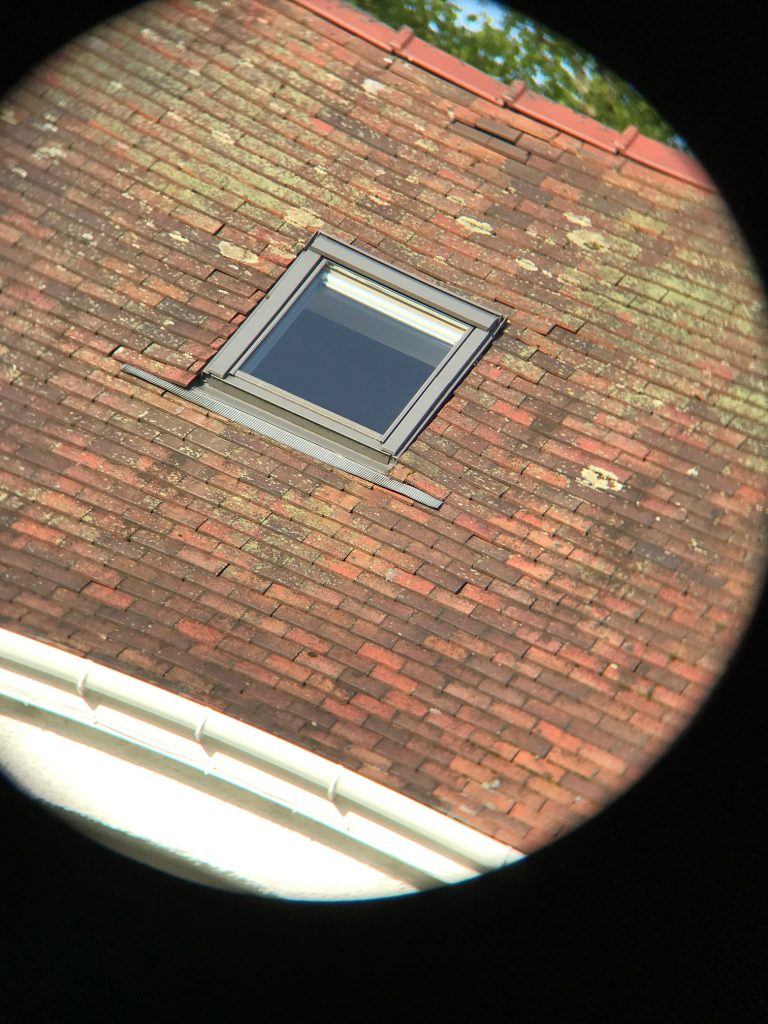
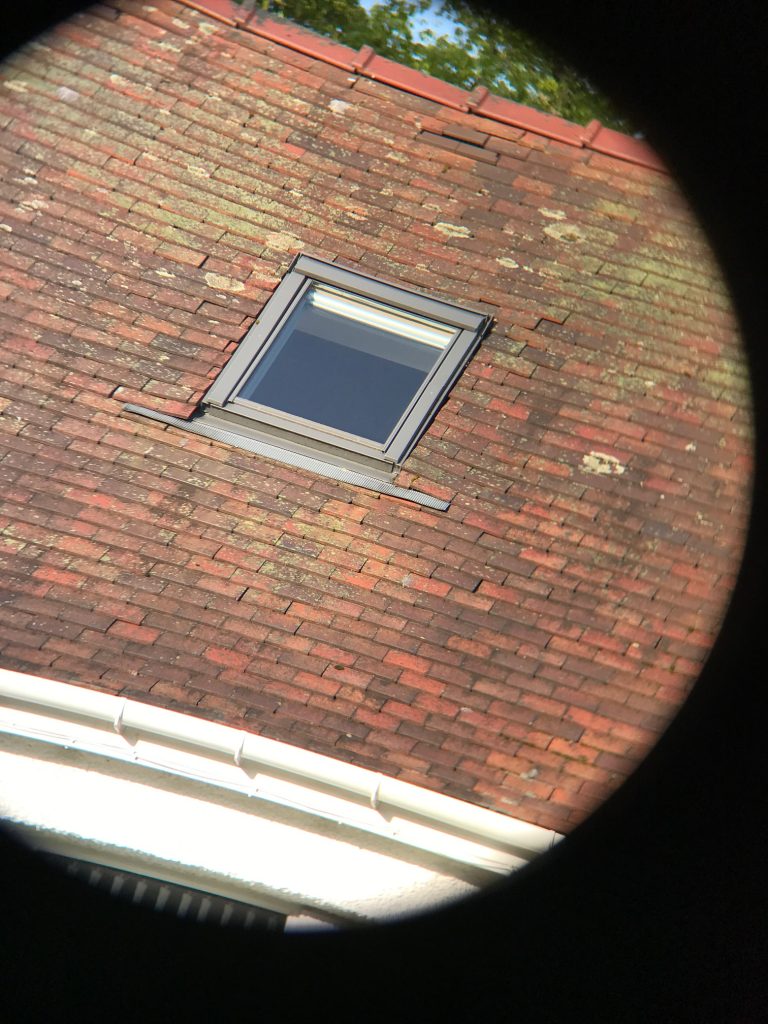
Aiming at a series of tiles on a roof at 20x, the image remains tack sharp nearly all the way across the field, with only slight softening occurring in the outer 10 per cent of the field. Cranking the magnification up to 60x, the same tests showed the image to be completely sharp from edge to edge. Below about 45x, high contrast targets show little or no fringing in the centre of the field even under poor lighting conditions. As the power is increased to 60x, I could detect some lateral chromatic aberration in the outer part of the field of high contrast targets, but it remained very well controlled in the central part of the image. This is par for the course for any high-end spotting scope and in this capacity the SA405 handled the targets very well indeed. What’s more, it’s difficult to know whether this residual fringing is attributed to the eyepiece or the objective.
Close focus was found to be just over 11m, a little closer than the advertised 12m. Though the scope has twist up eyecups, I elected not to adjust them, leaving them fully retracted. At magnifications up to 40x the entire field of view can be accessed with glasses on. Moving from 40x to 60x, the full field becomes progressively more difficult to see and at 60x, I could not see the entire field using my eye glasses. Luckily, I don’t normally view with spectacles, so this restriction was of little consequence to me.
More Nightime Testing
Moongazing in twilight; April 24 2023.
Turning the Svbony SA405 spotting scope onto a bright sodium streetlamp after dark produced excellent results. I could only detect a single, very weak internal reflection while the image of the lamp remained razor sharp with no haze or diffused light around the target. “This will be a great Moongazing scope,” I wrote in my journal. Over the following few evenings, I enjoyed clear skies allowing me to put this conjecture to the test my making some observations of the crescent and first quarter Moon with the instrument astride my Vixen Porta II altazimuth mount. The view at 20x was very impressive; very sharp, lovely contrast and only the merest trace of fringing seen when the Moon was moved to the edge of the field. I experienced the same results on the Moon as I did when I examined the tiles in the daytime; it remained pleasingly sharp across most of the field but lost some definition near the field stops. Since most of this distortion could be focused out, I deduced that the main culprit was mild field curvature. The Earthshine on the April crescent Moon was awesome to behold; always a beautiful sight with high quality optical instruments.
Cranking up the magnification to 60x I was delighted to see a wealth of high-resolution details as the Moon phase grew from a slender crescent to first quarter. Crater fields in the southern lunar highlands stood out starkly, and especially along the day-night terminator. The images were clean and crisp with no colour fringing observed. The limb did show a slight amount of secondary spectrum however, especially as the Moon drifted from the centre to the edge of the field. And just like that reported in my daylight tests on the tiled roof, I noticed that the image remained sharp all the way to the field stops.
Although a 90 degree diagonal is better suited to astronomical observations, I enjoyed some great views of showpiece double stars in the Spring Sky. Mizar and Alcor were beautifully sharp and moving up the sky to Polaris, I was able to cleanly resolve the faint magnitude 8.2 companion(Polaris B) easily at 60x. Later in the night as Cygnus gained altitude in the east, I enjoyed the gorgeous colour contrast double Albireo at 60x. With Delphinus about 20 degrees above the horizon in the wee small hours, I enjoyed splitting Gamma Delphini easily with the SA405 at 60x.
On nights where the Moon rose late or had set early, I went off in search of some of the more celebrated deep sky objects, such as the Double Cluster in Perseus, which was beautifully framed at 60x low down in my northern skies. The Beehive Cluster in Cancer presented excellently in this high-performance glass at 25x, with dozens of white and creamy white stars strewn haphazardly across the field. Turning to Leo now past the meridian and sinking into the western sky, I was still able to pick up the faint light from its most celebrated galaxies, M95, M96 and M105 just north of the star 53 Leonis. Turning to Hercules in the wee small hours of mid-April, the Svbony SA405 served up an excellent view of M13, the great globular cluster, now placed very high in the eastern sky.
Solar Observing
The Svbony SA405 20x-60x ED also proved to be a formidable telescope for observing the solar photosphere. Fetching a homemade white light filter constructed from Baader Astrosolar material, I enjoyed some great views of the solar disk throughout late April and early May 2023, with lots of sunspot activity to be seen. Having become accustomed to viewing the Sun using my 20x 60 Pentax binocular, I was impressed how much more I could see with this larger aperture and higher magnification spotting scope. Now that we’re approaching solar maximum, this will be a great scope for monitoring sunspot activity in the months and years ahead.
My First Field Trip with the Svbony SA405 20x-60x ED
Culcreuch Pond, April 2 2023.
I took the SA405 spotting scope and lightweight photographic tripod to one of my local patches to suss out the local wildlife. I walked the half mile country road up to Culcreuch Castle Pond, carrying the scope in its neoprene case and the tripod. Once I got there, it took me less than five minutes to set the gear up and running to begin observations thanks to the built-in 1/4-20 tripod interface.
The SA405 and lightweight tripod are easy to carry for extended periods and set up in just a few minutes.
Unfortunately there wasn’t much activity at the pond on that particular morning, but my eye was drawn to a Grey Heron lurking in the reed bed on the east side of the pond about 150 yards in the distance. Curious, I dialled in the 20x to get an overview of the scene. I could see the Heron was concentrating intently, standing absolutely still as it glared at the water beneath it. I had seen this stance many times before using my binoculars, so I knew something exciting was about to happen. I quickly racked up the power to 60x and refocused using the helical focuser. To my amazement, the Heron thrust its long neck forward and grabbed a large frog from the reedbed. The frog’s head was clenched between its maxilla and mandible, its legs outstretched and kicking the air frantically as it contemplated its final hours. Moment’s later, the Heron swallowed the frog whole. But then, as I continued to watch the Heron, it made itself ready for another pounce, staring intently once again at the water beneath it. And then wham! Another large frog was caught up in its beak, and down it went into its tummy. To say I was shocked to see this through the scope would be an understatement. I had always assumed that these graceful, large wading birds fed on small fish and eels. Never did it dawn on me that it gorged on frogs too!
That wasn’t the end of it either. Within a few more minutes, the gluttonous Grey Heron had caught a third adult frog; yes a third; swallowing it live in front of my eyes! What an unforgettable few minutes! I would never have been able to get this close to this magnificent bird with my 8x or 10x binoculars, as they are notoriously timid, flying off at the merest hint of danger. I immediately appreciated the great magnifying power and clear and sharp images served up my this nifty instrument from this distant vantage. Lets just say this maiden experience consolidated my admiration for these marvellous optical devices, even though it did put me off my lunch.
A spotting scope like this can be used in different capacities, depending on your inclinations. Some will choose to use it to carry out simple visual observations. Others will like to Digi scope, taking pictures of wildlife etc with their own phones or cameras. Others may want to take it still further by attaching a dedicated digital imaging camera to the scope to take still or continuously live feeds. For example, Svbony’s dedicated SC001 2 Megapixel imaging camera can be inserted into the scope simply by removing the eyepiece. The SC001 camera has Wi-Fi connectivity to allow you to conduct still or live video feeds on your phone using the company’s App.
In this blog, I simply present a few images to the reader so that you can glean some more information about its optical performance. The following images were captured using my hand-held iPhone without a mounting device. Furthermore, the images are entirely unprocessed.
The gluttonous Grey Heron moments before it caught its first frog.150 yards @60x.A Mute Swan out on the water. 120 yards @60x.A nesting Mute Swan resting in its nest. 130 yards @60x.Resting lambs on a warm spring afternoon. 130 yards@60x.The fallen tree at the north edge of the pond where Cormorants often congregate. 170 yards@20x.Branch of a dead tree set against a grey overcast sky. 95 yards @60x.
Conclusions & Recommendations
The Svbony SA405 20x-60x ED is an enjoyable spotting scope to experience. It’s very easy and intuitive to use and is very versatile, being more than capable of delivering great astronomical and terrestrial views. It’s perfectly at home on a lightweight photographic tripod or altazimuth astronomical mount. It delivers impressive images that most enthusiasts will be pleased with. Those wishing to explore other eyepieces can simply remove the supplied zoom eye piece and insert their own. This can provide even wider fields of view and potentially higher quality images. I write this in full knowledge that the SA405 is not the company’s flagship spotting scope model. That accolade goes to the SA401 20x-60x double ED scope, which can potentially serve up even sharper images for a few hundred dollars more.
I would recommend the SA405 to birders, general nature watchers and amateur astronomers who like to dabble in a bit of daylight observing. I think it represents very good value for money given the considerably higher prices commanded by more established sports optics firms like Opticron, Leica, Zeiss and Swarovski. And while it won’t match the performance of a $2k+ optic, it will do many things well and keep an enthusiast busy for years. In this capacity, it’s simply imagination limited!
Dr Neil English is a lifelong observer of the night sky but has, in recent years, broadened his horizons by delving into the weird and wonderful world of birding and nature studies. His new book, Choosing & Using Binoculars: A Guide for Stargazers, Birders and Outdoor Enthusiasts hits the shelves in the fall of 2023.
Accessories: Carry case, objective and rain guard(tetherable), lens cleaning cloth, test card, logoed and non-logoed neck straps.
Dimensions: 15 x 16.5cm
Warranty: 2 years
Price: $279.95
A few months back, I took the plunge and decided to order up one of the new binoculars offered by Oberwerk (see the preamble above). While I had heard great things about the company’s larger binoculars, I was genuinely intrigued when they brought out their SE series of smaller aperture Porro prism binoculars. The 8 x 32 SE has turned out to be something of a marvel; very bright, sharp, high-contrast images, a great big sweet spot and superb colour correction. But it didn’t end there. The same binocular is very well built and handles better than any other binocular I’ve had the pleasure to field test in this aperture class.. The 8 x 32 SE is the smallest binocular in this series, but my sustained attention to high-performance Porros stoked my interest in its larger sibling, the Oberwerk 10 x 42 SE. Intriguingly, it was being offered for only about $30 more than the 32mm model, so I ordered a unit up for testing and evaluation.
The Oberwerk SE 10 x 42 EDis a sturdily built binocular made for the great outdoors.
Like the 8 x 32 package, the 10 x 42 arrived within a week of me ordering it. Everything was well packed; the binocular with attached rain guards, the test card, neck straps and a fine soft padded case. Amazingly, this bigger brother of the 8 x 32 SE only weighs about 80g more. And just like the smaller Oberwerk, it’s built like a proverbial tank, with a thick, grippy rubber armouring surrounding the aluminium chassis.
The big beautiful eyecups on the Oberwerk SE 10 x 42 ED. Check out those antireflection coatings!
Everything worked smoothly; the central focus wheel, the right eye dioptre, the twist up eye cups with their comfortable eye relief. The only significant difference from the smaller model is that the objective lenses are not as deeply recessed. But that’s only because the extent of the recession of the 8x 32 SE objectives is truly cavernous!
Though not as deeply recessed as the smaller 8 x 32 unit, the objectives are still very well protected.
Next, the optics. Just like the 8 x 32 model, the 10 x 42 shows no internal reflections when pointed at a bright artificial light source. Taking a shot of the exit pupils showed very nice results, maybe not quite as nice as those found in the 32mm model but very good nonetheless.
Left eye pupil.Right eye pupil.
So what is it like to look through?
In a word: terrific!
On the afternoon it arrived, I quickly attached the neck strap and took myself off up to Culcreuch Pond to have a gander at the bird life. I was greeted by no less than three Cormorants, all perched on the fallen tree at the north edge of the pond. The generous field of view framed the birds perfectly. This is the tree I most often judge the size of the sweet spot during daylight hours as the trunk spans the field from edge to edge. I could instantly see that this was a high-quality optic with beautiful details on their feathers and long slender beaks coming through. I could also see that there was only a very modest amount of softening of the image at the field stops. That said, having experienced a few other 10x glasses with 6.5+ degree fields, the portal seemed a little short of what I expected. More on this later.
With leaden skies and the light rapidly failing, I didn’t think I’d see much more of interest that day, but as I was walking down the country road on the castle drive I heard the sound of a Woodpecker and quickly aimed the Oberwerk 10 x 42 SE as best I could towards some trees in an open field. Scanning carefully, I caught sight of a Great Spotted Woodpecker busy hunting for insects. And, as if by magic, a beautiful sunbeam broke through the clouds, illumining the tree with warm, radiant light. The striking colours of the bird – black, white and red -came to life. But then, from out of nowhere, a second Great Spotted Woodpecker emerged from behind another branch! I had never seen anything quite like this before! The view was razor sharp, the colours pure and intense, the stereopsis in the middle distance enhanced by the 10x boost producing an unforgettable visual extravaganza. The first bird took to flight after about 45 seconds of viewing it, the second followed suit shortly thereafter. Then the sunbeam disappeared, and I was back to sullen grey rainclouds serving as the backdrop to the tree top.
Still, the target served as an excellent test bed to see how well the optic was corrected for chromatic aberration. Once again, the Oberwerk 10 x 42 SE delivered in spades! Did it reach the sheer excellence of the 32mm unit? No, not quite, but it was very close.
I had anticipated that the perfect colour correction of the smaller 8 x 32 unit would be considerably more difficult to pull off with that higher magnification and greater light grasp of the larger 42mm objectives. But the results were excellent! I detected only a trace of lateral colour right out near the field stops and none within the sweet spot under these harsh lighting conditions. Indeed, on subsequent days with varying quality light, I became convinced that this binocular was well above average, even compared with other glasses endowed with well-executed ED glass objectives. Those who are sensitive to CA will be delighted with this optic. It’s just not an issue – quite a result, actually, for a big 10 x 42 like this.
Both the 8 x 32 and 10 x 42 Oberwerk Porros exhibit exceptional suppression of glare, which can only be achieved by a combination of high-quality coatings, good baffling and decently recessed objectives. Glassing into strongly backlit scenes presents little problem for these glasses. This extraordinary glare suppression adds to the visual punch of the images they serve up. Close focus on the 10 x 42 was measured to be 4.39m, a little longer than advertised but of no consequence to me, as this glass was designed for observing in the long to middle distance. Eye glass wearers will also be able to view the entire field thanks to the generous useable eye relief on these models.
The Oberwerk SE 10 x 42 is very comfortable to handle, despite its heftiness. Indeed, as I extended my glassing sessions with both these instruments, I came to appreciate that I could actually get slightly steadier images from them compared with my smaller, lighter glasses, so long as I didn’t over do it time wise, when muscular fatigue sets in. Studies I’ve read suggest hand-induced tremors manifest in the low frequency range, between 3 and 10Hz, and further indicate that using heavier glasses will introduce enough inertia to dampen these oscillations significantly. I noted this first with the smaller 8 x 32 SE comparing it with my lighter 8 x 30 Nikon E II, but it’s also true of the larger 10 x 42 unit, having done similar tests comparing it to my beloved Nikon E 10 x 35 WF.
Little & Large: the Oberwerk SE 10 x 42 ED(top) and the Nikon E 10 x 35 WF(bottom).
So how did these glasses compare optically? The Nikon has the wider field of view at 6.6 angular degrees. In bright light, the views are very comparable, that is, excellent, although I could see a good deal more lateral colour in the Nikon glass(non-ED) compared with the Oberwerk. In dull light conditions, such as near sunset or on heavily overcast days, the Oberwerk serves up significantly better images; they’re brighter and display no glare, which can sometimes be an issue for the Nikon. The Oberwerk also shows much milder pincushion distortion in the outer field compared with the Nikon too.
Adventures under the Stars
I can pretty much instantly tell if a binocular is mis-collimated in daylight tests, but I usually also test alignment of the barrels under the stars. By defocusing the bright star Arcturus using the right eye dioptre ring, I could see the focused star image from the left barrel was perfectly centred inside the defocused anulus of the right barrel image, so all was well. Centring the same star and moving it progressively further off axis, I was delighted to see that it remained a sharp pinpoint to about 80 per cent of the way to the field stop, after which the star showed the tell-tale signs of mild field curvature and some astigmatism. That said, even at the field stops, the star was only moderately deformed and didn’t present as an issue. Indeed, I consider that excellent performance for a binocular that lacks field flatteners.
The monopod maketh the binocular.
In my next test, I mounted the Oberwerk SE 10 x 42 ED on a tripod and centred Regulus in Leo, located some 12 degrees from the celestial equator and near my local meridian to conduct timing measurements of how long it took the star to reach the field stop. These times(in seconds) were doubled and then plugged into a standard astronomical formula requiring the cosine of the star’s declination, to measure field size. The arithmetic mean of such timings yielded a result of 6.44 angular degrees, a little less than the advertised 6.5 degrees, which I had suspected whilst comparing the Oberwerk to my Nikon E 10 x 35. These tests were carried out during a string of cold nights, where the temperatures fell below zero in the wee small hours of early April. This afforded an excellent opportunity to test another claim made by Oberwerk; fog proofing. Exposing the instrument to the cold for a couple of hours, I then brought it inside to a warm living room where the external optics fogged up, as expected. The inside of the instrument remained clear and fog free however, indicating that these instruments were indeed immune to internal fogging. Apparently, Oberwerk has been successfully doing this for well over a decade, as I came across a reference made by Phil Harrington who discussed this fact in his 2007 Star Ware.
Enjoying a long spell of settled clear weather, with blue skies by day and clear frosty nights, I enjoyed several astronomical vigils with this binocular. Handholding is OK for quick looks, but to get the most out of the instrument I mounted it on my trusty monopod, with a ball & socket head for increased stability and maximum manoeuvrability. On the evening of April 10 at 9.15pm local time, I spied an amazing apparition in the late evening twilight sky; the bright planet Venus and the Pleiades were framed within the same field of view! Venturing out about half an hour later with the sky fully dark, I was enthralled to see the same view, only this time many more stars were visible within the cluster and brilliant white Venus shining through the darkness, creating an unforgettable visual spectacle. Lying comfortably on a zero-gravity chair, I enjoyed spellbinding views of Praesepe and the Beehive Cluster at its heart, the sprawling stellar association known as the Coma Berenices Cluster(Melotte 111), the Alpha Persei Association and the Double Cluster, now sinking lower into my northern skies. I’ve said it before and I’ll say it again, there’s something very special about the star images Porro prism binoculars serve up compared with their roof prism counterparts. To my eye, they appear more pinpoint and intense, more aesthetically pleasing. What’s more, I’ve noted the greater contrast induced by smaller exit pupils(< 5mm). The sky appears noticeably darker, intensifying the images of stars and faint nebulae. That’s also why the Nikon E 10 x 35 WF is such a lovely stargazing glass!
Because summer twilight sets in from about mid-May to the end of July this far north, I often do some of my summer observing in the wee small hours of late April mornings when the sky is still properly dark, and the traditional summer constellations rise high in the eastern sky. I had the opportunity to observe the Milky Way through Cygnus and Lyra, soaking up the beautiful, pristine star colours each field of view afforded. The region around Sadr was particularly memorable, as was the striking colour contrast binocular double 31 Cygni. Brilliant Vega was pure white as the driven snow and nearby Epsilon 1 & 2 Lyrae were easy pickings for this binocular. The great globular cluster in Hercules, M13, was a striking sight in this excellent 10 x 42, as was Albireo(Beta Cygni), which was nicely resolved using a steady monopod into comely orange and blue components.
Conclusions & Recommendations
Complementary glasses.
The Porro prism binocular revolution continues apace, and Oberwerk has positioned itself at the cutting edge of this movement with the marketing of these new instruments. Both the Oberwerk SE 8 x 32 and 10 x 42 proved to be excellent performers by day, and also after dark. Their no-nonsense, robust build quality and great optical performance will delight most anyone who views with them. Indeed, the experiences I’ve had with these instruments make me seriously question why anyone would want to consider roof prism binoculars costing up two or three times more than these instruments for little or no gain in performance. It just doesn’t cut the mustard! Both represent exceptional value for money in today’s market and will provide years of reliable performance to birdwatchers and stargazers alike.
Needless to say, you’ll be hearing more about my adventures with both these instruments in the months and years to come!
So, watch this space!
Neil English is the author of seven books in amateur and professional astronomy. His 8th title on binoculars hits the shelves later this year.
The newly-restored Opticron Dioptron 8 x 32 ; a joy to look at and through.
A Work Commenced April 16 2023
In a previous blog, I briefly described the ergonomic and optical performance of two classic compact Porro prism binoculars– a Carl Zeiss Jenoptem 8 x 30 and a 30-year-old Japanese-made Opticron Dioptron 8 x 32. The little Zeiss was gifted to a former student of mine, who has since become a keen birder. The Dioptron remained in my stable, but I hadn’t used it very much. However, after sampling some of the KOMZ 8 x 30s, I dusted down the Dioptron to see how it compared with these Russian glasses. The experience rather shocked me. The Dioptron was in an entirely different league optically and somewhat better ergonomically than the Russian instruments. Indeed, the experience made me realise just how good the little 1990s vintage 8 x 32 Dioptron really was.
When it first arrived, I had not really examined its interior thoroughly to see if it needed cleaning. However, after carefully looking inside, I was surprised to see that it did have a thin veil of haze and the beginnings of a fungal infestation which fell below my radar. So I decided to have it professionally serviced. I phoned Tony Kay at OptRep, who had done a great job cleaning up my Nikon E 10 x 35 WF, and asked him if he’d be willing to clean up the little Opticron Dioptron. He said yes, and gave me a very reasonable quote. So off it went to his workshop in Selsey, on the English south coast. A couple of weeks later, I got it back, all cleaned up and looking like new. The optics were de-stained, cleaned, set and collimated. The hinges of the instrument were also freed – all ready to enjoy a new lease of life.
Bill of Work.
I thoroughly recommend OptRep. The service is super quick, and the workmanship second to none. All that remained was to give it a good clean with an Armor All wipe to condition the soft rubber eye cups and the chassis leatherette.
The Dioptron view from above.
The view was terrific: very wide(8.25 degrees), bright, extremely sharp with a great big sweet spot. It was a little brighter than I remembered it prior to dispatching. The slight yellow tint was still there though; a common feature of good optical glass from this era. There was also a bit of glare when pointed towards strongly backlit scenes but I felt it was perfectly acceptable. All in all, I was thrilled with its performance after I spent the afternoon glassing birds at two of my local patches. Here, I’d like to flesh out some more details concerning its ergonomic and optical design, as well as disclosing more information about other incarnations of this instrument I’ve discovered since first acquiring it last year.
The Dioptron 8 x 32 has a great retro look.
Ergonomics:
This has got to be one of the lightest and smallest 8 x 32 Porros in existence, weighing in at 494g without the strap – that’s 10 per cent lighter than the Nikon E II 8 x 30 and almost as light as the Swarovski CL Companion, the Opticron Traveler BGA ED 8 x 32 and Nikon Monarch HG 8 x 30 high-performance roof prism binoculars.
Underside .
The dioptre compensation ring, located under the right ocular lens has clearly delineated markings to quickly enable the user to set and remember his/her desired settings. However, it does tend to move, but that was easily remedied by affixing a very tightly fitting o ring around the bottom of the eyepiece that increases the frictional torque considerably. Since doing this, I’m delighted to say that the dioptre setting hasn’t budged a millimetre. What’s more, it’s nicely colour matched with the rest of the chassis so you’d hardly notice it’s there unless you point it out.
The fix for a wandering dioptre ring.
The eyecups give some eye relief but not a great deal. You can better access the field with glasses on by folding them down but even so, it’s difficult to engage with the entire field. That said, I had absolutely no problem seeing the entire field without glasses, even with the rubber cups extended. The central focus wheel is an entirely different design to the Japanese Nikon Es. For one thing, it’s much larger and considerably faster. Just half a turn clockwise brings you from closest focus – measured at 2.56m – all the way to infinity and a little bit beyond.
The chassis is mostly composed of high-quality machined aluminium with only a few plastic and rubber parts found on the bridge and around the objectives. Having rubber surrounding the objectives is a good move, as it won’t scuff the paintwork like it does on the metal-rimmed Nikon E objectives. And unlike my Nikon E II 8 x 30, which cannot reliably stand upright on a flat surface, the Opticron Dioptron can!
The instrument feels great in my medium-sized hands. The leatherette provides excellent grip and there is ample room for your fingers to engage with the focus wheel, either from the top or, indeed, from the bottom. It has a beautiful, high-quality feel about it. Indeed, you instantly get the feeling you’re handling a durable, high quality optical instrument.
The binocular is fully multicoated with the best coatings available at the time. The objectives have a strong blue tint in broad daylight, while the eye lenses display a purple-green bloom. Coatings have improved somewhat from the 1990s though, but the ones applied to this instrument are more than adequate for use in most lighting situations, but maybe not my first choice on dull winter days or at dawn and dusk, where newer coating technologies clearly excel over older treatments.
Optics
The Dioptron shows some internal reflections when pointed at a bright streetlight but they are fairly weak and not especially consequential. The exit pupils look good with minimal levels of peripheral light around them.
Left exit pupil.Right exit pupil.
Optically, the view is very impressive; sharp, nice contrast, and commanding a large sweetspot. The instrument shows some mild pincushion distortion and field curvature out near the field stops as well as lateral colour. The field stops are beautifully delineated in the Dioptron, something I’ve really come to appreciate in binocular optics. This nifty little 8 x 32 Porro delivers terrific 3D impressions of the landscape, a feature that continues to endear these instruments to me. Comparing the Dioptron to the Nikon E II 8 x 30, I judged their central sharpness to be very comparable. The latter serves up a brighter image with more contrast though, and its superior coatings were better at suppressing glare. The Nikon E II has a noticeably wider field – 8.8 degrees versus 8.25 degrees – but the Dioptron is plenty wide enough for most applications. In addition, the Nikon E II has a significantly better close focus than the Dioptron(1.96m versus 2.56m).
I think I prefer the focuser on the Dioptron. It’s super smooth, gliding with all the gracefulness of the innards of a Swiss watch. Images snap to an absolute focus with no ambiguity. This renders it an excellent birding glass in good light. As the light fades in the evening, however, the superior light transmission of the Nikon glass is easy to see. Its images are significantly brighter. Again, these comparative tests are not meant to portray the Dioptron in a negative light, only to show how it’s a product of its time. Optical coatings have improved since the 1990s and the Nikon has some of the very best available.
The Opticron Dioptron 8x 32(left) and the Nikon E II 8x 30(right).
As soon as it arrived back from its restoration, I took it off for a saunter to one of my local patches. I was lucky enough to register my first sighting this season of a group of Swallows. At first, I was overjoyed to see just one, its distinctive fork tail gleaming in weak Spring sunshine, perched high in the trees near Culcreuch Pond, resting from its long sojourn from North Africa. But as I scanned the high branches of a few other trees in the vicinity, I caught sight of several others. Some of them took to flight, gliding low over the fields with breakneck speed. What a thrill!
On another occasion, I brought both the Dioptron and my small Zeiss Terrra ED 8 x 25 pocket binocular into the west end of Glasgow to visit my in-laws and to do a spot of urban birding. I’m glad I brought both along, because it gave me an opportunity to compare both. The Zeiss is a nice pocket glass to be sure, but it can never approach the huge step-up in performance of a high-class 8 x 30. Size-wise, there’s not an enormous difference between these instruments – both could pass as pocket binoculars – but from the point of view of sheer performance, the Zeiss didn’t even come close!
When the Dioptron was first marketed in the UK, it commanded a price tag of about £120 back in the early 1990s. But there’s an interesting twist to the story of this model. The gentleman I bought the Russian Tento 7 x 35 from, Phil Grimsey, informed me that he had acquired a Japanese-made 8 x 32 from a charity shop going under the name of Panorama Puma. It was probably made for the German market.
The Panoroma Puma 8 x 32. Image credit: Phil Grimsey.
The chassis was identical to the Dioptron as were the antireflection coatings applied.
The Panoroma Puma 8 x 32. Image Credit: Phil Grimsey.
This suggests the instrument was rebadged under several names and was not exclusively developed by Opticron. That said, Phil is also chuffed to bits with his own lucky acquisition.
So, was it worth the restoration fee? You betcha!
Sarcophagi.
I prepared a sarcophagus for the Dioptron; a simple plastic Tupperware container filled with silica gel desiccant, to dry out its interior and keep it dry, rendering it functionally fog proof so that it can work in all weathers.
Thanks for reading!
Neil English has included a chapter on classic binoculars in his new book, Choosing & Using Binoculars: A Guide for Stargazers, Birders and Outdoor Enthusiasts, which hits the shelves in the fall of 2023.