
In this review, I’ll be test driving the Zeiss Terra ED 8 x 32 compact binocular.
Tune in soon for more details…..
In this review, I’ll be test driving the Zeiss Terra ED 8 x 32 compact binocular.
Tune in soon for more details…..

A Work Commenced December 9 2025
Product: Sky Rover Banner Cloud 7.5 x 32 with 2-ich astronomical filters
Country of Manufacture: China
Chassis: Magnesium alloy overlaid by protective rubber
Exit Pupil: 4.3mm
Eye Relief: 18mm
Field of View: 184m@1000m(10.4 angular degrees)
Dioptre Compensation: +\-4
Coatings: Fully broadband multicoated, Phase corrected Schmidt Pechan prisms, hydrophobic coatings on ocular and objective lenses
Prism Type:H-Bak7GT
ED glass: Yes
Field Flatteners: Yes
Waterproof: Yes, 1m/30 mins
Nitrogen Purged: Yes
Close Focus: 2m advertised, 1.95m measured
Light Transmission: 90-92%
Tripod Mountable: Yes
Dimensions:13.9 x 12cm
Weight: 822g
Accessories: Soft padded carry case, objective covers, ocular rain guard, 2-inch astronomical filters, filter adaptors, padded neck strap, microfibre cloth, instruction manual
Warranty: 3 Years
Price: $409 without filters, $505 with 2” filter set
In previous reviews, I showcased two amazing new high-performance binoculars from SkyRover: the 8 x 42 and the larger 10 x 50. These featured class-leading optical designs with ED glass, flat fields and ultra-wide angle eyepieces( 9.1 & 7.5 degrees, respectively) that left their European competitors in the starting blocks. Since their launch in 2023, the Banner Cloud series has gone from strength to strength, delivering world-class performance at prices hitherto unheard of. Customers voted with their wallets, and despite desperate attempts from ignorant, spineless trolls, they are currently enjoying great success bolstered by many dozens of happy user testimonies.
But SkyRover did not rest on their laurels, reaching out and listening to their client base, when they committed to bringing to market two new models in the 32mm aperture class: the 6 x 32 sporting a true field exceeding 12 degrees, and just recently, a 7.5 x 32 model boasting a field of view of 10.4 angular degrees! Of course, there have been designs like these before but never offering the same level of image quality at the edges of the field and at bargain prices. The new SkyRovers are changing all that. In this review, I’ll be showcasing the long-awaited 7.5 x 32 SkyRover Banner Cloud(SRBC), which I believe could be their best binocular yet, for daytime viewing at least! To see why, read on.
A Beautifully Presented Binocular

The SRBC 7.5 x 32 arrived in a beautiful presentation box. Many of the key features of the binocular are printed on the side, as is the new 3-year warranty.

The padded case is very well made with an eye catching red SR logo on the front. The padded neoprene neck strap is an ideal match for the weight of this binocular too. The rain guard fits over the eyecups firmly as do the objective lens covers.

The 7.5 x 32 has shorter barrels than the 42mm series making it a bit more compact. It’s still a hefty glass though, tipping the scales at 822g without the rain guard and objective lens covers attached. This makes it significantly heavier than most other 32mm binoculars – a necessity to get that class-leading field of view.

The large central focus wheel is buttery smooth to turn with absolutely no free play. I reported that the focus wheel on the 8 x 42 SRBC stiffened significantly at the end of its travel but this is not the case on the new 7.5 x 32. 1.4 turns clockwise brings you from closest focus to a little bit beyond infinity. Intriguingly, the earlier models from the series focused counter clockwise!

The dioptre compensation under the right eyepiece turns with just enough inertia to stay in place once adjusted. Indeed, I have never had any issues with this on any SRBC binocular I have had the pleasure of using.

The eye cups offer five positions in total. They click into place firmly and hold their position well. They can also be unscrewed from the binocular to get at dust and other debris picked up during extensive field use. Eye relief is very generous for the bespectacled among us. I was able to see the field stops when the cups were fully retracted while wearing my progressive glasses.
The objective lenses have multilayer antireflection coatings that ensure very high light transmission. They are well baffled against stray light and protected from whatever the weather throws at you.

The 7.5 x 32 feels great in the hands. My fingers can wrap around the large barrels to comfortably access the focus wheel. Indeed, it balances that little bit better than the 8 x 42, guaranteeing a more secure hold in field use.
Another neat feature of both the 6x and 7.5 x 32mm SRBCs is their ability to accept 2 inch filters for deep sky sweeping, which are affixed via two supplied screw-on adaptors. We’ll take a closer look at this provision later in the review.

Optics
My first test was to see how the binocular behaved when pointed at an intensely bright light source. Just like all the others in the Banner Cloud series, the 7.5 x 32 yield excellent results, with no significant internal reflections with a rather subdued diffraction spike. Checking for light leaks round the eye pupils yielded excellent results with round entrance pupils surrounded by lots of darkness: a good omen indeed in predicting how well the instrument would behave against the light.

The view can summed up in a few words: wonderfully sharp from edge to edge, exceptionally immersive, with hard, round field stops, lovely contrast, accurate colours and almost no chromatic aberration save for the merest trace in the last 10-15 percent of the field. Depth of field is also very good indeed. Pincushion distortion is extremely mild especially given the exceptional size of the field. Resistance to general and veiling glare is also well above average. In short, a world-class image with a huge wow factor owing to that enormous field of view.
Notes from the Field

In order to get the most immersive field of view with the least amount of glare, I never extend the eyecups out to their fullest extent but rather bring them down two clicks as you can see in the photo below. The left eyecup is positioned correctly for my eyes compared with the fully extened cup seen on the right:

This 7.5 x SRBC is by far the most comfortable and immersive 32mm binocular I have personally experienced. The larger exit pupil over a regular 8 x 32 certainly helps here but there is also the improved depth of focus moving from 8x to 7.5x, as well as that enormous, ultra-flat field of view. The sheer size of the field is hard to relate in numbers, but compared with say the Zeiss Victory SF 8 x 32, which hitherto presented the widest field of view in a 32mm roof prism format, the 7.5 x 32 SRBC presents a portal nearly 40 per cent larger by way of comparison!
Like the other SRBC models I’ve field tested, there is a generous amount of post infinity focusing in the 7.5 x 32, which is good news for those of us who have severe myopia. Close focus was measured to be slightly less than 2m: great for watching close up objects like insects, flowers and rocks in ‘macro’ mode.
A Comparison with a Known ‘Alpha Class’ 32mm Format Binocular

The lust of the eyes and the pride of life…..
To give the reader some idea of the quality of the view through the 7.5 x 32, I compared it with a Leica Ultravid HD Plus 8 x 32. The latter needs no introduction of course: it is widely regarded as one of the very best compact binoculars ever made. It is also the smallest of the current genre of 32mm binoculars. With a field of view of 7.7 degrees though, the view is noticeably restricted compared with the SRBC which brings a field nearly twice the size to your eyes. Central sharpness is excellent in both but that sharpness extends all the way to the edge of the SRBC field. In contrast, the little Leica glass shows a touch of peripheral softness in the outermost 10 per cent of the field. Colour tone is a little different too, with the Leica glass serving up ‘warmer,’ more saturated colours than the more neutral tones of the SRBC. What really surprised me however, was the level of lateral chromatic aberration in both binoculars. I fully expected the SRBC to show more pronounced fringing owing to its much larger field but that was not the case. Examining a variety of high contrast targets under harsh lighting conditions, it was the Leica that showed more pronounced fringing near the field stops! Pincushion distortion was much more evident in the Leica too!
The importance of a wider field of view was brought home to me one early afternoon in December while carrying both instruments with me on a two mile trek around my local estate. On one heavily overcast occasion, I was glassing some denuded tree branches with the 7.5 x 32 SRBC, when I noticed a Great Spotted Woodpecker perched on a branch in the upper left-hand corner of my field of view. I made a mental note on where the binocular was centred and then reached for the Leica glass, centring the field of view on that same spot. The Woodpecker was no where to be seen, as it was outside the field of view of the Leica glass!
Lessoned learned: with smaller fields of view you’ll be missing stuff.
Impression has a power all of its own.
The hydrophobic coatings on both the Leica and the SRBC outer lenses worked equally well in my field tests. Both instruments quickly dispersed condensation breathed on the eyepieces on cold, damp winter days. Performance against the light was very comparable in both binoculars, that is, excellent!
Now a word on the ergonomics of both binoculars. While the Ultravid HD Plus has a very nice focuser, the focus wheel on the SRBC is even smoother and easier to move. The Leica also has a locking dioptre built into the focus wheel, which is excellent, but hardly a necessity. The traditional dioptre compensation ring located under the right eyepiece is perfectly adequate to the task. It holds its position very well indeed.
A final note on the weight difference of the binoculars: the Leica weighs in at a mere 536g compared with the significantly bulkier 822g SRBC. As I’ve noted before, the extra weight allows me to hold the SRBC a little bit more stably owing to its greater inertia. This becomes important while glassing under windy conditions, when the majority of users would notice the difference. The greater weight of the SRBC generates a more stably held image. In summation, only if portability is the primary concern, would I choose the Leica over the Sky Rover.
Sweeping the Heavens

While a 32mm aperture binocular would not be my ideal choice for deep sky viewing, having an ultra-flat 10.4 degree field is not to be sniffed at. I chose the 7.5 x 32 over the 6x model since it goes that little bit deeper and has a larger image scale. My experiences of the 7.5 x 32 on the night sky were very favourable. The Moon is razor sharp against a dark sky hinterland. Placing the full Moon in the centre of the field gives the impression that the magnification is lower – an illusion caused by the magnanimity of its field of view. After all, the 7.5 x 32 can get 20 full Moons into its field! Again I could only detect some minor fringing when the Moon was placed quite a bit off axis but to speak of such fringing is academic at best.
I did do one check to estimate the field size of the 7.5 x 32. Albireo in Cygnus and the Coathanger asterism in Vulpecula are separated by about 10 degrees of sky and I was indeed able to see both in the same field of view. This was not achieved using the 8 x 42 SRBC with its 9.1 degree field.
Showpieces of the winter night sky were beautifully presented: the Hyades & Pleiades in Taurus, the Sword Handle and Belt stars in Orion could be seen in the same field of view with plenty of room to spare. Kemble’s Cascade, the Alpha Persei Cluster and the famous Double Cluster were also nice to observe. I did notice a modest drop in illumination of stars as they approached the field stops though. I didn’t do much observing with the UHC filters however. I observe from fairly dark rural skies so there would be little need to use them. Under my conditions they did show a modest enhancement of nebular objects such as M42 in Orion but at the expense of attenuating star brightness a bit.
Conclusions

Test driving the new 7.5 x 32 has been a real thrill. For a modest price of just a few hundred dollars you’re getting super nice optics that is sure to wow you from the first time you bring it up to your eyes. I consider the Sky Rover Banner Cloud series to be quite revolutionary, pushing the envelope on optical quality and setting new records in wide field viewing. Christmas has certainly come early!!
Dr Neil English runs the full gamut of binocular genres in his book, Choosing & Using Binoculars, A Guide for Stargazers, Birders and Outdoor Enthusiasts

A Work Commenced July 2 2025
Product: Leica Ultravid HD Plus 8 x 32
Country of Manufacture: Portugal
Chassis: Magnesium Alloy and Titanium covered in black Vulcanised Rubber.
Exit Pupil: 4mm
Eye Relief: 13.3mm
Field of View: 135mm @1000m(7.74 angular degrees).
ED Glass: Yes-Schott Fluorite
Other Notable Glass: Schott HT
Dioptre Compensation: +\- 4
Close Focus: 2.1m advertised, 1.91m measured
Hydrophobic Coatings on Outer Lenses: Yes, AquaDura
Fogproof: Yes
Waterproof: Yes/5m
Accessories: Objective lens covers, rain guard, neoprene neck strap, lens cleaning cloth, padded soft case, test certificate, warranty card and user manual
Warranty: 10 Years
Weight: 535g advertised, 534g measured
Price(UK): £1499
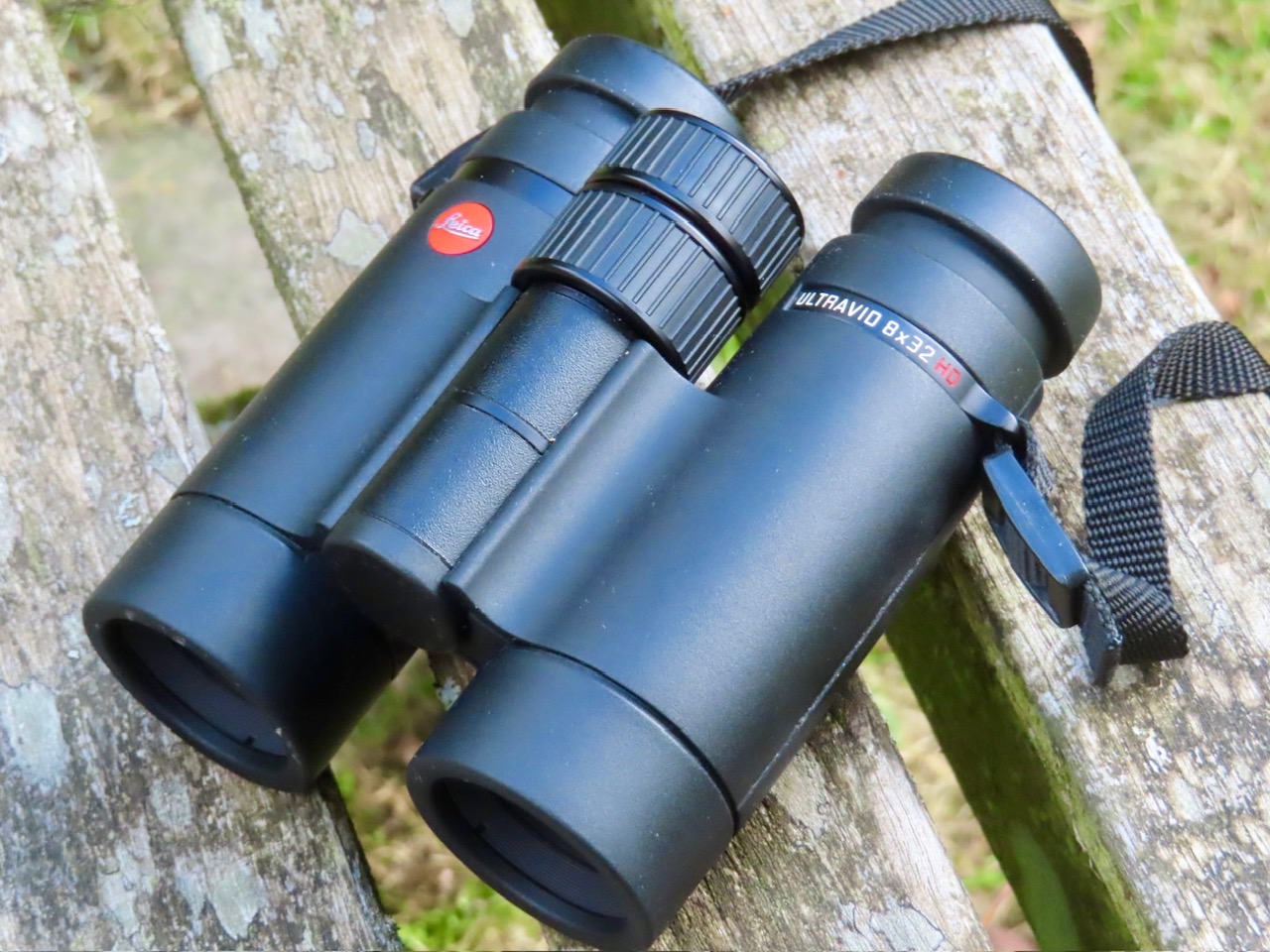
The Leica Ultravid series is one of the longest continuously manufactured binoculars by the prestigious German company, Leica. Introduced in the Black Rubber (BR)form back in 2003, the series was upgraded to the HD series in 2007, which featured Schott Fluorite glass for improved colour fidelity and Leica’s innovative AquaDura hydrophobic and anti-scratch coatings. Finally in 2015, the company introduced the latest version: the Ultravid HD+ series which incorporated Schott HT glass in the prisms which increased light transmission to an impressive 92-3 per cent. In all Leica offer the HD+ series in 8 and 10 x 32, 7, 8 and 10 x 42 and two larger models – the 10 and 12 x 50. This review will discuss the smallest HD + model; the 8 x 32.
My first experience with this series came a couple of years back when I had the pleasure of looking through the 10 x32 Ultravid (UV)HD+ observing birds out on the water of Loch Carron, just a few miles from my home. The owner was so impressed with the binocular that he bought a second 10 x 32 for his daughter. It was here that my concerns about the small size were put to rest, since I was able to hold them very comfortably in my medium-size hands.
The 8 x 32 is an amazingly small and compact model, only 11cm from the end to end with the eyecups kept down. Tipping the scales at 534g, it’s super light weight.

The focus wheel is disproportionately large, making it very easy to manoeuvre using one or two fingers. While there is some inertia getting it moving , focusing is very precise with no free play. This is an improvement over their entry-level model, the Trinovid HD 8 x 32, the focus wheel of which had a small amount of free play. Just over one full revolution clockwise brings you from closest focus to a little bit beyond infinity. The dioptre compensation is accessed by pulling up the top part of the focus wheel, turning the wheel and pushing it back in.

The eyecups can be used in three positions: fully retracted or pulled up through two click stops. Like I said many times before, Leica’s eyecups are amongst the best in the industry. They are supremely comfortable and click rigidly into place.

Eye relief is quite tight on the 8 x 32 though, especially for eye glass wearers. I did test them using my spectacles and I could just see the entire field but it’s certainly not a comfortable experience especially during prolonged field use. Luckily, I don’t wear glasses using my binoculars so it was really a non-issue for me.
Unlike the larger UVHD+ models, the underside of the barrels on the 32mm models have no thumb indents. Over the years, I’ve cultivated a strong disliking for these anyway, so not having them is a bonus in my books!

The objective lenses are nicely recessed with excellent knife-edge baffles to minimise glare when glassing against the light. The coatings are immaculate: giving a faint purple bloom when examined face on but present more of a tobacco hue when seen at more oblique angles.


In the hands, the little Leica UVHD+ 8 x 32 is very firmly held thanks to the textured black rubber armouring, though it’s a magnet for dust, pollen and other airborne matter.
I can wrap my little fingers round the front of the barrels while using my ring- and middle-finger to do most of the focusing. It’s also a supremely handsome binocular with a strong retro accent I very much like.

Optics:
Looking at an intensely bright light source from across the room through the Leica UVHD+ showed no internal reflections but I did pick up a moderate diffraction spike. The same was true when I turned the binocular on a distant street lamp after dark.
Next I examined the exit pupils while the instrument was aimed towards an indoor room light. As you can see below the result was excellent: exemplary in fact! Just nice round pupils surrounded by complete darkness!


Credit where it’s due: the view has real ‘gestalt:’ beautiful, arresting: razor sharp, wonderfully contrasted, with vibrant colours. Chromatic aberration is absent in the centre but does show up as lateral colour in the outer part of the field. Being used to larger, flatter fields, I was half anticipating that the 7.74 degree field would be rather restrictive or ‘tunnelled,’ but I did not get that impression. The view is extremely relaxed, especially for a compact model like this.
The Leica UVHD+ 8 x 32 does have more pincushion distortion than I would have liked and the edge sharpness could be better. Finally, when glassing with bright sunshine directly behind me, I noted some annoying reflections off the ocular lens. Thankfully this can be remedied simply by placing a finger over the side of the eyecup.
Notes from the Field:
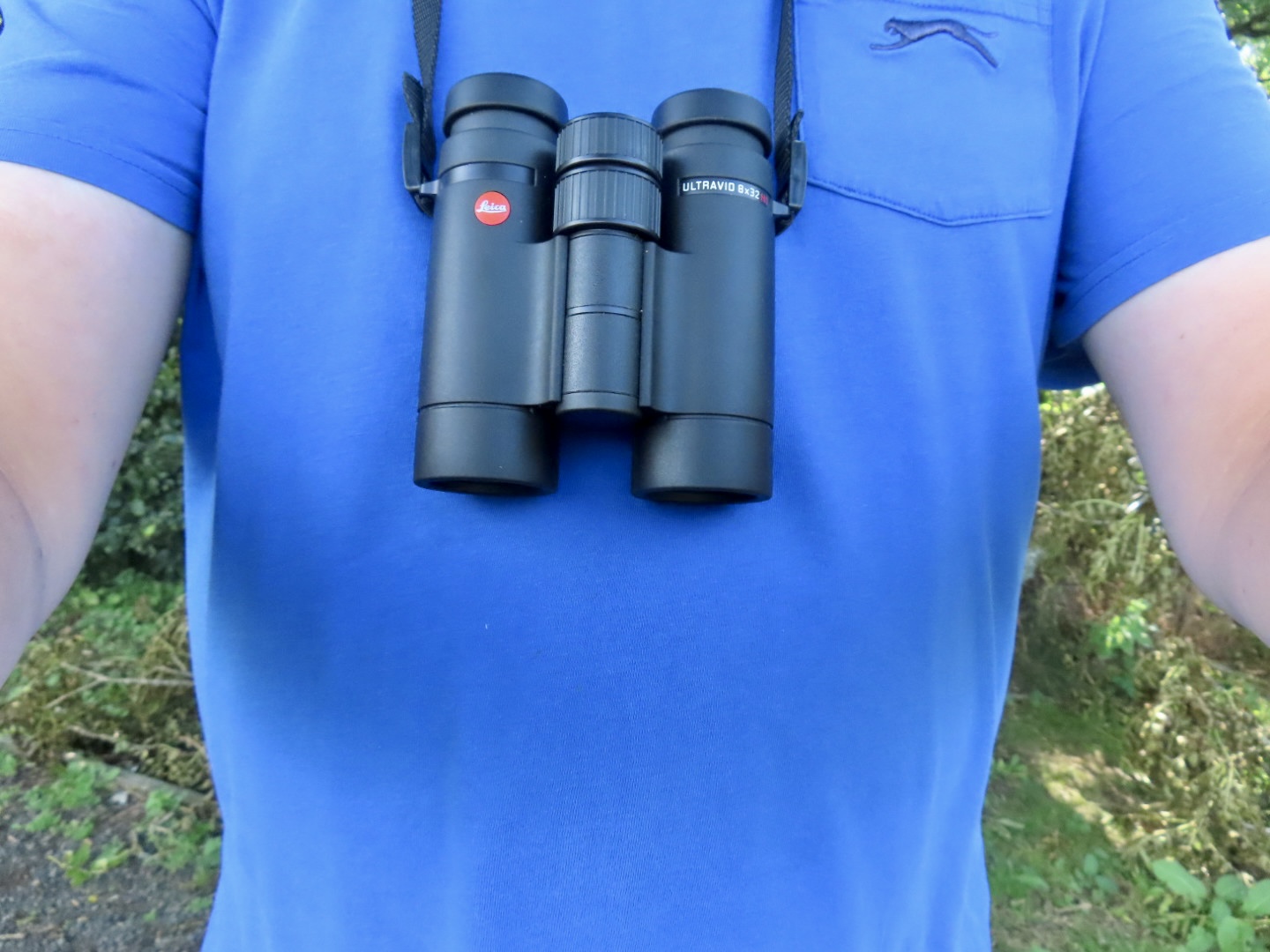
Make no mistake about it; the Leica UVHD+ 8 x 32 is a study in miniaturisation. A true marvel in both mechanical and optical engineering!
But it ain’t perfect.
Close focus was measured to be 1.91m, closer than the advertised 2.1m, but not nearly as impressive as the super close 0.95m I measured on the Trinovid HD 8 x 32. There are two aspects to the image of the UVHD+ that are noteworthy compared with my main binocular, the superb SRBC 8 x 42: colour saturation and resistance to glare of all kinds.

In the centre of the image, sharpness in both is quite comparable but the colours generated by the SRBC optical system are a little more neutral than in the UVHD+, the latter of which has a noticeably higher transmission to wavelengths in the 600-700nm range, which renders a warmer image. Where the UVHD+ betters the SRBC is in suppression of glare, both veiling and general glare when glassing against the light. And while an 8 x 32 is no match for a larger 8 x 42 of equal quality, I found the performance of the UVHD+ to be excellent in summer twilight, where the Schott HT glass boosts light transmission in the 400-500nm range, which allows the darker adapted eye to perceive objects in the blue part of the visual spectrum that little bit better. I refer the reader to Holger Merlitz’s The Binocular Handbook page 10 for details.
Conducting some observations of the bright summer star, Vega, the little Leica glass showed perfect collimation and quite a flat field. Only in the outer 20 per cent of the field or so could I detect a bit of field curvature which could be focused out, but there remained a small amount of astigmatism right at the field stops.
Though I did not do a side by side comparison, I would rate the optical quality of the Leica UVHD+ to be higher than the Zeiss SFL I tested some time ago. It just has a more relaxed view compared with the Zeiss, with the warmer colours and superb glare suppression, pulling it ahead. But this is bound to be rather a subjective impression.
One thing’s for certain though, the Leica UVHD + is much more in keeping with a pocket glass philosophy than either of the current Alpha glasses offered by Swarovski or Zeiss, as exemplified by the design of the NL Pure and SF 8 x 32 models, respectively. These are considerably larger in comparison, and so can’t really be considered to be in the same portability class, at least size-wise. In contrast, the little UVHD+ certainly can fit in an average coat pocket.

Value for Money?
The Leica UVHD+ 8 x 32 is an expensive piece of kit that’s for sure. But when I compare it to the optically excellent SRBC 8 x 42, which retails for one third of the price of the Leica, it gives me serious grounds for pause in recommending it, especially as an auxiliary travel glass. In addition, with the soon introduction of smaller 32 mm class of SRBCs offering the same excellent quality optics in ultra-flat fields fully twice the size of the Leica UVHD+ and at a fraction of its cost, it may render these smaller glasses by Zeiss, Swarovski and Leica all but obsolete. In the end, you vote with your wallet.
Dr Neil English is author of Choosing & Using Binoculars: A Guide for Stargazers, Birders and Outdoor Enthusiasts.
A Work Commenced April 6 2025
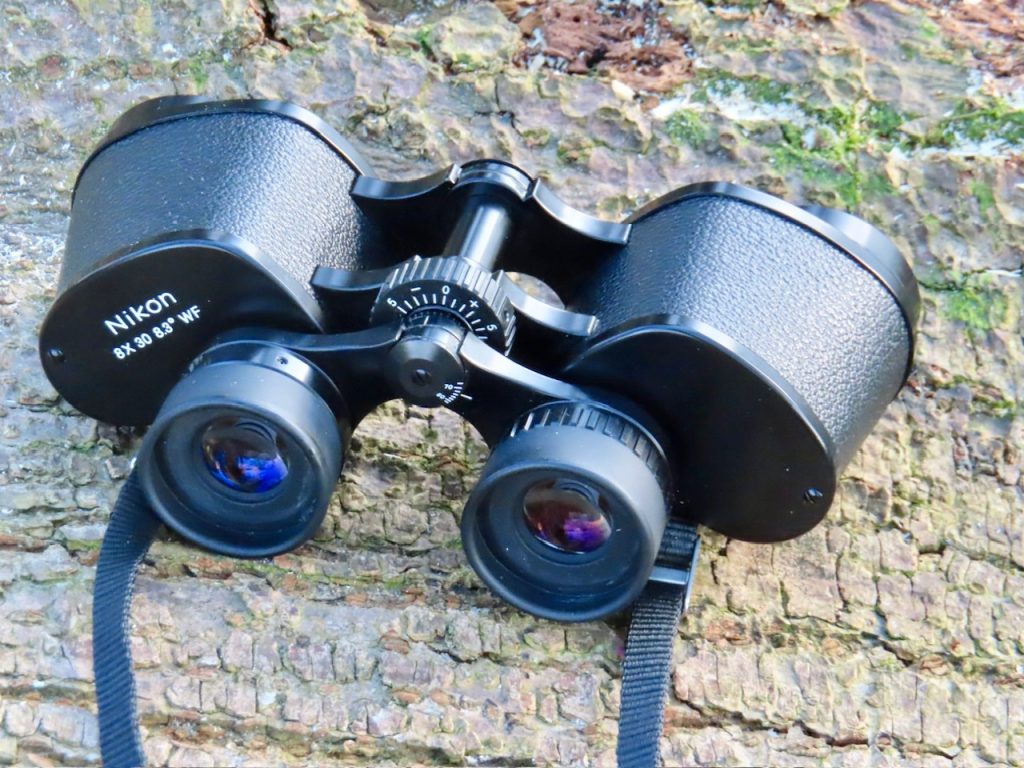
Want a really great binocular that exudes class and pedigree? A binocular that delivers in spades optically but won’t break the bank? Then look no further than this late model Nikon E 8 x 30!
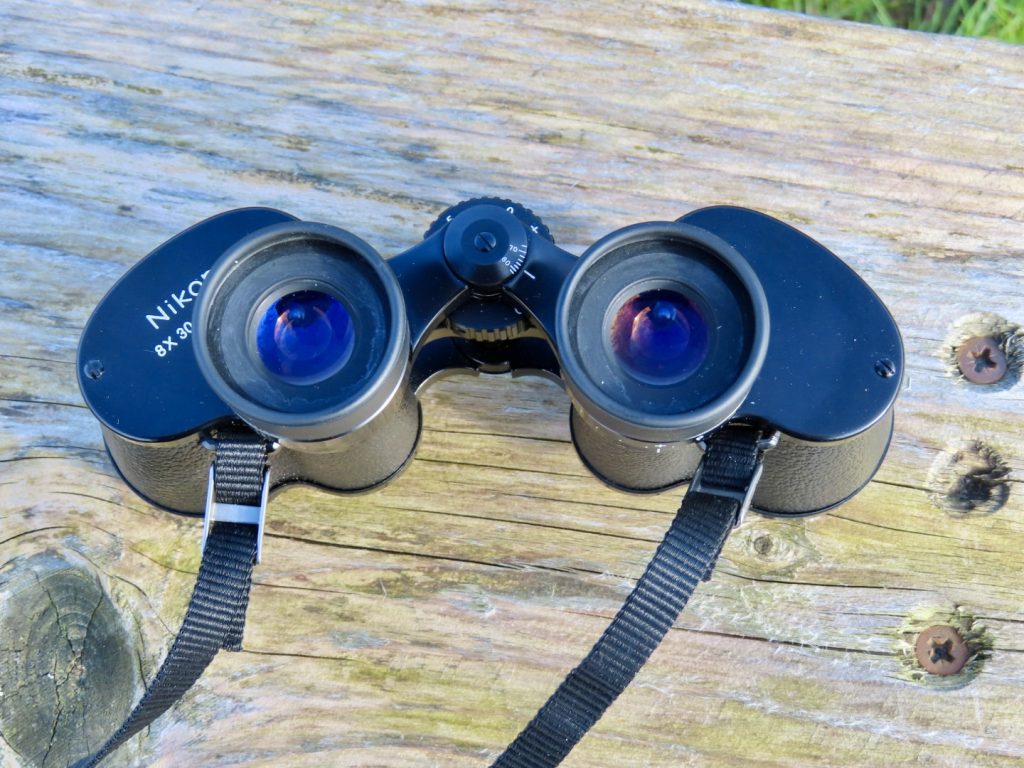
I picked this up from EBay for about £150 plus import duties from Japan, so about £200 all in. It’s in absolutely mint condition despite being about 40 years old based on its late serial number(#922372). Indeed, when I examined the original receipts I got with the instrument, I could see that it was originally made in 1985:

These models had an advanced single coating on all glass surfaces including the prisms. The Model E was updated in the late 1980s to the Criterion model Es (discussed in my 2024 book, Choosing & Using Binoculars)which had full multi coatings. These are easy to distinguish from each other by the colour of the bloom of the ocular and objective lenses: the older Es having a purple tint while the newer Criterion models possessing a greenish bloom.
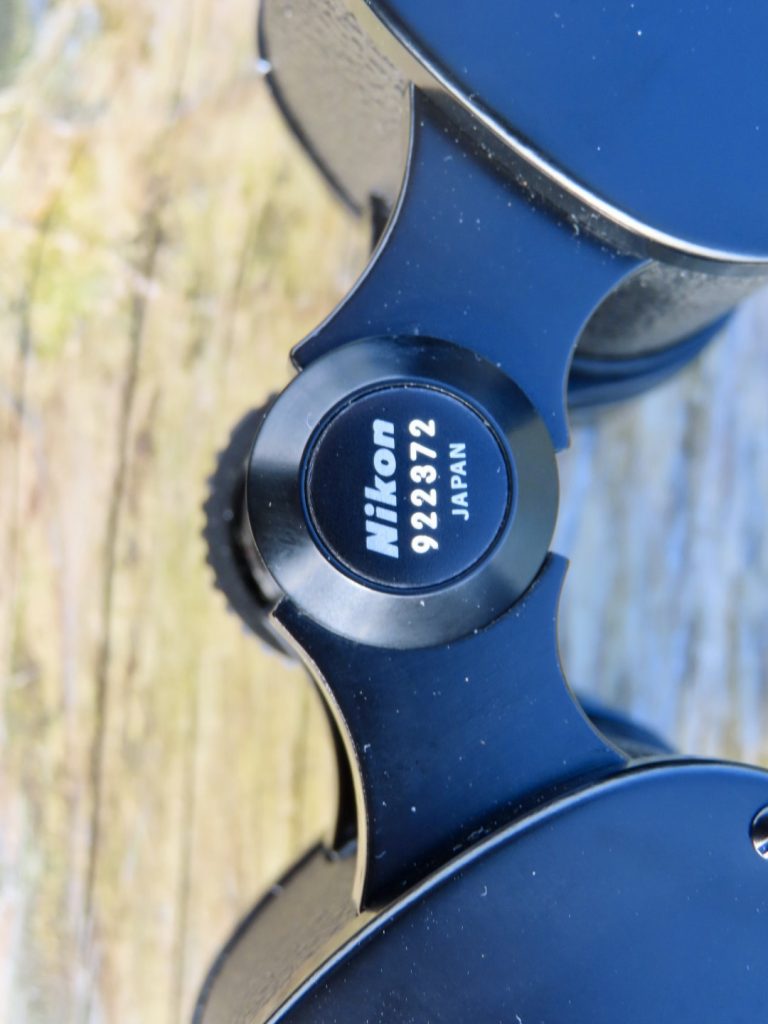
Mechanically, the Nikon E is beautifully built, in a robust magnesium alloy housing. Indeed, having tested it extensively on field trips, it is arguably true that the build quality of these classic E series was a little higher than the later Criterion and even the most recent EII incarnations.
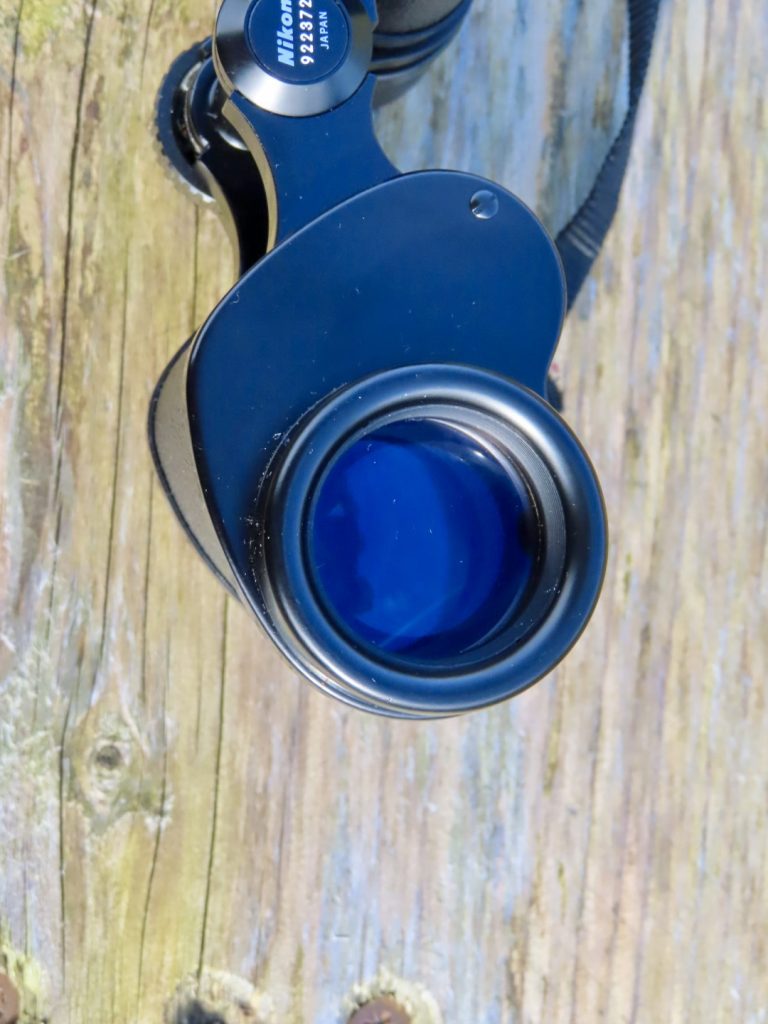
My unit has a smooth focuser that exhibits a fair amount of friction. And while it’s harder to turn than the most recent EII model, it will likely last longer than the latter because the plastic is tougher than the softer synthetic rubber found on more recent models.
Optically, the Nikon E 8 x 30 sports a wide 8.3 degree true field- very large for its time and still very generous by today’s standards. The view is extremely comfortable and immersive – maybe a little more comfortable even than the venerable EII. It’s a very sharp optic with a great big sweet spot. Contrast is excellent with very good control of colour fringing. The outer field shows moderate pincushion distortion to minimise the dreaded rolling ball effect. Colour tone is ever so slightly yellowish which is not at all distracting to my eyes.Close focus is a very decent 2.5 metres.
I did pick up a few internal reflections aiming the binocular at some bright light sources after dark though, and on the Moon, but they were far less injurious than I had expected given its single coated specification. Performance against the light is also impressive.
Having compared it to a late model E. Leitz Binuxit 8 x 30, also in pristine condition, and dating from about 1960, it is clear to see the improvement in light transmission in the Nikon E. Coating technology had very clearly evolved for the better in that quarter of a century!
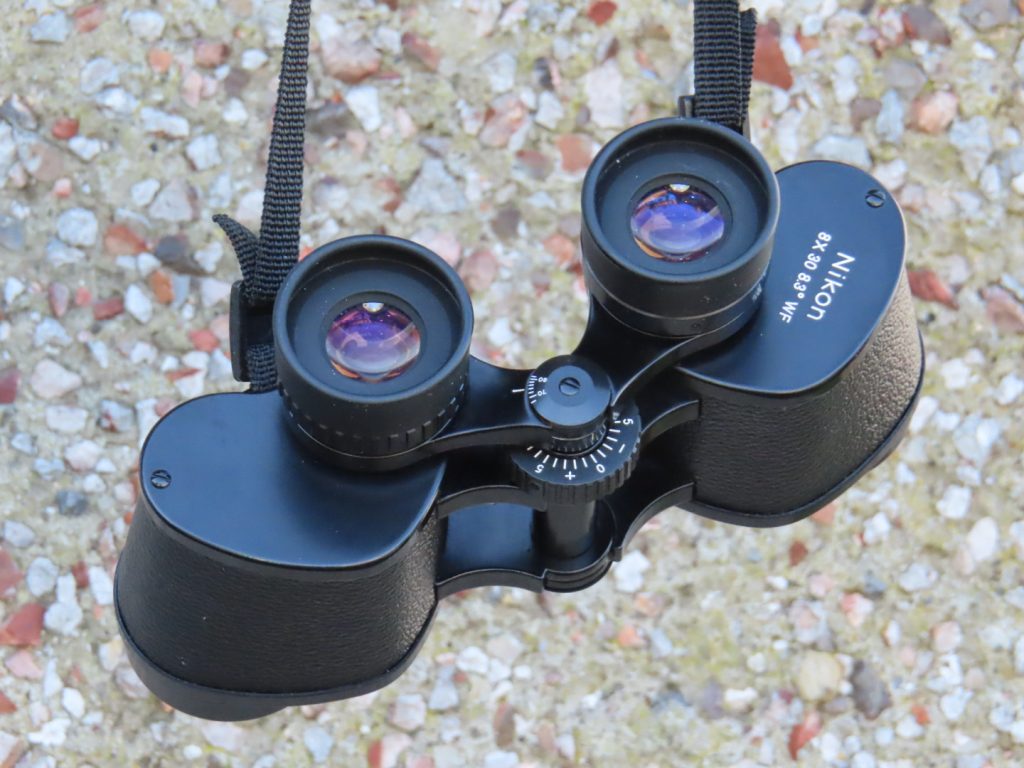
In short, I was very pleasantly surprised by this classic 8 x 30 from the Japanese optics giant. If you’re on a budget and want a piece of optical and mechanical excellence from yesteryear, but can still deliver beautifully clear and sharp views, I’d strongly recommend this model. It’s likely that the later model Es had better coatings than the earlier versions so be on the look out for units with serial numbers from the 700,000-950,000 range. I guarantee you’ll be impressed!
Read more about great modern classic glass in my book, Choosing & Using Binoculars: A Guide for Stargazers, Birders and Outdoor Enthusiasts.

A Work Commenced October 12 2024.
Product: Opticron Discovery SP 7 x 28
Country of Origin: China
Chassis: Aluminium & Polycarbonate overlaid by protective rubber
Exit Pupil: 4mm
Eye Relief: 18mm
Field of View: 136mm@1000m(7.8 angular degrees)
Dioptre Compensation: +\-4
IPD Range: 52-72mm
Coatings: Fully multicoated.
ED glass: No
Waterproof: Yes
Nitrogen Purged: Yes
Close Focus: 3m advertised, 2.76m measured
Tripod Mountable: Yes
Dimensions:15.4 x 10.5cm
Weight: 345g advertised, 380g measured
Accessories: Soft padded carry case, objective covers, ocular rain guard, padded neck strap, microfibre cloth, instruction manual
Warranty: 5 Years
Price(UK): £69.00
I’m delighted and excited to provide my initial impressions of a charming little Porro prism binocular newly launched by Opticron: the Discovery SP 7 x 28. I ordered a unit from the Birder’s Store, Worcester for £69, who I highly recommend, and two days later the package arrived. A small blue box greeted me inside, containing the instrument tucked safely inside a soft padded black case, together with a logoed neoprene neck-strap, rubber ocular rain guard, and tethered objective caps, a lens cleaning cloth, instruction card and warranty (5 years) details. Tipping the scales at just 380g, it weighs scarcely more than a typical pocket binocular, yet delivers a much more satisfying and comfortable optical experience than any pocket glass I’ve personally encountered.

The accessories provided were all excellent too – something I rarely see in products costing many times more!
The Discovery SP 7 x 28 is small, sleek and good looking, with a very well armoured, thick rubber substrate protecting the aluminium and polycarbonate chassis. The central hinge is strong and holds your ideal IPD very well. It features modern, twist-up eyecups that work well for those who wear glasses and those who don’t. Three positions are offered and all lock in place firmly. The large, ribbed focus wheel on my unit operates smoothly with a fair amount of friction, turning through 1.5 revolutions anticlockwise from closest focus ( a decent 2.76m) to well beyond infinity. This will therefore be good news for those with very short sightedness!

The right eye dioptre is located under the right eyepiece, and is reassuringly stiff, ensuring it won’t easily move out of place during field use. There is also provision to mount the instrument on a tripod if required.
I detected only the smallest amount of play in the focus wheel which didn’t detract much from my visual impressions after testing it in dull, overcast conditions and in bright, sunny conditions. The view is very impressive: bright, accurate colours, tack sharp in the centre and only a little softer at the edges of its 7.8 degree field. Depth of field is also noticeably better than an 8 x 30 glass. Star testing showed precise collimation as well as excellent, pinpoint stars nearly all the way to the field stops, with only a trace of field curvature and astigmatism creeping in at the extreme edges.

What really surprised me was the darkness around the exit pupils: truly remarkable for a binocular costing so little! Indeed, they were substantially better than those exhibited by the Kowa YF II unit I recently showcased. Control of internal reflections was also very impressive, as judged by observing a very bright light source across a darkened room. In addition, when I turned the glass on a bright gibbous Moon on the night of October 14, it showed a very impressive image, with Saturn just a few degrees away from it. Lunar details were crystal clear and sharp, showing remarkably little chromatic aberration, and with only a moderate amount of ghosting that didn’t bother me that much.

Briefly comparing the Opticron to the Kowa YF II, I formed the distinct impression that these were cut from the same cloth, so to speak, with similar build quality and overall optical performance, showing only moderate levels of pincushion distortion off axis.


Like the venerable Kowa YF II, the Discovery SP feels great in the hands. It provides a very comfortable, stable and pleasant viewing experience, with its generous 4mm exit pupil. While the AFOV is noticeably smaller than the Kowa YF II( 55 vs 60 degrees), it never felt constrained to my eyes. Performance against the light is surprisingly good – even a tad better than the Kowa costing twice as much!

It is small enough to slip into an ordinary coat pocket.

I captured a few hand-held images through the Opticron Discovery SP 7 x 28 using my Canon Powershot Zoom monocular giving a power of 8.4x( See below):


It’s exceptionally easy to capture images with this feather light instrument.

Conclusions & Recommendations

Cor, Blimey!
What a delightful little instrument!
Who says you have to cough up a lot of dosh in order to enjoy a pleasant optical experience? Those days are well & truly behind us!
With its generous IPD range, the Discovery SP is ideal for kids and those with smaller faces. Optically very impressive and surprisingly well built, most anyone would be pleased with this little instrument. It’s an ideal travel binocular with its pocket-glass weight and diminutive physical dimensions, ideal for stowing away in a small space. Opticron has hit the ground running with this new arrival, and I think it will prove to be very popular!
Very highly favoured!
Neil English delights in bringing exceptional binocular bargains to the masses. Please support his ongoing work by purchasing a copy of his latest book: Choosing & Using Binoculars: a Guide for Stargazers, Birders and Outdoor Enthusiasts.

A Work Commenced September 21 2024
Product: Kowa YF II 8 x 30
Country of Manufacture: The Phillippines
Chassis: Polycarbonate overlaid by protective rubber
Exit Pupil: 3.75mm
Eye Relief: 16mm
Field of View: 132m@1000m(7.5 degrees)
Dioptre Compensation: +\-4
Coatings: Fully broadband multicoated, KR Hydrophobic coatings on ocular and objective lenses
ED glass: No
Field Flatteners: No
Waterproof: Yes
Nitrogen Purged: Yes
Close Focus: 5m advertised, 2.9m measured
Tripod Mountable: Yes
Dimensions:16.5 x 17cm
Weight: 475g advertised, 476g measured
Accessories: Soft padded carry case, objective covers, ocular rain guard, padded neck strap, instruction manual
Warranty: Limited Lifetime Warranty
Price: £159.95(UK)
Arguably the most charming binoculars are embodied in the small and versatile 8 x 30 Porro instruments. Small enough to take everywhere, they’re easy to make well and deliver excellent views even in compromised lighting conditions. That together with their modest pricing compared to roof prism models, render them a compelling choice for the budget savvy consumer. I was once again reminded of these facts when I tested Kowa’s YF II 8 x 30 over a few weeks. What follows is a summary of my findings.
Ergonomics:

The unit I ordered up proved to be a perfect sample. Assembled in the Philippines, its twist up eyecups locked firmly into place and has generous eye relief for eye glass wearers. The focus wheel has small depressions to assist in its rotation. It proved to be very smooth with zero free play. It’s neither too fast or too slow: just perfect in fact! I love the thick, textured rubber armouring of the chassis which is easy to grip. It feels great in my medium sized hands.

Tipping the scales at just 476g , it’s featherlight but completely waterproof and dry nitrogen purged for complete reliability in adverse weather conditions. Kowa applied their proprietary KR hydrophobic coatings to the outer lenses to help keep the lenses clear of condensation on the wettest days.
The Kowa YF II features fully multicoated optics, which were perfectly applied to the lenses and prisms for bright, crisp images. Though you’ll probably not need to mount the instrument owing to its low weight, it can be mated to an adapter for use on a tripod or monopod.

Just like the very similar Opticron Savanna 8 x 30 previously reviewed, its lower minimum IPD of 50mm makes it ideal for those of us who have small faces.
All in all, I was very impressed with its well thought through ergonomics: something I’ve come to expect from a well established spirts optics firm like Kowa.

Optics:
The Kowa YF II responded well to my bright light test, revealing some very minor internal reflections and no diffraction spikes. Examining the exit pupils gave decent results with perfectly round pupils. I did note some minor light leaks around the exit pupil however which would introduce some glare in low light conditions. However, considering its modest retail price, and since this would not be of much use in such situations, it’s quite an acceptable compromise.

The view is quite excellent, sporting a decent 7.5 degree field. It’s tack sharp inside its generously wide sweet spot. Objects take on a vivid three dimensionality in the middle distance thanks to its traditional Porro design. Contrast and colour rendering are also top notch. Despite not having field flatteners, edge of field performance is very good with only very mild field curvature creeping in in the outer 15 per cent of the field, as affirmed by monitoring the quality of star images after dark. Close focus was much better than advertised too: I measured 2.9m as opposed to 5m in the specifications.
In summary, the Kowa YF II offers exceptional value for money, delivering very high quality views in a brilliant, light weight package. It will serve as a fine birding and travel binocular and is an excellent choice for children.
Highly Recommended !
Read much more about budget-friendly binoculars in my latest book, Choosing and Using Binoculars: a Guide for Stargazers, Birders and Outdoor Enthusiasts.

A Work Commenced September 10 2024
Product: Nikon Prostaff P7 8 x 30
Country of Manufacture: China
Chassis: Polycarbonate overlaid by protective rubber
Exit Pupil: 3.75mm
Eye Relief: 15.4mm
Field of View: 152m@1000m(8.7angular degrees)
Dioptre Compensation: +\-4
Coatings: Fully broadband multicoated, Phase corrected Schmidt Pechan prisms, Hydrophobic coatings on ocular and objective lenses
ED glass: No
Field Flatteners: No
Waterproof: Yes
Nitrogen Purged: Yes
Close Focus: 2.5m advertised, 2.28m measured
Tripod Mountable: Yes
Dimensions:12.5 x 13cm
Weight: 485g advertised, 476g measured
Accessories: Soft padded carry case, objective covers, ocular rain guard, padded neck strap, microfibre cloth, instruction manual
Warranty: Limited Lifetime Warranty
Price: £189.00(UK)
The Japanese sports optics giant, Nikon, has firmly established itself as one of the most successful marketers of binoculars in the modern world. What sets them apart from the European manufacturers of sports optics is their excellent bang for buck. Another distinguishing feature of all the Nikon products I’ve tested is their excellent quality control. But, as we shall see, there are apparently limits to this.
In the last few years, Nikon gave their entry-level and mid tier binoculars – the Prostaff and Monarch series- a makeover, incorporating more advanced features into these models that would have been quite out of the question only a decade ago. In this review I’ll be discussing my thoughts on the new Prostaff P7 8 x 30, the successor to the original Prostaff 7S 8 x 30 I reviewed back in 2020.
So What’s New?

Quite a few things actually. There’s a new hydrophobic coating applied to the lenses, which causes condensation to bead and slide off the optics in damp weather conditions. The right eye dioptre is now lockable and the field of view is substantially wider, going from 6.5 degrees to a whopping 8.7 degrees! And while it’s about 60g heavier than the first-generation Prostaff 7S, it still tips the scales at a featherweight 476g. The rubber armouring is also new with a more textured grippy feel than the original model.

I liked how it feels in my medium-sized hands. The textured rubber affords a good grip and the barrels protrude far enough beyond the bridge to allow your fingers to securely wrap around the instrument. But other things about its ergonomics niggled me. For one thing, the central hinge was too loose, so much so that I had to keep adjusting the IPD while in field use. The focus wheel is covered in thick black rubber with deep ridges. It turns smoothly enough but my unit had a small amount of play which detracted from the overall viewing experience.
The eyecups are excellent, clicking firmly into well-established detents.
I’m not really a fan of lockable dioptre mechanisms, especially the designs used by Nikon and Vanguard. I find them overly delicate and a bit flimsy to say the least. And while the dioptre locked well enough on this unit, I was always left wondering when it was going to snap. In this capacity, a simple rotatable ring under the right ocular lens, like that exhibited on the less expensive Prosfaff P3 would have been more welcome …. and more durable I suspect!

Optics
Examining how the instrument handled a bright light source from across my living room showed up a few significant internal reflections as well as a small diffraction spike, which also showed up on a bright sodium street lamp after dark.

Daytime views are very good: it’s got a great big sweet spot, with excellent central sharpness and contrast owing to its phase corrected roof prisms and highly effective multilayer coatings. Colour tone looked neutral to my eyes, and its performance against the light proved to be above average. Testing on the brighter stars of summer in a twilit sky showed good off-axis control of aberrations with only mild field curvature slightly bloating the stellar images in the outer 20 per cent of the field. That said, what most impressed me about the little Prostaff P7 8 x 30 was its huge field of view: an enormous at 8.7 degrees! It really has to be seen to be believed! Indeed, it’s noticeably wider than the more expensive Monarch M7 8 x 30.
1.3 revolutions clockwise takes you from closest focus(a decent 2.28m)to infinity. But there was not much ‘beyond infinity’ focus in my test unit. Eye relief is decent but nothing to write home about: I struggled to see the entire field using glasses with the eye cups fully retracted.
Conclusions & Recommendations

Clearly, the little Prostaff P7 8 x 30 has a lot of things going for it. It sports very good optics and a huge field of view. But in my unit at least it was let down by a somewhat dodgy focuser and a loose central hinge. The presence of internal reflections and a diffraction spike on bright light targets after dark didn’t endear it to me either. Maybe I got a bad sample? Maybe if I bought another unit it would turn out fine? If you purchase from a reputable retailer capable of checking these features prior to dispatching, then you might win the jackpot. All in all, I would cautiously recommend this binocular to the community and hope Nikon can iron out some of these mostly mechanical issues in newer batches. It downright deserves that much at least!

Dr Neil English is the author of Choosing and Using Binoculars: A Guide for Stargazers, Birders and Outdoor Enthusiasts, first published earlier this year.

A Work Commenced August 24 2024
Product: Zeiss SFL 8 x 30
Country of Manufacture: Japan
Chassis: Magnesium alloy overlaid by protective rubber
Exit Pupil: 3.75mm
Eye Relief: 18mm
Field of View: 142@1000m(8.1 angular degrees)
Dioptre Compensation: +\-4
Coatings: Fully broadband multicoated, Phase corrected Schmidt Pechan prisms, LotuTec coatings on ocular and objective lenses
ED glass: Yes, UltraHD
Field Flatteners: Yes
Waterproof: Yes, 4m
Nitrogen Purged: Yes
Close Focus: 1.5m advertised, 1.57m measured
Light Transmission: 90%
Tripod Mountable: Yes
Dimensions:12 x 10.7cm
Weight: 460g advertised, 462g measured
Accessories: Soft padded carry case, objective covers, ocular rain guard, padded neck strap, microfibre cloth, instruction manual
Warranty: 10 Years
Price: £1299(UK)
Back in 2014, Zeiss launched their new flagship binoculars embodied in the Victory SF, which were offered in both 8 x and 10 x 42 configurations. Then in 2020, two smaller models were launched, the Victory SF 8x and 10 x 32. While these offered class leading optical performance, they were rather long (15cm)and heavy(over 600g) in their compact class. The demand for something smaller and more lightweight impelled Zeiss to re-imagine their Victory SF series, and to create a new line of instruments offering top-notch optical performance in a more diminutive and lightweight package. In 2022, Zeiss answered their fans with the new SFL series, first introduced in 8 x and 10 x 40 configurations, but followed soon after with their smallest compact models yet developed: enter the 8x and 10 x 30 SFL.
Just like in the Zeiss Victory line, the SF stands for “ smart focus” while the L designates its light weight. So what did they do? Under the aegis of a newly head-hunted optical engineer from Swarovski, they made the lenses a little bit thinner(2mm) and smaller, which allowed them to be mounted in a shorter tube assembly. They also jettisoned the centrally placed locking dioptre mechanism to shave off even more weight, with the result that the new SFL 8 x 30, for example, tipped the scales nearly 150g lighter than the Victory SF 8 x 32. But there were other changes to the optics. The Ultra FL glass was replaced by Zeiss’ proprietary Ultra HD( UHD), of slightly lower grade. The field of view shrunk a bit too. Compared with the Victory SF 8 x 32( 8.8 degree field), the 8 x 30 SF sports an 8.1 degree field. In addition, while the SFL line does have field flattening optics, it’s not the ultra-flat system exhibited by the Victory SF series, as I was to discover during field testing. Light transmission took a small dive too: down from 92 percent in the case of the Victory SF to 90 in the case of the SFL series. The reader will note that these SFL binoculars are not made in Germany, but in Japan, under the supervision of Zeiss. In this capacity, they share that distinction with the Zeiss Victory Pocket series. Here, I’ll be taking a close look at the Zeiss SFL 8 x 30 model.
Ergonomics

This is one small binocular. Check it out compared with the Zeiss Conquest HD 8 x 32.

Despite its small size, the Zeiss SFL 8 x 30 is surprisingly easy to handle. Its short bridge allows the barrels to protrude enough to enable the user to wrap their fingers round them for a secure grip, although those with larger hands may struggle a little with it. The black rubber armouring is lightly textured which also helps with gripping the instrument. The eyecups are well made and very comfortable to view through for prolonged periods. They can be unscrewed from the eyepieces to assist cleaning, though I did discover that if they’re not screwed in securely they can be accidentally unscrewed while extending the cups upwards.

A little extra care is definitely required here. It’s not an issue for me, as I leave the cups permanently extended. There are four positions, each of which locks into place firmly with an audible ‘click.’ Eye relief is plenteous: I can easily engage with the entire field while wearing my eye glasses.
The focuser is excellent: big and easy to engage with. Just 1.4 revolutions clockwise brings you from closest focus to infinity and beyond. I was delighted to see that there’s a decent amount of ‘post infinity’ travel too which will be music to the ears of those of you who have extreme short-sightedness. A single finger can rotate it smoothly and accurately. Just a slight turn of the wheel brings objects into sharp focus from close up to far off. While there is no play or backlash in the movement, it does show some resistance to movement near the end of its anticlockwise travel.
I really like the right eye dioptre on the SFL. It’s got excellent resistance to movement. Simply rotate it into your preferred position and leave well alone.
Zeiss claim that the SFL is watertight to 400mbar water pressure. Why they use millibar units is a bit of a mystery to me. Isn’t immersive depth much more accessible to the average Joe? Both Swarovski and Leica publish depths and not pressure. Quite sensibly I’d say. Indeed I note that the two well known binocular reviewers linked to in the preambles above parrot this nomenclature too. C’mon guys: a bit of high school physics will clarify this for your readers. Follow this procedure:

Optics
Examining how the binocular coped with shining a bright white light source from across a room showed very good results. Internal reflections were well controlled and unlike the Zeiss Conquest HD I tested it against, it didn’t show a prominent diffraction spike. I did however pick up some faint ghosting when examining the blue super full Moon shortly after local midnight on August 21.
Examining the exit pupils showed excellent results as you can see below.


Optically, the view is very impressive: wide, bright, tack sharp within its generous sweet spot, with plenty of high resolution details on display. It is significantly better, for example, than the image served up by the Conquest HD 8 x 32 I tested along side it. Glare suppression is excellent against the light. Colours are vividly but naturally portrayed.
There is some mild pincushion distortion off axis and I detected some softening of the images near the field stops. The nature of this edge-of-field softening became all too clear when I monitored the bright star, Vega, high overhead. The bright white luminary remained tightly focused within the inner 60 per cent of the field or so but thereafter began to distort. At the field edge it was quite noticeably bloated. Because I was able to focus much of this out showed it was field curvature in the main. The same was true when I trained the SFL on a waning gibbous Moon in the wee small hours of August 24. While it was tack sharp within its sweet spot, it became quite blurry near the field stops. Which brings me to the subject of field flattening optics. Clearly not all field flatteners are created equal. Comparing it to the ultra flat field of my full size Sky Rover Banner Cloud 8 x 42 APO, for example, which showed pinpoint stars right across a significantly wider field from edge to edge, the result for the Zeiss SFL was rather disappointing, especially considering its rather steep retail price.

Chromatic aberration was essentially absent from the centre of the field but crept up as I moved my test subjects off axis. Near the edge of the field, the images of dead tree branches against a uniformly bright overcast sky showed significant lateral colour. It was noticeably more pronounced than in my control binocular(the Banner Cloud mentioned above). Again this was a bit disappointing as I know of much cheaper binoculars that have much better colour correction. These results were also clearly seen when examining a silvery white Moon.
Notes from the Field

Close focus was measured at 1.57m: very good indeed, though I was half expecting it to be a tad shorter, based on all the comments I read or heard about during my researches, which almost invariably claimed sub 1.5 m close focus. The view is very comfortable: perhaps the most comfortable compact I have personally experienced. Panning showed up no rolling ball effect which I attribute to the influence of Dr Holger Merlitz, whose research findings were taken into consideration by Zeiss in the overall optical design of the SFL series.
The big selling point of the SFL series, of course, is their light weight, and at 462g it certainly is light! But this can be somewhat of a disadvantage in some circumstances, as I discovered when I brought it out during a blustery spell prior to the arrival of Storm Lilian during the third week of August. With strong winds whipping by me in the open air, I found it much more challenging to hold steady compared with a full size 8 x 42 under the same conditions.
Conclusions & Recommendations

Without question, the Zeiss SFL is a premium compact binocular that excels in many areas: feather light, small size, a comfortable wide field of view and razor sharp optics within its sweet spot, but it doesn’t quite reach the dizzying heights of optical performance seen in the current line of ultra-flat field APO binoculars in the 32mm format. It will appeal greatly to daytime birders and those who like to travel.
Still, for me at least, like all compact binoculars I’ve gradually discovered, it leaves something to be desired compared to the more immersive and engaging views garnered by top quality full-size instruments. So something to bear in mind.
Very highly recommended!
Dr Neil English is the author of Choosing & Using Binoculars: a Guide for Stargazers, Birders and Outdoor Enthusiasts. Please support his ongoing work by purchasing a copy of the book.

A Work Commenced May 5 2024
Product: Opticron Verano BGA VHD 8 x 32
Country of Manufacture: Japan
Chassis Material: Rubber over Aluminium/ Polycarbonate
Eye Relief: 18mm
Exit Pupil: 4mm
Field of View: 131m@1000m(7.5 angular degrees)
Coatings: Fully Broadband Multicoated, Oasis Phase coatings on Schmidt-Pechan prisms.
ED Glass: Yes
Close Focus: 2m advertised, 2.23m measured
Dioptre Compensation: +\- 3.5
Waterproof: Yes
Nitrogen Purged: Yes
IPD Range: 56-75mm
Weight: 531g advertised, 554g measured
Tripod Mountable: Yes
Accessories: Padded soft case, rubber rain guard and tethered objective caps, padded neckstrap, instruction card with warranty.
Dimensions: 12.4 x 13cm
Warranty: 30 Years
Price(UK): £300-350
If you’ve been following my reviews or reading my new book, you’ll already know that I have cultivated a great admiration for the UK-founded company Opticron. Over the years, the company has brought an excellent selection of compact and full-size binoculars to the market that offer very good optical performance at prices that many consumers can afford. I’ve already highlighted their impressive range of Porro prism binoculars, as well as their most excellent flagship roof prism model, the Japanese-designed Aurora BGA VHD in 8 x 42, which delivers sensibly perfect images across a flat 8.1 degree field. In this review, I’ll be discussing another Japanese-made model from Opticron; the Verano BGA VHD 8 x 32, kindly lent to me by the very experienced binocular enthusiast. Gary Murphy, from Northern Ireland.

The name ‘Verano’ derives from the Spanish for ‘Summer,’ and as luck would have it, I received the package right at the end of another academic year, preparing my students for careers in maths and the physical sciences. And though summertime has not quite arrived yet, the longer hours of daylight proved ideal for testing this binocular.

First Impressions
The instrument arrived safely, well packaged, inside its original box. Tucked away inside the black soft carry case, I was immediately taken by the very small and chunky body of the Verano 8 x 32. It’s almost as wide as it’s long, at just 12.4 x 13cm making it almost as tiny as the Leica Ultravid HD Plus 8 x 32 (11.6 x 11.6cm), the most compact 8 x 32 I have personally experienced. Tipping the scales at just 554g, it’s almost as lightweight as the Leica glass too. The chassis is overlaid by a thick black rubber armouring which offers excellent grip. The large, central focus wheel rotates very smoothly and easily, taking two full turns clockwise from one end of its focus travel to the other. I detected no backlash in the focus mechanism in either direction of travel.
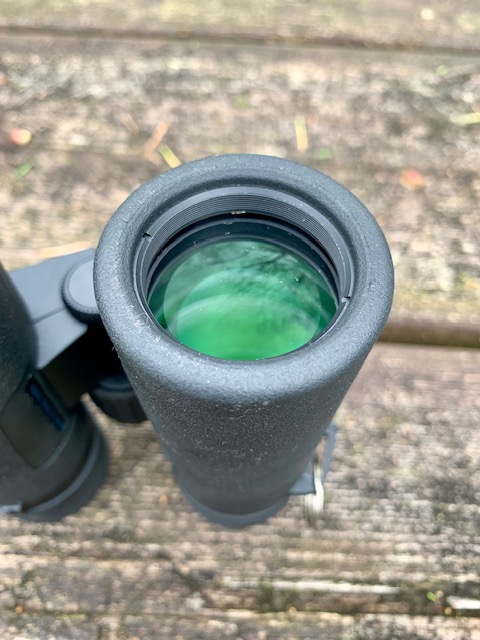
The objective lenses have very evenly applied antireflection coatings which exude a green colour in natural daylight but renders the lenses almost invisible when looking at them head-on. They’re also very decently recessed to protect them from peripheral light and the elements.
The eyepieces are decently large and easy to engage with, and comfortable to press one’s eyes against during prolonged periods of viewing. The right eye dioptre is adjusted using a subtly protruding lever which has an excellent amount of friction, ensuring that it won’t wander while in field use. The twist-up eyecups are rather large and provide 4 positions. I found my optimal setting by twisting the cups down a few millimetres from fully extended which set them in an intermediate position between two locked settings. It was a minor irritation finding and maintaining these settings, but after some practice it came as second nature to me.

Eye relief is generous. I was able to access almost the entire field with my spectacles on and while the cups were fully retracted.
I personally found no difficulty in handling the instrument stably, although those endowed with larger hands might find the little Verano a little cumbersome to use.
In summary, the Opticron Verano BGA VHD 8 x 32 is a joy to handle with a sensible, ‘no frills’ body design that the majority of people will find convenient to use. Good job Opticron!
Optics:
The Opticron Verano 8 x 32 displayed excellent control of internal reflections. I detected none of any significance. Nor was there any diffused light around an intensely bright light source. These results are as good as I’ve seen on any quality optic. Examination of the exit pupils showed great results too: nice dark regions surrounding the circular pupils. From these results I fully anticipated better than average control of glare and stray light. And, as I shall shortly divulge, that’s exactly what my field tests revealed too!

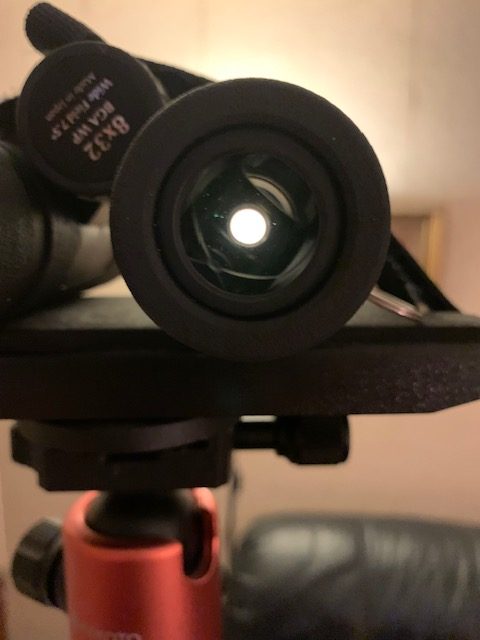
I took an instant liking to the images served up by this binocular: bright, very sharp within a generously wide sweet spot, very accurate colours and excellent correction of off-axis aberrations, particularly pincushion distortion. Glare suppression is also well above average on this unit. Qualitatively, I formed the opinion that the Verano images were very similar to the company’s more expensive Aurora model. Looking back on my notes of the latter showed it had an edge over the Verano in getting rid of that last residual of glare against the light, and had a wider, flatter field owing to its built-in field flattening optics. Indeed with its very conservative field size (7.5 degrees), the Verano can dispense of the need for field flattening optics as the view remains quite sharp even near the field stops. I was able to verify this under the stars when the bright stellar luminary, Vega, remained decently sharp even when placed at the edges of the field. I’m certainly confident that the Verano was indeed assembled on a genuine VHD platform like the Aurora, Opticron’s flagship offering.
Notes from the Field
8 x 30/2 is my favourite binocular format, with a strong preference for Porro prism models over their roof prism counterparts. So it took a little bit of getting used to using a compact roof like the Opticron Verano in the field again, learning how best to hold it in my hands, but practice makes perfect.
The Verano has a very smooth and responsive focus wheel but what I found quite remarkable was the amount of travel it exhibited beyond infinity – more than one full revolution(so more than half its focus travel in fact) – allowing users with severe myopia to engage with the instrument without wearing spectacles. Indeed given this fact, I was especially delighted to see that its close focus distance was a little over 2 metres. For the record, if this feature is not required the focuser could be recalibrated to accommodate much closer focusing distances.
Testing the Verano in a variety of lighting conditions, the quality views kept coming. Its excellent central sharpness allowed me to view small migrant birds such as Pied and Grey Wagtails, at long distance, foraging in sheep fields or combing the shores of my local river, respectively.
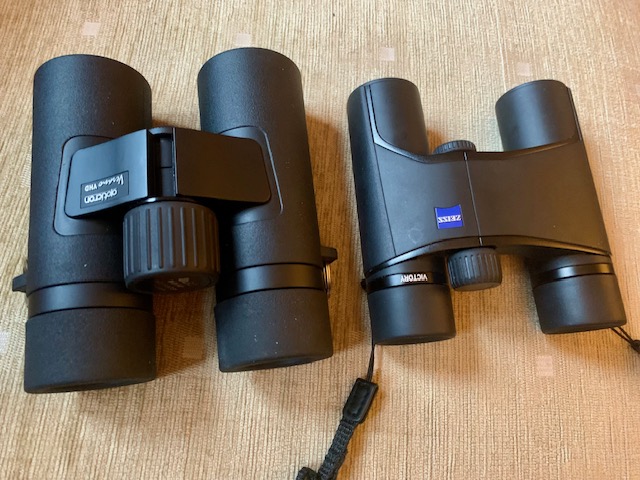
I conducted some visual comparisons of the Opticron Verano with my Zeiss Victory Pocket 8 x 25( a £650 retail value), sporting the same true field of view. The comparisons were very instructive. The Verano displayed very similar central sharpness to the Zeiss. In good light, I perceived the sweet spot in the latter to be slightly larger and had slightly better optical performance against the light but the differences were subtle at best. However, in dull evening light, the greater light gathering power of the Verano pulled it noticeably ahead of the Zeiss, giving it distinct advantages over the smaller instrument under these conditions. These observations served only to consolidate my opinion that the 30/32mm format is more versatile than smaller aperture glasses.
Conclusions & Recommendations

I thoroughly enjoyed test driving the Opticron Verano BGA VHD 8 x 32. I note that this high-quality instrument can be acquired new at values below £300 if you shop around. That represents excellent value for money. What’s more, with Opticron’s 30-year warranty on this product, you can be assured of receiving first class attention should you hit any snags with it. I note also that there are 42mm options from the same series should you prefer this larger format.
Highly Recommended!
My thanks to Gary Murphy for kindly lending me the binocular for field testing.
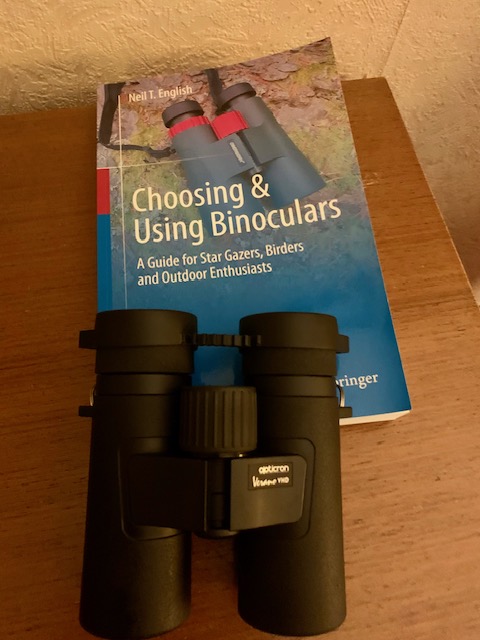
Read about many more binocular models, from the very large to the very small, in my new book: Choosing and Using Binoculars: A Guide for Stargazers, Birders and Outdoor Enthusiasts.
A Work Commenced February 20 2024
Product: Swarovski Habicht 8 x 30 W
Country of Manufacture: Austria
Exit Pupil: 3.75mm
Eye Relief: 12mm
Field of View: 136m@1000m(7.8 angular degress)
Dioptric Compensation: +\_ 5
Close Focus: 3m advertised, 2.68m measured
IPD Range: 56-72mm
ED Glass: No
Light Transmission: 96%
Waterproof: Yes(4m/13 feet)
Fogproof: Yes
Operating Temperature Range: -25C to +55C
Weight: 540g advertised, 536g measured
Accessories: Cordura carry case, neck strap, rain guard, lens cloth, instruction manual.
Warranty: 10 Years(+1 year if product registered online)
Price(UK): £875.00

Anyone with an interest in binoculars and their history will undoubtedly be familiar with the Swarovski Habicht Porro prism binoculars, the company’s oldest continuously developed product line, which began production immediately after WWII. This review will concentrate on arguably the most popular of the Habicht line: the compact and lightweight 8 x 30 W.
First Impressions:

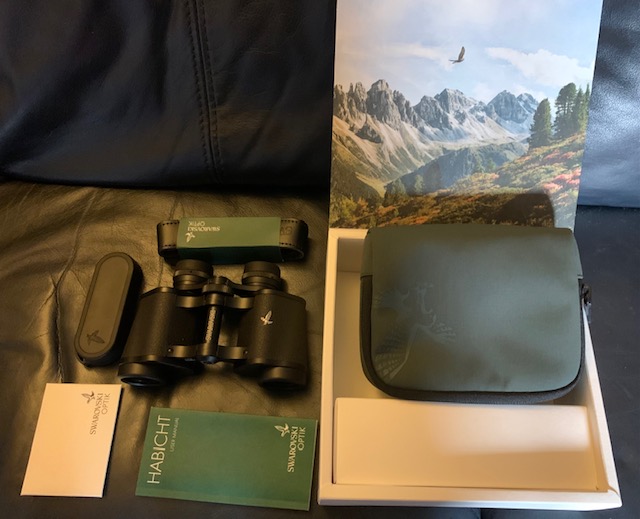
The instrument was bought from a reputable dealer: The Birder’s Store in Worcester. The instrument was dispatched via expedited delivery and arrived within 24 hours of purchasing. The package was delightful: a nice presentation box with a beautiful alpine scene. The instrument was found encased in a lovely green Cordura case together with its rain guard. The package also contained a logoed neck strap, instruction manual and microfibre lens cleaning cloth.

The instrument was immaculately presented with a serial number beginning with the numerals 12 indicating that its year of manufacture was 2022. The rubber eyecups are very comfortable but afford minimal eye relief at 12mm. This didn’t present a problem for me as I don’t wear spectacles while glassing. However, some folk have endeavoured to acquire the longer rubber eyecups that accompany the more heavily armoured GA model for better eye relief.
The focus wheel moves smoothly and very precisely. Just over one revolution clockwise takes you from closest focus to a little bit beyond infinity. Unlike quite a few other reports, I do not consider the focuser on the 8 x 30 W to be overly stiff. Indeed, I very much liked it right out of the case! What I especially appreciated though was the + and – markings on the side of the focus wheel facing the ocular lenses: which allow the user to dial in the approximate focus for objects close at hand and in the middle distance without ever having to look through the instrument!
I was very relieved to see the dioptre compensation ring moves with a fair amount of tension. This means little to no wandering while operating in the field. Indeed it is just about as good as that found on the Nikon EII 8 x 30.

The leatherette armouring on the 8 x 30 W seems more organic to me, less artificial, than that found on the Nikon EII body. It is slightly more elastic and grippy too. It didn’t take me long to find the best way to handle the instrument, which is a joy to hold in one’s hands. Being intimately acquainted with the haptics of the EII 8 x 30, I would say the only significant difference between the two models is the slightly wider spacing between the barrels and the central shaft of the Habicht, making it easier to wrap one’s fingers round. The latter is also a bit more streamlined than the former: a fact confirmed by comparing their weights – 565g for the EII and 536g for the Habicht 8 x 30 W.
The ocular lenses are a little smaller than those found on the Nikon EII and thus are ever so slightly harder to engage with.

The 30mm objective lenses have immaculately applied coatings and are recessed a few millimetres from the binocular frame.

The leather neck strap is a real work of art it must be said, and an absolute pleasure to use. Beautifully crafted from traditional materials it’s adorned with the fetching silvered avian Swarovski logo on either side. Indeed I have yet to see a better neck-strap than this one!

Although I elected not to store the instrument in the supplied green Cordura case for everyday use, it will serve as an excellent travel case when I need it.
All in all, the Habicht 8 x 30 W is a most charming and impressively designed instrument with a great deal of attention to detail immediately in evidence!
Optical Testing:
My first optical tests were to check the collimation and look for internal reflections. Collimation was spot on as my star testing revealed. Directing an intensely bright beam of light from across my living room into the binocular revealed excellent results: just two very insignificant reflections noted with no diffused light or diffraction spikes( the standard result for a Porro). This was a most excellent result indeed!
This was confirmed by glassing a bright, waxing gibbous Moon in the February sky and a bright yellow sodium street lamp after dark, both of which showed the same great results.
Next I took some shots of the exit pupils, which you can see below:


As you can see, both pupils are perfectly round with very little in the way of any false pupils in their vicinity. You can however make out some light leaks well beyond the exit pupils which may be responsible for manifesting some glare and off axis flaring. More on this later.
The view through the Swarovski Habicht is simply out of this world! In careful tests involving my EII 8 x 30, Zeiss Victory Pocket 8 x 25 and a Leica Ultravid HD Plus(UVHDP)8 x 32, it was the clear winner in terms of sheer central sharpness, brightness and contrast. Really quite incredible!
Particularly memorable was a shootout I conducted with a new villager, Davey, who had just completed building a new home overlooking Loch Carron, just a few miles from my home. He recently acquired both an 8 x and 10 x 32 Leica UVHDP, as well as an older Leica Trinovid BN 8 x 32, and invited me up to his place to have a look around. Observing the loch and the surrounding forests from his porch, he got a good chance to compare the views in both the Habicht and his 8 x 32 with their similar sized fields. We both declared the Habicht to have the superior optics but his jaw dropped when I told him that the Habicht was half the price of the Leica!
It makes for wonderful viewing in any kind of lighting conditions, but really excels in dull, overcast lighting where its extraordinary light transmission(an astonishing 96%) pulls it readily ahead of all the competition. Comparing it most carefully to the EII 8 x 30 I would describe the Habicht as peeling off that last layer to reveal its subjects in breathtaking clarity. The field stop in the Habicht is very nicely defined also.
I do want to mention another brief test though. My former student and astrophysics graduate, Joe Stearn, joined me one afternoon with his dad’s Oberwerk SE 8 x 32. Joe reckoned his dad’s instrument was sightly better than his own unit which he left back home in rural Massachusetts. We compared the views and decided they were very close; with the nod going to the Habicht in ferreting out low contrast detail in dull overcast. Like I said before, the Oberwerk SE 8 x 32 with its ED objectives is an exceptional performer but at 800g it’s not a glass you want to carry round your neck all day!
Chromatic aberration is better controlled in the Habicht compared with the EII, particularly off axis, but this might be due to the former’s smaller field of view(7.8 compared with 8.9 degrees in the EII). Pincushion distortion is also vanishingly low in the Habicht, even at the extreme edges of the field, rendering it a most excellent instrument for studying architectural features. The sweet spot on this unit is quite generous: maybe covering the central 60 per cent of the field, after which gentle field curvature gradually distorts the outer part of the field of view. The Habicht has a very uniformly illuminated field though. Moving the gibbous Moon from the centre of the field to the edge revealed little in the way of light drop off. Some lateral colour and a touch of astigmatism were also in evidence by studying the bright star Procyon as it was gradually moved from the centre to the field stops.
Notes from the Field:

Several Habicht 8 x 30 W users have reported that the instrument suffers from excessive glare. I can report that this is grossly exaggerated. Yes, it behaves less well against the light than the Nikon EII or Zeiss Victory but I have never perceived it as excessive with the worst cases easily improved by shielding with an outstretched hand over the objectives. The Habicht does exhibit strong off axis flaring however. Just placing a bright Moon just outside the field of view reveals this fairly easily.
Close focus was measured to be 2.68m: better than the advertised 3m but this can actually be improved owing to the large beyond infinity reach of the existing focus wheel. By resetting the position of infinity closer to the end of its travel, a significantly better near focus value could be obtained. I am aware of a binocular repair company that can provide such a service. For others, the extra focus travel beyond infinity will help severely myopic individuals achieve good infinity focus without wearing glasses.
I have not had any issues with the focus wheel on the Habicht. Reports that it can’t be used for extensive birding activities because of the sluggish movement of focus wheel are also untrue in my experience. I’ve been able to track birds flitting from nearby bushes to trees in the middle distance with no problems at all. In short, it’s called skill and practice makes perfect!
Depth of focus and the wonderful stereoptic view only provided by Porro prism instruments are very similar in both the EII and the Habicht. Indeed they render roof prism models decidedly ‘flat’ in comparison.
Storage:
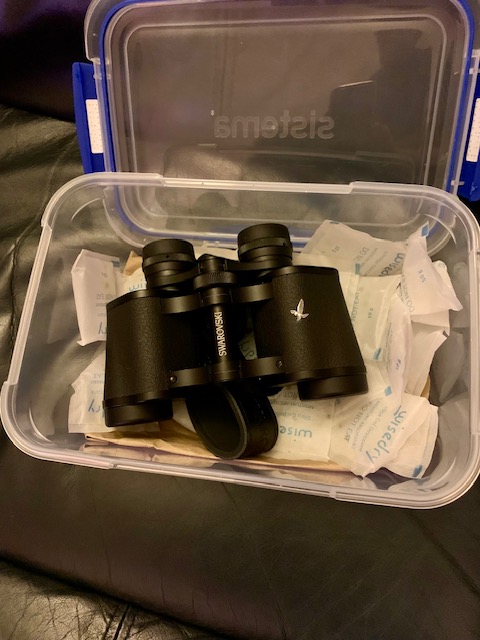
I elected to store the Habicht 8 x 30 W in a dry box: just like all my other non/waterproof Porros. It’s much easier to access the instrument using this set up compared with storing it in the zipped Cordura case supplied with the instrument.
Closing Remarks & Conclusions:

The Swarovski Habicht 8 x 30 W exhibits the best optical performance I have personally experienced in the 30mm/ 32mm binocular format, with ergonomics that don’t fall far behind it. If anything it underscores my conviction that compact alpha roof models are a profligate waste of money. If you’re after world class optics in a small, lightweight and weather resistant chassis, check this binocular out! It will delight its owners with years of peerless optical and mechanical performance.
Very highly favoured!
Neil English’s new book, Choosing and Using Binoculars: A Guide for Stargazers, Birders and Outdoor Enthusiasts, is now available for purchase.