While it is generally true that you get what you pay for, it’s also true that you can pick up very decent optics for not a lot of money. I was very much reminded of this when I test drove the Nikon Aculon A211 7 x 35. This is yet another cost-effective Porro prism binocular from Nikon having a good black rubber armouring, twist-up eye cups and a large central focus wheel. Though it’s not quite as well armoured as Nikon’s more expensive and waterproof Action EX 7 x 35, it is considerably lighter, tipping the scales at just 684g. Indeed, I had no trouble carrying it round my neck for several hours while completing a 10km trek near my home.
The Nikon Aculon A211 7x 35 is a pleasure to use.
The instrument is multicoated ensuring a high light transmission. Indeed, according to tests carried out by allbinos.com, light transmission is close to 80 per cent. Right out of the box, this little Aculon impressed. I had a wee bit of trouble adjusting the dioptre setting as the ring under the right ocular was quite stiff but it eventually yielded. The image is bright and sharp within its sweet spot, which covers the inner 50-60 per cent of the field depending on your degree of accommodation. Contrast is very good too. But what’s most impressive is its huge field of view: 9.3 angular degrees. That’s ideal for surveying landscapes. Eye relief is tight though: that wasn’t a problem for me as I don’t wear glasses while looking through binoculars, but when I did try to engage the view with eye glasses on, I could not see the entire field.
I found that the Aculon had a small amount of glare when the eye cups were fully extended upwards but I was really surprised to discover that I could comfortably access the entire field of view without glasses when they were fully retracted! This will obviously reduce the wear on the eyecups, so extending their functional longevity. But it also had the effect of removing much of the glare I encountered in the open air.
The focus wheel is silky smooth and easy to turn with no backlash or free play. Indeed it felt considerably better than the Action EX 7x 35 I reviewed some time ago. Moreover, of all the different brands of binoculars I’ve tested over the years, Nikon focus wheels have been consistently excellent. The ease with which I could move the focus wheel made this binocular a very enjoyable birding binocular. Indeed, I spent some time watching flocks of Long Tailed Tits flit from tree to tree across the valley. Their mode of flight – in fits and starts – reminded me very much of the way Wagtails navigate during the warmer months of the year. It was so easy to keep up with them, even as they moved off into the distance. The impressive depth of field meant refocusing was an infrequent affair. And that’s got to be a good thing for any birder.
I was impressed by its close focus distance – less than half of the 5m advertised value. The enhanced 3D views through the Nikon Aculon A211 were very memorable, especially when scanning for signs of life inside a densely forested patch near my home. The field curvature actually helps keep closer objects at the bottom part of the field tightly in focus, creating a heightened sense of spatial awareness. This little 7x 35 was a much better fit in my hands than the larger 8 x 42 Aculon I tested prior to acquiring this smaller instrument. Does it have any flaws? Yes. When I turned the binocular on a bright streetlamp after dark I picked up significant internal reflections. It was the same when I glassed a bright, waning gibbous Moon. Bothersome? Yes, a little, but didn’t really detract from the nice, relaxed views I enjoyed during the day. And while the internal reflections detract somewhat from the aesthetic of Moon watching, it’s quite an impressive stargazing binocular. By studying the image of the bright, first magnitude star Rigel, I could see that field curvature and coma are strongly apparent near the field stops but to be honest, there is plenty enough field to thoroughly enjoy the view. Lateral colour was also strong at the edge of the field but nowhere near as bad as what I saw testing the larger 8 x 42 Aculon A211.
I spent 30 minutes enjoying the glories of the Winter sky on Christmas Day. Orion looked magnificent riding high on the meridian, sweeping east into Monoceros where the binocular easily showed the somewhat overlapping NGC 237 and NGC 2244 and even the 8th magnitude M50 to the south was faintly discerned. I also enjoyed sweeping up the three Messier open clusters high overhead in Auriga. The large, expansive field of the little Nikon Aculon 7x 35 made light work of framing all of them inside the same field. I also spent some time in a zero gravity chair sweeping through the wonders of Perseus, Cassiopeia and Cygnus, now sinking low into the northwest sky.
The Nikon Aculon A211 7x 35 in its ultra dry Sarcophagus.
For a binocular that you can acquire for about £100 or less, it’s probably a best buy in my opinion. It does lots of activities well and is great fun to use. If you’re on a tight budget and want decent optical performance in a portable package, go check them out. Indeed, as a firm Porro prism binocular fan, this is such a good bargain that I decided to prepare another ‘Sacrophagus’ for the Nikon Aculon A211 7 x 35; a simple water tight Tupperware container with lots of activated silica gel desiccant inside. This will also render them fog proof, as my tests on higher-end Nikon Porros have shown
Recommended!
Dr Neil English is busy writing a book dedicated to binoculars. Choosing & Using Binoculars: A Guide for Stargazers, Birders and Outdoor Enthusiasts, which will hit the shelves in late 2023.
Coatings: Fully broadband multi-coated, dielectrically coated and phase corrected Schmidt Pechan prisms, hydrophobic and scratch resistant coatings on outer lenses.
Dioptre: Lockable +/- 4 dioptres
Waterproof: Yes 10 mins at 5m depth
Dry Nitrogen Purged: Yes
Weight: 450g
Tripod Attachable: Yes
Dimensions(L/W): 11.9/ 12.6cm
Warranty: 10 years
Accessories: high quality clamshell case (zip closed), high quality logoed padded neck strap, rubber ocular and objective lens caps(2 types supplied), warranty card, instruction manual.
Price: £780- £825(UK)/ $950(US)
The Japanese camera giant, Nikon, also manufacture an extensive range of binoculars and spotting ‘scopes for the growing sports optics market. Much of their less expensive models have now been transferred to China but they still manufacture their best gear in Japan. In this blog, I’ll be providing a comprehensive review of one of Nikon’s top tier binoculars – the Monarch HG – and in particular the 8 x 30 compact model. The binocular was purchased(£840) with my own cash and I have no association with any optics company, so what you’ll get here is a completely impartial opinion on its properties.
Packaging & Ergonomics
The Nikon Monarch HG 8 x 30 arrived in a rather plain looking brown box. Inside, the binocular was nicely housed inside a really high quality zipper-closed clamshell case. Everything was packed away nicely and I was surprised to see that Nikon included two different kinds of objective covers. The first has caps that can be firmly pressed into the objective. The other option is to go without them. In this case, Nikon provide the user with simple rubber covers that protect the ends of the barrels but do not include the tethered ends. Since I’m no fan of tethered caps, I elected to replace them with the sleek rubber covers.
The great quality clamshell case that accompanies the Monarch HG 8 x 30 as well as the ocular and objective covers.
The binocular itself is very nicely finished in a leather-like textured rubber that is quite reminiscent of the BL offerings from Leica. The strong Magnesium alloy body provides light weight(just 450g) but enough mechanical strength to meet the tough demands of outdoor work, yet I was left feeling that the armouring was a bit too meagre compared with the thicker rubber offerings found on the very popular Monarch 7 line. I began to wonder just how durable this covering would be going forward, especially while negotiating thick brush and brambles. Personally I would have sacrificed some of the obvious aesthetic appeal of this armouring in favour of something a little bit more practical and bulky.
The Nikon Monarch HG 8 x 30 has a very attractive textured rubber armouring but is a bit too thin for my liking. Note the made in Japan stamping under the left ocular.
The right eye dioptre is very nicely engineered. To adjust it, simply push it up, rotate to the desired position and push it back down to lock it. Unlike less expensive models which possess a similar kind of lockable dioptre, Nikon’s solution is very firm. And unlike what some of the reviewers above have mentioned, I never experienced a situation where it popped up by accident.
The focus wheel is a work of art. Taking just over one revolution to go from one end of its travel to the other, it is silky smooth and completely backlash free, enabling one to easily use just a single finger to execute precise focus. Neat!
The Monarch HG is fitted with a very high quality focus wheel that moves with perfect smoothness. Just one finger is enough to get precise focus time and time again.
While there are no thumb indents on the underside of the binocular, I found I never really desired them. The longish barrels are easy to get my medium sized hands around and the instrument feels solid and stable to man handle. The stiff, single bridge design works perfectly well with a binocular of this size too, and I was able to engage with it using one hand without any difficulty, thanks to the fairly long barrels. Having said that, I’m not a fan of glassing this way, as two hands are always more stable than one!
The eye cups are properly machined metal, with a soft rubber overcoat. They have three positions and lock firmly in place. That said, I have seen similar quality eyecups on much more economically priced binoculars, such that I didn’t consider those of the Monarch HG to be exceptional in any particular way. For example, I felt they were similar in quality to the Celestron Trailseeker 8 x 32 I reviewed some time ago. With an eye relief of 16.2mm, I could image the entire field without glasses, but couldn’t see all the way to the field stops with my eye glasses on, and with the cups fully retracted.
Optical Evaluation:
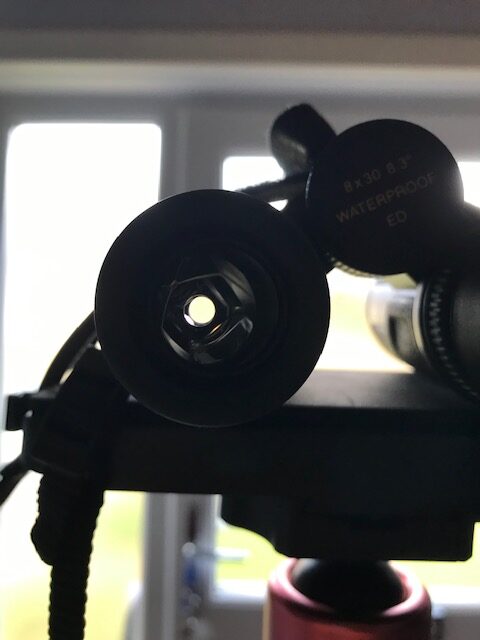
Collimation was spot on, as judged by examining the images of a far distant vista in both barrels. Inspecting the exit pupils, I was less than impressed with the amount of light around the eye box of each ocular, as seen in the images shown below. I expected a little better attention to these details in a binocular marketed as ‘premium.’ For further commentary on this, see the remarks made by the reviewer in Preamble 3 above.
Left ocularRight Ocular
Performing my simple iphone torch test, I directed an intense beam of white light into the binocular and examined the image. I was disappointed to see a fairly pronounced diffraction spike although internal reflections were very well controlled, with no sign of diffused light around the light source. The same spike was present when I turned the binocular on a bright sodium street light after dark. My control binocular – the Barr & Stroud Series 5 ED 8 x 42 – in comparison, showed no diffraction spikes and even better control of internal reflections.
Right from the get go, I was extremely impressed with the brightness and sharpness of the image of the Monarch HG 8 x 30 in bright sunlight and its enormous field of view ( 8.3 degrees checked on the stars). The image sparkled with high resolution details on everything from flowers, tree trunks and distant hills. The image was unusually immersive. Indeed, comparing it to my Series 5 8 x 42 ED, which exhibits a similar true field size(8.1 degrees), I came away with the distinct impression that the HG was delivering a slightly higher magnification than it really was. I have no explanation for this rather wonderful optical illusion but I witnessed it on too many occasions to discount it as not entirely illusory! The image remained impressively sharp across the vast majority of the field thanks to the built-in field flattening technology, with only a minor amount of distortion seen at the field edge. Looking through many layers of fresh mature Sycamore leaves under a forest canopy against a bright overcast sky, revealed virtually no chromatic aberration. Only at the extreme edges of the huge field of the HG did I detect a trace. Depth of focus was very good in the Nikon Monarch HG 8 x 30 but not quite as good as my Leica Ultravid 8 x 20.
Glare was exceptionally well controlled on this unit – better than my control Series 5 binocular in this regard – and that was also the case for veiling glare. This is best tested by looking at some under growth with the Sun immediately above it. Here too, the Monarch HG 8 x 30 bested my Series 5 control – but it wasn’t like a night and day difference.
But despite scoring very high marks optically in many departments, the little Monarch HG 8 x 30 was not without its issues. The most immediate problem I encountered was blackouts, that is, spherical aberration of the exit pupils. I found it very annoying. Indeed, it was not only present while panning with the binocular but it also showed up quite often as I moved my eye around the enormous field while glassing a fixed target. And while one can learn to minimise these blackouts by paying more attention to proper eye placement, I could never really ‘make it go away,’ as it were. Furthermore, the effect was noted by my wife, as well as by several of my students. Looking through my notes on the Leica Trinovid HD 8 x 32, I also recorded some blackouts but they were few and far between in comparison to this Nikon binocular. Nor was this entirely caused by the small exit pupil (3.75mm), as my little Leica Ultravid 8 x 20, with its smaller exit pupil of 2.5mm, is virtually devoid of this problem. I concluded that these pronounced blackouts must have something to do with the special, wide-angle eyepiece design of the Monarch HG. Indeed, the same blackouts were also mentioned by the reviewer in Preamble 4 above using a 10 x 42 Nikon Monarch HG. In addition, I never encountered these blackouts through a Nikon Prostaff 7s 8 x 30, which, despite its identical magnification, objective diameter and exit pupil size to the HG, has a simpler eyepiece design and smaller field of view.
Less serious was the observed rolling ball effect I noted for the first time in my binocular testing career, a consequence of artificially flattening the field. It was quite apparent while panning the edge of a forest at a distance, and gave me somewhat of a queasy feeling. That said, I’m confident I could unlearn this effect with more sustained use.
Further Notes from the Field
A stylish companion in the great outdoors.
Close focus of the Nikon Monarch HG 8 x 30 is very good. While advertised at 2m, I measured a significantly closer focus of 1.81m. The vast majority of targets from 20 feet away all the way out to infinity snap to focus merely by moving the focus wheel through about one quarter of a turn of the wheel. Because the focuser is so soft and smooth, I found this activity to be particularly enjoyable. It really is quite impressive!
The image through the HG is impressively bright, with good enough transmission to allow one to continue to glass well into twilight, but ultimately proving inferior to a decent 8 x 42 in similar low light conditions. Nikon claims a light transmission of 92 per cent, but two spectrophotometric measures on the 8 x 30and 10 x 42 show slightly lower values of 90.1% and 88.3%, respectively. That said, the light curves look almost identical and show a nice, flat profile over the most important visual wavelengths, peaking in the red.
Astronomical Tests
The 8 x 30 format is about the minimum aperture required to really enjoy the night sky. Smaller binos are all well and good for the Moon and some of the brightest deep sky objects, but you go a whole lot deeper moving from 20-25mm up to 30mm. The Moon looks very sharp, bright and colour free through the Nikon Monarch HG 8 x 30, but I did notice a trace of the 4 diffraction spikes emanating from the Moon during waning gibbous under good, transparent conditions.
Testing on a rich star field like the Alpha Persei Association afforded a good opportunity to test for field flatness/curvature. Canvassing the help of a former student of mine and keen amateur astronomer, we noted that the field is not perfectly flat to the field stops in the Nikon Monarch HG. Stars remained very tight out to about 75 per cent of the field, with distortion increasing rapidly in the last 25 per cent of the field. That said, in most situations, the stars remained acceptably sharp over the entire field, so should be an enjoyable companion under the starry heaven.
Moving a last quarter Moon from the centre to the edge of the field of the HG did reveal a small but significant darkening of the maria which provides strong visual evidence for a drop off in illumination in the outer 20 per cent of the field. I found it very difficult to discern these changes during tests conducted in broad daylight.
Conclusions
A birder’s dream bino?
For some folk, the Nikon Monarch HG might well be a birder’s dream binocular, with its very sharp, contrast-rich and extremely wide and flat field of view. For me though, I feel the blackouts are a major issue which would make me somewhat leery of paying the relatively steep retail price for these binoculars. This concern isn’t just confined to the Nikon Monarch HG though, as another reviewer mentioned how the same phenomenon completely put off his daughter while testing the Zeiss Victory SF 10 x 32, so any potential buyers will be strongly advised to try them out before buying. I find it a little alarming that some of the reviewers presented at the beginning of this blog never even mentioned this effect! What’s more, the small size of the Nikon Monarch HG 8 x 30 may not suit those who have large hands. In addition, the rolling ball effect, while mild in this binocular, may deter others in favour of models that do not have field flattening technology. In the end, the decision lies with you!
Thanks for Reading!
Dr Neil English is the author of Chronicling the Golden Age of Astronomy, celebrating four centuries of visual telescopic astronomy.
Make no mistake about it; we live in a golden age for buying binoculars. Never before has the consumer had so much choice available, thanks to incredible advances in optical technology which has given many other individuals access to very decent optics for a small financial outlay. In recent years, new coating technologies have greatly increased light transmission and image sharpness, to such an extent that even the budget models now available can and do outperform premium models offered only a few decades ago. In addition, the incorporation of extra low dispersion(ED) glass is now common even in inexpensive models, which, if executed properly, promises to cut chromatic aberration and increase image contrast still more.
As I’ve commented elsewhere, the 8 x 32 format is the new 8 x 42, as evidenced by the offering of the former by both mass market and premium binocular manufacturers alike. This is in no doubt attributed to their lower mass, improved ergonomics and very efficient light transmission, as well as their perfect suitability during bright daylight but also well into low light situations encountered at the earlier stages of dusk and dawn. Apart from the use of premium pocket glasses – my personal favourite format – the 8 x 32 format has always interested me, owing to its compactness and smaller exit pupil (4mm), which uses the best part of your eye to analyse the binocular image.
While many entry-level ED models are priced in the £250 to £300 range, I became very intrigued by a less well known manufacturer, Svbony, a Hong Kong-based optics firm that has recently marketed a compact and mid-size model – an 8 x 32 and 10 x 42 – chock full of advanced features. But what really piqued my interest was that Amazon UK were offering the 8 x 32 ED model for just £99.99, inclusive of delivery! As you can see from the specifications above, the Svbony 8 x 32 ED has a number of advanced optical features that I simply wouldn’t expect in a model at this price point, but having another binocular available – the Celestron Trailseeker 8 x 32(retail price £146 UK) – that also possesses many of the same features – I was able to conduct an in-depth study of how the Svbony ED binocular compared with it.
Ergonomics Comparison
The Svbony 8 x 32 ED(right) and the Celestron Trailseeker 8 x 32(left).
No doubt you’ve heard that possessing a magnesium alloy frame is a feature only common to upper-tier binocular models, I would like to take this opportunity to put this urban myth to bed, once and for all. Since both the Svbony and the Celestron Trailseeker models feature a magnesium body in this low price category, having this design feature is no longer the preserve of the best models but is now commonly available even in much more economically priced products.
The Celestron Trailseeker has a large plastic focuser that becomes very hard to move in Winter owing to the solidification of the grease used in its gearing. But in warm weather, it becomes much easier to turn. In contrast, the lower priced Svbony 8 x 32 ED has a much higher quality metal focus wheel, which is much smoother and easier to turn. Taking just one and a half revolutions to go from one extreme of its focus travel to the other, I would describe it as slow to progressive in speed, so not especially suited to either birding or hunting – more of a general purpose instrument than anything else.
Turning now to the dioptre ring located under the right ocular in both models, the Svbony’s metal dioptre ring is better designed than the plastic one found on the Trailseeker. Looking at a close up of the Svbony dioptre, you can see that the markings are easier to make out, helping the user achieve his or her optimum position better. And just like the Trailseeker, the Svbony dioptre ring is stiff and thus will not get nudged out of position so easily during field use.
The lower-priced Svbony model has a higher quality dioptre ring compared with the Celestron Trailseeker.
Looking next at the quality of the eyecups, I was delighted to see that the Svbony had good, high quality rubber-over-metal twist up cups, pretty much identical in quality to those found on the more expensive Trailseeker. What is more, they stay rigidly locked in place when fully extended. Yet again, that the Svbony possessed such high quality eye cups was a pleasant surprise to me, as I was not expecting anything as good as that on a compact binocular costing less than £100.
The matt black armouring on the Svbony is a little bit more grippy than the Trailseeker and the ribbing at the side of the former reminds me very much of the armouring found on the Zeiss Terra ED models I’ve sampled.
The ribbed side armouring on the Svbony 8 x 32 ED is very reminiscent of that found on Terra ED models.
The objectives on both the Svbony and the Trailseeker are equally well recessed to protect the glass from dust, rain and peripheral light. The anti-reflective coatings look to be completely different though, with the Trailseeker having a standard greenish reflection in bright daylight, as opposed to the more subdued purple hues seen on the Svbony.
The objective lenses on both models are nicely recessed but appear to have entirely different anti-reflection coatings applied. The Svbony model is at the top.
Overall, the Svbony 8 x 32 ED feels slightly lighter and more comfortable to use than the Celestron Trailseeker 8 x 32, which is a bit more ‘clunky’ in comparison, at least in my medium sized hands. That, together with the noticeably better focus wheel and dioptre ring on the former means that, from a purely ergonomic perspective, the lower-priced Svbony is the clear winner.
Optical Comparisons
Good ergonomics, of course, count for nothing if the optics are not up to scratch, so how well would the £99.99 Svbony 8 x 32 ED fare in comparison to the Celestron Trailseeker 8 x 32? Having reviewed the Trailseeker some time ago, I was quite impressed with how well it handled a beam of intense white light directed into it from my iphone. That’s because the same model is fully broadband multi-coated and has super-high reflectivity dielectric coatings applied to its Schmidt-Pechan roof prisms. I’ve seen similar results on dozens of high quality binoculars and so I expected the Svbony to yield good results too, if indeed it has those same coatings.
My efforts confirmed that the Svbony also passes this test with flying colours! Specifically, the image was devoid of any significant internal reflections and with no diffused light around the beam, which often betrays the use of lower quality optical components introduced into the optical train. What is more, while the Trailseeker did show a weak diffraction spike, the Svbony had none. Indeed, I would place the Svbony slightly ahead of the Trailseeker, based solely on the flashlight test. So far so very good!
But the good news only continued when I performed a daylight comparison test of both the Svbony ED 8 x 32 and the Celestron Trailseeker 8 x 32 . While both models have effectively the same field of view(7.87 degrees), I felt that the Svbony provided a slightly sharper image than the Celestron, with better contrast and improved control over veiling glare. Both instruments have a large sweet spot but edge of field performance was a little soft in both models, as was the degree of field curvature seen. Chromatic aberration, although quite low in the Trailseeker, was better handled in the Svbony under the same conditions. Whatever ED glass elements are present in the Svbony, it seemed to be doing its job well. Depth of focus in the Svbony 8 x 32ED is also good; a real plus if you’re a prospective birder. Close focus is just under two metres(1.98m measured).
Another way to ascertain whether similar coating technologies were applied to both the Svbony and the Celestron Trailseeker, is to perform a low light test by comparing the brightness of the image in both instruments at dusk. On paper, I expected both to behave rather similarly, and that is exactly the result I achieved. Both 32mm models produced a more or less equally bright image, with perhaps the nod going to the Svbony! As I have shown in many other comparisons, the ED element may have conferred a slight advantage to the Svbony in these challenging conditions but as expected, it was marginal if anything.
………………………………………………………………………………………………………………….
Note Added in Proof: If you go back and listen to the optics trade review of the GPO Passion ED 8 x 32 linked to above, the presenter informs us that GPO did not use ED glass in their largest 56mm models, citing their reasons in relation to the lack of chromatic aberration seen in low light environments. If ED glass really had a significant low light advantage, don’t you think they’d mention it or go ahead and use it? And why do so many binocular reviewers(in published magazines too) I have come across still perpetuate this myth?
………………………………………………………………………………………………………………………….
Examining the 4mm diameter exit pupils on the Svbony showed nice, round pupils with no signs of truncation. There was also a nice periphery of blackness immediately around both pupils, which contributes to the high contrast images I detected during my daylight tests.
Exit pupil of the left barrel of the SvBony 8 x 32 ED.And the right eye.
Concluding Comments
The Svbony 8 x 32 ED was a very eye-opening and pleasant experience. In terms of both optical and mechanical properties, it proved superior to the Celestron Trailseeker. Indeed, I would put the Svbony more on par with the new Celestron Trailseeker ED, though I’ve not actually tested this model. The very few realistic reviews I’ve seen of the Svbony 8 x 32 ED claim that it performs like models double or triple the price; a sentiment that I wholeheartedly agree with. And at a retail price of less than £100, there is very little in this binocular that I can find fault with.
Very highly recommended!
Neil English is the author of seven books on amateur and professional astronomy. His next book, Choosing & Using Binoculars: A Guide for Stargazers, Birders and Outdoor Enthusiasts will be published by Springer Nature in late 2023.
Post Scriptum: I performed a measurement of the field size of the Svbony 8 x 32 ED just after local midnight, July 22. Turning to the Plough (Big Dipper) asterism high in the northwest, I was just unable to fit Phecda and Merak into the field of view of the binocular. These are separated by 7o 54′ or 7.9 angular degrees, so I’m confident that the stated field size(7.87o) for this binocular is fairly accurate.