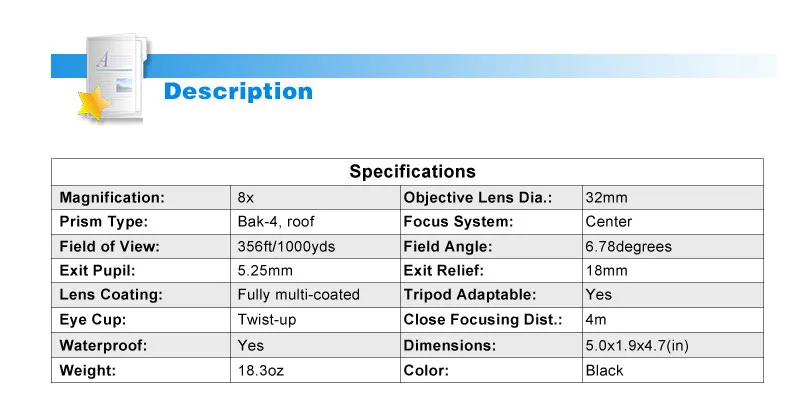
Pentax is a company long synonymous with good optical quality. Over the last few years, I’ve reviewed a few models manufactured by this company, ranging from the very small(6.5x 21) to the very large(20x 60). In particular, I’ve included an earlier incarnation of the 20 x 60 SP model in my own personal arsenal of binoculars, where it’s employed in deep sky observation and regular white light solar observing. So, I was excited to see how its smaller sibling, the 10x 50 SP WP, would shape up in field tests.
First Impressions
I purchased the binocular with my own money and it set me back £170, inclusive of delivery charges. The binocular arrived double boxed, including the instrument itself, packed inside its soft case, together with plastic end caps for both the ocular and objective lenses, a logoed padded next strap and instruction sheet containing information concerning the warranty. The plastic caps that protect the optics of the 10 x 50 SP looked identical to those that accompanied my 20 x 60, and together with the woefully inadequate soft case, represent the weakest links in the entire package. The caps are loosely fitting and invariably fall off when the binocular is picked up. As for the case, it does very little to protect the binocular from serious knocks so should really be upgraded to either a padded soft case or better still, an aluminium hard case to protect your investment.
Ergonomics
Thankfully, my initial impressions of the binocular itself were far more favourable. When I unpacked it, I was immediately struck by its rugged build quality. The binocular weighs in at a hefty 1kg and is covered with a thick layer of synthetic rubber identical to that found on my 20 x 60 . Like its bigger brother, it has a lockable focuser; simply push the wheel forward and it disengages with the internal gearing, preventing the wheel from being moved. Although not an essential feature by any means, I can see where it would come in useful if one observes targets at a fixed distance from the user or when observing the night sky, where all the subjects are located more or less at infinity.
The central focus wheel is very easy to grip and is lockable simply by pushing it forward.
The twist up eyecups are very well made and very comfortable to use. There are three positions; fully down, intermediate and fully extended. Eye relief is a very generous 20mm. Usually, I observe with the eye cups fully extended but I actually found the view to be most comfortable and immersive at the intermediate position without wearing eye glasses.
The very solid twist up eye cups are comfortable to use and have three positions. Eye relief is generous allowing those who wear glasses to fully engage with the entire field.
The ‘WP’ part of its name, I assume, refers to ‘Water Proof,’ with a specified JIS class 6 rating. The instrument is purged with dry nitrogen gas to prevent internal fogging and is O-ring sealed. The dioptre ring is located under the right ocular lens and is negotiated by moving an easy to access lever which can be adjusted clockwise or anti-clockwise. It is reasonably stiff to the touch so should hold its position well. The underside of the 10x 50 SP WP has two large thumb indents for easier hand holding. I found that my thumbs naturally rested in them while holding the binocular up to my eyes.
The focus wheel is very stiff; a strict no-no for birding or any activity that requires rapid focus changes. But for stargazing or for stationary targets located in the distance, it works just fine.
You’ll find two large thumb rests on the underbelly of the binocular for more secure gripping.
Optics
The proof of the pudding, of course, lies in the eating, and this is where this well-made classic Porro prism binocular really shines. The SP series underwent an upgrade from the first generation models, with better multi-layer anti-reflection coatings being applied throughout the optical train. Allbinos tested this modelout and measured a light transmission value of about 85%, which is very good indeed considering the modest price tag on this binocular, as well as the fact that some of the world’s best Porro prism binosachieve about 95% or so.
Not for the Birds
Inspecting the innards of the instrument in broad daylight showed it to be clean and dust free. Setting up my iphone torch to its highest setting in my back garden at dusk and placing it a comfortable distance away revealed a few minor internal reflections and no diffraction spikes or diffused areas; another good result indicating that all was well with the instrument in keeping bright light sources under control. Placing the beam just outside the field of view showed very little ghosting so this will be a good binocular to observe bright objects in the night sky such as the full Moon and stars located near it. It will also garner excellent views of cityscapes at night. Close focus was measured to be about 5.3 metres – a little better than advertised but nothing to write home about. The coatings on the ocular and objective lenses seem to be very evenly applied. In addition, the objective lenses are very deeply recessed which helps protect the optics from the vagaries of the British climate and also cuts down on stray light.
Very evenly applied multi-layer anti-reflection coatings applied to the objectives help transmit a decent amount of light through the optical train.
In broad daylight, the view through the Pentax 10x 50 SP WP is very impressive, with great contrast, good colour rendition and good but not outstanding control of glare. Depth of focus is not bad, but the 3D pop that Porro prism binoculars are famous for was there in spades. Colour correction is excellent, even off axis, where one can detect a small amount of lateral colour. Field curvature is very gentle but does show a fairly minimal amount of pincushion distortion near the field stops. Even though the field of view is fairly narrow at 5 angular degrees, it didn’t feel overly restrictive to my eyes. At just over 1kg weight and delivering a 10x optical boost, these are not binoculars that one could handhold for long but it’s certainly possible to scan the landscape and night sky for a few minutes before some fatigue sets in. These are however, perfect for use on a lightweight monopod or tripod for ultra stable viewing.
Further testing at dusk showed excellent control of internal reflections and clean, crisp images garnered from a bright sodium street lamp. Placing the lamp just outside the field of view showed up no significant off-axis flares. Placing the binocular on a light weight monopod and turning them on the night sky also served up excellent results. Centring the bright Summer luminary, Vega, in the binocular field and focusing in showed a pinpoint sharp image with no secondary spectrum and with no diffraction spikes. Better still, moving the star to the edge of the field induced only a little distortion and some lateral colour(purple fringing), indicating that the aspherical optical element built into the eyepieces of the Pentax SP binocular were doing their jobs well. And while the skies were far too bright to provide a more in-depth study, with strong Summer twilight upon us here in central Scotland, I compared and contrasted the view through the Pentax 10 x 50 and my trusty Barr & Stroud Series 5 8 x 42 mounted on a second monopod. Turning my attention to the well placed Coathanger asterism in Vulpecula revealed a cleanly resolved view in both instruments, but with fainter stars showing up better in the Pentax, albeit in a smaller true field.
Conclusions & Recommendations
In recent years, thanks to great advances in technology, there has been a steady movement within the amateur community towards roof prism designs over older, Porro prism binoculars. But after spending a few weeks testing out this affordable model from Pentax, I was genuinely surprised and delighted by its optical performance. Indeed, you’d have to fork much more money for a roof prism binocular with the same specifications as this Pentax to get the same optical quality. The only real advantage of the roof prism incarnations at 10 x 50 are their lower mass(but not by much) and slightly smaller frames. Having sampled a few inexpensive and mid-priced 10 x 50 roof prism binoculars in the past, I can say hand on heart, that they did not deliver the light transmission values anywhere near those attained by this classic, affordable 10 x 50. Indeed, I would strongly recommend readers to look more closely at tried and trusted Porro prism designs in aperture classes of 50mm or above over the roof prism varieties, especially now that they come with full waterproofing.
Qui bono?
Amateur astronomers looking for quality deep sky views on dark, clear nights, and casual daytime viewers with permanently set-up tripods or monopods surveying targets set in the distance. Remember that five degrees is still plenty good enough for the vast majority of deep sky observing! These would work very well in holiday cottages set by a lake or overlooking a picturesque valley floor. And although they can be handheld for short excursions, they do benefit greatly from mounting.
Very highly recommended!
Dr Neil English has over 40 years experience studying the night sky with all sorts of telescopes, but in the last few years has devoted himself to seeking out bargains for savvy binocular enthusiasts. His highly lauded 650+ page magnum opus, Chronicling the Golden Age of Astronomy, summarises four centuries of telescopic observing, from Thomas Harriot to Patrick Moore.
Raising of the Ink Flag, marking the end of the 1948 Arab–Israeli War. Image credit Wiki Commons.
Originally Posted April 24 2019.
Updated May 23 2021
On that day I raised My hand in an oath to them, to bring them out of the land of Egypt into a land that I had searched out for them, ‘flowing with milk and honey,’ the glory of all lands.
Ezekiel 20:6
Any unbiased reading of the Bible will soon reveal that the Creator of the Universe has had a long and enduring relationship with the Jews. This people group were the first humans to forge a relationship with God, where He made Himself known to them and guided their founding of a nation in a relatively tiny strip of land on the eastern shores of the Mediterranean Sea. The Biblical narrative accurately portrays much of the history of the ancient Jewish nation and modern archaeological research is unveiling more and more details that affirm the historicity of their story, despite militant opposition from secular academics, who have been proven wrong time and time again.
Mlp of Israel and Judah in the 9th century BC. Image credit: Wiki Commons.
Originally the land promised to the Jews by God actually stretched from the Nile to the Euphrates:
In the same day the Lord made a covenant with Abram, saying, Unto thy seed have I given this land, from the river of Egypt unto the great river, the river Euphrates: The Kenites, and the Kenizzites, and the Kadmonites, And the Hittites, and the Perizzites, and the Rephaims, And the Amorites, and the Canaanites, and the Girgashites, and the Jebusites.
Genesis 15:18-21
God explicitly states the extent to which the Jews could legitimately call their land in the Second Book of Moses, called Exodus:
I will set your boundary from the Red Sea to the sea of the Philistines, and from the wilderness to the Euphrates River; for I will hand over the inhabitants of the land to you, and you will drive them out from you.
Exodus 23:31
We also read the same thing in the opening passages of Joshua:
Cross the Jordan River. Lead these people into the land that I am ready to hand over to them .I am handing over to you every place you set foot, as I promised Moses. Your territory will extend from the desert in the south to Lebanon in the north. It will extend all the way to the great River Euphrates in the east (including all Syria) and all the way to the Mediterranean Sea in the west.
Joshua 1:2-4
Because of their unfaithfulness to their God, the former glory of the kingdom established by David and his son, Solomon, was gradually but inexorably wrenched from them because of their reluctance to follow Torah, as well as their eagerness to seek out and worship the false gods of the surrounding nations and the inter-marriage of their nobles with the nobility of foreign cultures(and against God’s wishes). As a result, ancient Israel and Judah suffered many waves of conquests by foreign imperial powers including Assyria, Babylon, Persia, Greece, Rome, Byzantium and the various waves of Islamic invasions over the centuries and millennia. Israel ceased to be a free nation about 2,600 years ago being occupied by foreign powers throughout much of this time.
The Mereneptah Stele, dating to the 13th century BC, has the earliest known reference to Israel as a nation inscribed on it. Image credit: Wiki Commons.
For much of its history, the Jewish people have suffered terrible persecutions under various powers, culminating with the attempt of the evil Nazi regime to exterminate them from the face of the Earth. Still, despite these perils, they have bucked all the odds to maintain their culture and religion; indeed they are the only truly ancient people that exist through modern times. After World War II, the United Nations created a homeland for the remaining Jews, which culminated in the declaration of independence of the modern state of Israel on May 14 1948. The declaration was immediately condemned by all the surrounding Arab nations and was immediately attacked, leading to the Arab-Israeli War (1948-9). No superpowers came to the aid of the young nation but miraculously, the Israeli’s won. Less than twenty years later, Israel was once again attacked by a coalition of Arab nations including Syria, Jordan and Egypt in June 1967. Though attacked on three different fronts and greatly outnumbered in terms of troops, tanks and aircraft, the conflict lasted just six days, with Israel, miraculously, emerging victorious. Thus, Israel had to work hard from the outset to establish its borders, rapidly developing an excellent military machine that staved off aggressive behaviour by its surrounding enemies, and which remains so to this day.
In the 73 years since its founding days, the story of Israel has been one of astonishing prosperity, so much so that many Bible believing Christians accept it as a clear and unambiguous miracle in our times. Furthermore, it is clear that while the majority of contemporary Jews do not accept Jesus as their Messiah, the Lord would not make a complete end of them, but established them again for the sake of a minority who have(or will) come to accept Christ as their Lord and Saviour. Furthermore, the Bible foretells that this tiny little nation will play an important role in converting many unbelievers to the true God during the Great Tribulation period, otherwise known as the time of Jacob’s Trouble.
Most denominational Christians however, have been taught the false doctrine of replacement theology, which assumes that the modern Church has taken the place of Israel, and as a result, know very little about how Israel will play a central role in God’s ultimate plan for the salvation of many people. This was essentially my thinking for most of my life, as I continued in my walk with the Catholic Church, being largely ignorant of Biblical knowledge. We had no Bible in our home(my neighbours had none either), and no Sunday Schools when I was growing up. Indeed, I saved up some pocket money to buy a children’s Bible in my youth and only purchased my first ‘real’ Bible:- an old King James Version:- as a graduate student during my time at the University of Dundee in the mid-1990s. But this is equally true of many Protestant denominations, which teach nothing at all concerning the true role of Israel in God’s redemptive plan for humankind. Only when I began to read the Bible for myself, as a non-denominational Christian, that I rejected the notion of replacement theology.
With the Lord, there is the Church and then there’s Israel; they are not one and the same.
With Israel, it’s personal.
Consider the particular interest our Lord has expressed in the land of Israel;
For the land you are going in to possess is not like the land of Egypt from which you came. There you planted your seed and watered it by foot, like a vegetable garden. But the land you are crossing over to possess is a land of hills and valleys, drinking from the rain of the heavens it drinks in water. It is a land that Adonai your God cares for—the eyes of Adonai your God are always on it, from the beginning of the year up to the end of the year.
Deuteronomy 11:10-12
The prophet Ezekiel writes:
Therefore say to the house of Israel: Thus says the Lord God: Not for your sa ke do I act, house of Israel, but for the sake of my holy name, which you desecrated among the nations to which you came.
Ezekiel 36:22
So what’s it all about then? In a phrase, the execution of Absolute power!
Israel is God’s land; He gave it to the Jews.
The prophet Jeremiah writes:
Thus says the Lord, “If My covenant for day and night stand not, and the fixed patterns of heaven and earth I have not established,then I would reject the descendants of Jacob and David My servant, not taking from his descendants rulers over the descendants of Abraham, Isaac and Jacob. But I will restore their fortunes and will have mercy on them.’”
Jeremiah 33: 25-26
In other words, the Lord would sooner abolish the laws of nature than renege on His promises to Israel.
In Ezekiel 37, God states explicitly that His covenant with Israel is for all time:
I will make a covenant of peace with them; it will be an everlasting covenant. I will establish them and increase their numbers, and I will put my sanctuary among them forever.
Ezekiel 37:26
So let’s take a closer look at the remarkable rise of Israel in the modern psyche. As a nation state, Israel is tiny, with a land area of just 21,000 square kilometres, smaller than Wales(or the US state of New Jersey) and ranking about 150th out of the 200 or so nations on Earth. It’s population is currently 9.76 million, of which 75 per cent identify as Jew. But with antisemitism on the rise worldwide it is estimated that as much as half the entire global population of Jews will be living in Israel by 2030. The Gross Domestic Product (GDP) of Israel is $564 billion, but Its per capita annual income is even more impressive, at $58,2700 per annum, making its citizens the 13th richest nation in the world. Indeed, according to the Economist, Israel was ranked the 4th most successful economy in the world as of 2022. Israel is also home to more millionaires per capita than any other country in the world, with over 7,200 millionaires with collective assets of approximately $45 billion. What’s more, Israel’s economic wealth far exceeds that of all the surrounding (Muslim and non-democratic) nations. The life expectancy of the average Israeli is 83.5 years, where it polls as the 10th longest among the other nations of the world. Israel’s age demographic though is astonishing and contrary to every other developed nation currently in existence. 25 per cent of the population are under the age of 14 and 40 per cent are aged 25 years and younger. Only 11 per cent of the Israeli population is aged 65 years and older!
This very youthful population is also highly educated; 45 per cent of Israeli’s hold a Bachelor’s degree or its equivalent; higher per capita than any other nation on Earth. Their official language is Hebrew, for centuries considered an all but dead language, but thanks to the efforts of Jewish linguists, is now widely spoken and thriving. Curiously, though Israel is one of the most technologically advanced nations currently in existence, her citizens are taught little or nothing about Darwinian evolution in public schools, which dovetails with the ideology’s current fall from grace as a proper science of origins. And yet, Israel is a shining light in the emerging biotechnological and agricultural industries, both of which require an excellent knowledge of the life sciences.
Because of more or less incessant terrorist threats from foreign regimes, Israel has one of the best trained professional armies in the world. The so-called Israeli Defence Forces (IDF) has about 150,000 full-time members and over 400,000 reserves. All Israeli citizens over the age of 18 are obliged to undergo two years and eight months of military service for men and two years for women, although many seek exemptions on religious, psychological and physical grounds. This rise in military power also comports with the Biblical narrative, which describes the desolate land of Israel being revived from a “valley of dry bones”(see Ezekiel 37):
So I prophesied as He commanded me, and the breath came into them, and they came to life and stood on their feet, an exceedingly great army.
Ezekiel 37:10
Despite more than half of the land being desert and only 20 per cent being arable, Israel is a world leader in irrigation technology. In addition, it’s de-salination technology is now being exported to other nations (the US state of California, for example, is now steeply committed to using these technologies). The north of the country receives a plentiful supply of rain but the south is much more arid, with the result that water transport and use is carefully regulated. The statistics are impressive; agriculture’s share of total water use fell from more than 70% in 1980 to 57% by 2005, and is projected to drop to just 52% by 2025, according to a recent report. Many nations around the world have benefitted greatly from Israel’s lead in this regard. Indeed this small nation has become the fruit basket of Europe and the Middle East, growing and exporting over 40 different types of fruit. Indeed, 95 per cent of all Israel’s food is homegrown, supplemented by imports of meat, grains, coffee, cocoa and sugar. Israel also produces most of the flowers sold in Europe(especially during the winter months), with an industry estimated to be worth $60 million. These flowers are almost exclusively grown on 214 hectares of land.
A Lemon grove in the Galilee. Image credit: David Shankbone.
Just as the Bible informs us, Israel has truly become “a land of milk and honey.” Specially bred, disease-resistant cows produce the highest amounts of milk per animal in the world, with an average of 10,208 kilograms of dairy in 2009, according to data published in 2011 by the Israeli Central Bureau of Statistics, outperforming cows in the US (9,331 kg per cow), Japan (7,497), the European Union (6,139) and Australia (5,601). Honey production in Israel is prodigious, with more than 100,000 apiaries scattered across the country and exported to many other nations around the world. And despite the alarming decline in bee numbers in almost every other country, Israel’s bee populations have not endured such decimation, thanks to the implementation of a number of ingenious management strategies. Indeed, the Israeli department of agriculture estimate that the value of their bees as vehicles of pollination is worth more than 30 times the value of the honey they produce! In 1948, only about 400,000 acres of land in Israel could be tilled. Today it stands at over a million acres, with productivity increasing by a factor of 16 per unit of water used. And instead of growing strains of wheat that are waist high, as is the case in most other nations, Israeli farmers cultivate new varieties that only grow to knee height and so require far less water to bring them to maturity.
In the spheres of technology, Israel ranks as the 8th most powerful nation in the world. Outside of Silicon Valley, California, Silicon Wadi on the coastal plains just outside Tel Aviv has the highest number(over 3,000 as of 2019) of IT start-up companies in the world. The first anti-virus software was formulated here, as was the first voicemail technology, and all manner of memory sticks that we use in our everyday lives. Motorola, Microsoft, Celebrite and Intel all have major investments here. The oil industry is booming at an unprecedented rate in Israel with valuable, high-grade crude oil and natural gas reserves found in the Negev, the Golan Heights and most recently off shore in the Leviathan and Tamar fields. Analysts suggest that the energy reserves in these newly discovered sites could power the nation for another 300 years! What’s more, it is expected that Israel will become a major supplier of petrochemicals to the European nations by building under-sea pipelines across the Mediterranean.
In recent years, geologists have assessed Israel’s mineral wealth. In particular the rapidly evaporating Dead Sea has an estimated $5 trillion of minerals salts including, calcium, sodium, magnesium and potassium chlorides, bromides and iodides, phosphates and other resources. Even the mud dredged up from the Dead Sea floor has important medicinal properties that many people will pay for. Moreover, an extremely rare mineral, Carmeltazite, hitherto thought to form only in outer space was recently found in Israel, which, owing to its rarity, is potentially more valuable than diamond.
By most anyone’s standards, the story of the re-birth of Israel is a remarkable phenomenon. Look how much they have achieved in only one human generation! But all of this was foretold in the prophecies of Ezekiel, most likely dated to 7th century BC:
Thus says the Lord God, “On the day that I cleanse you from all your iniquities, I will cause the cities to be inhabited, and the waste places will be rebuilt.The desolate land will be cultivated instead of being a desolation in the sight of everyone who passes by.They will say, ‘This desolate land has become like the garden of Eden; and the waste, desolate and ruined cities are fortified and inhabited.’Then the nations that are left round about you will know that I, the Lord, have rebuilt the ruined places and planted that which was desolate; I, the Lord, have spoken and will do it.”
Ezekiel 36:33-36
And yet, the Biblical narrative also suggests that this new-found prosperity will attract the eyes of power-hungry nations surrounding it, like a proverbial moth to a brightly lit lamp:
After many days you will be summoned; in the latter years you will come into the land that is restored from the sword, whose inhabitants have been gathered from many nations to the mountains of Israel which had been a continual waste; but its people were brought out from the nations, and they are living securely, all of them.You will go up, you will come like a storm; you will be like a cloud covering the land, you and all your troops, and many peoples with you.”
‘Thus says the Lord God, “It will come about on that day, that thoughts will come into your mind and you will devise an evil plan, and you will say, ‘I will go up against the land of unwalled villages. I will go against those who are at rest, that live securely, all of them living without walls and having no bars or gates,to capture spoil and to seize plunder, to turn your hand against the waste places which are now inhabited, and against the people who are gathered from the nations, who have acquired cattle and goods, who live at the centre of the world.’ Sheba and Dedan and the merchants of Tarshish with all its villages will say to you, ‘Have you come to capture spoil? Have you assembled your company to seize plunder, to carry away silver and gold, to take away cattle and goods, to capture great spoil?’”’
Ezekiel 38:8-13
The Bible also asserts that Israel is the centre of the world as God sees things:
Thus says the Lord God, ‘This is Jerusalem; I have set her at the centre of the nations, with lands around her.
Ezekiel 5:5
And when we look at Israel’s geographic location, it indeed lies at the hub of three continents; Africa, Europe and Asia.
The Bible also confidently predicts that Israel will always attract trouble makers and that eventually all the nations will be gathered against her under the auspices of the Anti-Christ:
It will come about in that day that I will make Jerusalem a heavy stone for all the peoples; all who lift it will be severely injured. And all the nations of the earth will be gathered against it.
Zechariah 12:3
The Book of Jeremiah also makes it clear that when the Jews come back in the land after being scattered among the nations, they will do so without the ark of the covenant:
Then it shall come to pass, when you are multiplied and increased in the land in those days,” says the Lord, “that they will say no more, ‘The ark of the covenant of the Lord.’ It shall not come to mind, nor shall they remember it, nor shall they visit it, nor shall it be made anymore.
Jeremiah 3:16
And what do we see today? Israel back in the land without the ark! This was quite simply unthinkable at the time it was written, since it was indispensable to their worship.
What is more, the ancient nation of Israel was divided up into two kingdoms- the northern territory of Israel, and the southern territory of Judah, in the reign of king Jeroboam I, and remained so. But the prophet Jeremiah informs us that when the people come back in the land in the latter days, there would no longer be such an administrative division:
In those days the people of Judah will join the people of Israel, and together they will come from a northern land to the land I gave your ancestors as an inheritance.
Jeremiah 3:18
What is the ‘northern land’ referred to in this verse of Scripture?
It could well be Russia, as some 1.2 million Israeli citizens originated there.
Isn’t the Bible remarkable for its accuracy? Surely, we are living in the times of fulfilled prophecy!
Already, we can see this gradual build-up (a Biblical “hook in the jaw”) with the hatred expressed by the politicians of many countries toward Israel as well as pervasive antisemitism(an irrational hatred of the physical descendants of Abraham, Isaac and Jacob, which is both trans-generational and global in reach). Sadly, one of Israel’s greatest enemies is the United Nations(UN)(Indeed, in light of its abject moral failures – a consequence of abandoning the Biblical God and the overwhelming archaeological evidence for the Jewish right to the land uncovered in recent years – it ought to be renamed the United Nothing). For example, Syria bombs its civilians with chlorine gas, China tortures dissidents, Venezuela restricts access to food, and Burma is engaged in the ethnic cleansing of its Muslim minority. Yet despite these atrocities, the UN Human Rights Council trains the bulk of its diatribe on, you’ve guessed it, Israel!
At the time of writing, 31 UN members don’t recognise the state of Israel. Additionally, the nations of Bolivia, Mali, Mauritania, Niger, Qatar and Venezuela have suspended ties to Israel. Most of these nations do not want the state of Israel to exist. There are also several countries, most notably Egypt, that recognise the state but almost always vote against it. That is how far-reaching the Israeli-Palestinian conflict has become!
The UN has chosen to oppose Israel at nearly every turn because of the influence and encouragement of all of these member states. On the UN security council, Israel has the support of the U.S’s power of veto and is therefore safe from most harmful resolutions, but in the general assembly the anti-Israel countries almost always win out. The most recent example of this was the decision to condemn the United States for recognising Jerusalem as Israel’s capital even though they have every right to claim it as their own. That resolution overwhelmingly passed. But if the UN were nicer to Israel, every Muslim majority country in the world (except Albania and a few others) would withdraw from the organisation and thus would lose all of its influence over the Muslim world. There would be no more peacekeepers in Syria and Iraq, no nuclear weapons inspectors in Iran, etc. To my mind, the UN has strategically chosen to alienate Israel, over dozens of others. As a result, most Israelis are rightly suspicious of the UN to the extent that it’s somewhat of a mystery why they haven’t yet severed all ties with the organisation.
The so-called ‘Palestinian conflict stems from the claim that Palestinians are a valid ethnic group of people who occupied the land along with the Jews. But this claim is a complete lie, as anyone who has studied classical history can attest. Not once is the term ‘Palestine’ referred to in the Bible. Indeed, it actually derives from about 135 AD, when the Roman Emperor Hadrian (reigning from 117-138 AD), who in the aftermath of the Bar Kokhba Revolt, laid waste Jerusalem and ostracised the Jews from the city, re-naming it, Aelia Capitolina after himself(Publius Aelius Hadrianus). Moreover, Hadrian re-named the province, Syria Palaestina, in a derogatory reference to Israel’s ancient and wicked enemies, the Philistines( originating from Greek stock).
Yet it is important to remember that both the UN and the state of Israel were both founded on very similar principles: the exercise of democracy, liberty, national self-determination, as well as freedom from persecution and the respect for basic human rights. But the simple truth is that the vast majority of countries that oppose Israel respect none of these principles, as their actions so clearly demonstrate. Moreover, most of them don’t even care for an independent Palestine either. They just view Israel as a convenient scapegoat. It is tragically ironic that the UN, an organisation that has done so much good for the world, is siding with tyrannical regimes rather than a nation that clearly shares its own values!
This is especially prescient in light of what was witnessed by the world when Israel was condemned by most of the international community who accused them of genocide in the 11-day long war with the terrorist organisation, Hamas, which took place in May 2021. Despite the fact that Hamas initiated the conflict by firing rockets – a few thousand in all – into Israel from the Gaza Strip. The corrupt mainstream media fanned the flames of antisemitism by siding with the Palestinian terrorists, resulting in mass protests and wicked violence against Jews all over the world. Some of the participants in these protests included Biblically illiterate(read clueless), ‘nominal’ Christians. Furthermore, such events are prophesised to escalate as we get closer and closer to the triumphant return of Christ to the Earth.
Sunset on the Mount of Olives, Jerusalem. Image credit; Andrew Shiva.
The Bible also tells us that the people of Israel will not be uprooted again:
I will bring back the captives of My people Israel; They shall build the waste cities and inhabit them; They shall plant vineyards and drink wine from them; They shall also make gardens and eat fruit from them. I will plant them in their land, And no longer shall they be pulled up From the land I have given them,” Says the Lord your God.
Amos 9: 14-15
All of those prophecies have now been fulfilled.
Israel, a vibrant, liberal democracy, is here to stay no matter what evil intentions the goat nations plot against her. This is in spite of the majority of their people’s stubborn unbelief in the true Messiah they had rejected 2,000 years ago. That said, the Messianic Jewish population (who accept Yeshua as their Lord and Saviour) has increased ten-fold to ~30,000 in just a decade! Truth be told, Israel is actually one of the most secular nations on Earth, with Tel Aviv having risen to notoriety in recent years as the gay capital of Europe/Middle East. The Bible addresses the spiritual blindness of Israel in both the Old and New Testaments;
When Jesus had said these things, he departed and hid himself from them.Though he had done so many signs before them, they still did not believe in him,so that the word spoken by the prophet Isaiah might be fulfilled:
“Lord, who has believed what he heard from us, and to whom has the arm of the Lord been revealed?”
Therefore they could not believe. For again Isaiah said,
“He has blinded their eyes and hardened their heart, lest they see with their eyes, and understand with their heart, and turn, and I would heal them.”
Isaiah said these things because he saw his glory and spoke of him.
John 12:36-41
Jesus Christ ascended into heaven from the Mount of Olives in Jerusalem and the Bible tells us that He will once again set foot on it at His second coming, where He will fight against those nations wishing to destroy Israel:
Then the Lord will go forth and fight against those nations, as when He fights on a day of battle. In that day His feet will stand on the Mount of Olives, which is in front of Jerusalem on the east; and the Mount of Olives will be split in its middle from east to west by a very large valley, so that half of the mountain will move toward the north and the other half toward the south.
Zechariah 14:3-4
So, we’re living in exciting times; times that most unbelievers are completely oblivious to; but that too was foretold. Israel is indeed the timepiece for understanding the climactic events in world history.
So keep watching Israel, the Biblical ‘fig tree’ and pray for the peace of Jerusalem(Psalm 122:6), as we are instructed to.
Neil English is the author of a large historical work; Chronicling the Golden Age of Astronomy.
If anyone causes one of these little ones—those who believe in me—to stumble, it would be better for them to have a large millstone hung around their neck and to be drowned in the depths of the sea. Matthew 18:6
The immortal words of Jesus Christ attest to His great love and care for children. He warned us about the grave dangers of indoctrinating young minds to the ways of the world. Yet, our educational institutions, all the way from kindergarten through University, place a maximum emphasis on teaching children that all of the grandeur of the natural world can be explained by known natural laws and actively discourage children from entertaining thought processes that appeal to the supernatural or the divine. But these findings fly in the face of recent research conducted by psychologists that reveal something altogether different:- that young children, irrespective of whether they are brought up by parents in a religious or a secular home, are strongly disposed to thinking that many natural phenomena have been intentionally created by non-human agents or a deity of sorts and, furthermore, ascribe purpose to natural objects. Sadly, by the time children reach adolescent ages, much of this design intuition is suppressed by educational and/or cultural conditioning as they fully engage with our secular societies, teachers and parental influences(1)
Beginning in the late 1920s, the Swiss child psychologist, Jean Piaget, came to some very surprising conclusions about young minds. In particular, he showed that, contrary to popular belief, children are not merely less sophisticated thinkers than adults, they are capable of thinking in radically different ways to adults. In particular, Piaget described children as ‘artificialists,’ who drew their subjective intentional experience to conclude that all things were created by people or intelligent agencies for a purpose(2). As such, Piaget concluded, children are broadly inclined to view natural phenomena, whether living or non-living, in teleological terms. For example, clouds are for ‘raining’ and lions are for ‘keeping in a zoo.’ Furthermore, when Piaget asked children how natural objects originated, they frequently identified ‘God’ as the cause. And not only that, they perceived this God as anthropomorphic, having an overarching authority of its own, like some kind of ‘super parent’ and could even formulate a mental representation of such an agency despite its intangibility to the senses(2).
Intuitive Theists
Piaget’s assertion that young children were incapable of distinguishing between human and non-human causes proved controversial though, and subsequent studies have shown that he was wrong on some of these issues. Young children can, in fact, identify some natural causes. Yet he was correct in saying that children start out with the intuition that the natural world was made for a purpose. Back in 2004, University of Boston child psychologist, Deborah Kelemen, provided strong evidence that young children (4-7 years of age) are “intuitive theists” who are “disposed to view natural phenomena as resulting from non-human design(3).”
Further work conducted by Kathleen Corriveau, also based at Boston University, conducted a study of 66 kindergarten children aged between 5 and 6 years, from religious and non-religious backgrounds(4). In the study, the children were presented with 3 different narratives; religious, historical and fantastical. Across the board, children thought the historical narratives were true. When it came to the religious narratives though, children brought up in religious homes were more likely to accept it as true than their counterparts raised in secular homes. The most striking difference Corriveau et al found came from the presentation of the fantastical narrative, where 87 per cent of the secular kids rejected as false, as compared to only 40 per cent of kids raised in religious homes(4). That said, Corriveau concluded that “religious children have a broader conception of what can actually happen.” What is more, she added, “exposure to religious ideas has a powerful impact on children’s differentiation between reality and fiction.”
What I found most striking is how these child psychologists reacted to their own findings. For example, Kelemen suggested an ‘interventive’ learning program in a storybook format (where have we heard that before?!) to ‘help’ them develop greater ‘scientific literacy’ at an early stage(3). For Kelemen at least, the correct way to think is to uncritically believe in unguided evolution, where the encouragement of religious streams of thought are portrayed negatively, specifically as a form of indoctrination.
Born Believers
Building on these findings of the University of Boston psychologists, Justin L. Barrett, based at the Centre for Anthropology and Mind at the University of Oxford concluded in his recent book, Born Believers, that “children tend to believe that the world has order and purpose and that there is a supernatural element to the origin of this order(5).” Indeed, Barrett further added that, “a child’s playing field is tilted towards religious beliefs.” Furthermore, he raises a very provocative question- what if the indoctrination, as implied by Kelemen, involves teaching children not to believe in God? What if there are tangible benefits to not only nurturing but further developing the ‘intuitive theists’ within every child? In this capacity, Barrett further suggests that religious thinking enriches the imagination and is absolutely vital for contemplating reality itself. After all, even the most ardent materialist would be hard pushed to deny that every now and then, the unusual or even the ‘fantastical’ can and even does happen. Tacit examples include peer-reviewed, clinically documented medical miracles that defy any rational explanation(6). Furthermore, Roger Trigg, a collaborator with Barnett at the University of Oxford’s Ian Ramsey Centre added these comments to Barnett’s findings;
“This project suggests that religion is not just something for a peculiar few to do on Sundays instead of playing golf. We have gathered a body of evidence that suggests that religion is a common fact of human nature across different societies. This suggests that attempts to suppress religion are likely to be short-lived, as human thought seems to be rooted to religious concepts such as the existence of supernatural agents or gods, and the possibility of an afterlife or pre-life(7).”
Clash of Worldviews
These research findings made by psychologists are at direct odds with sentiments popularly expressed by atheists. For example, Richard Dawkins, who has adopted a hard-line stance on raising children with religion stated that we should be instilling in children a healthy degree of scepticism, teaching them that “‘it’s too statistically improbable for a prince to turn into a frog.” The irony has not gone unnoticed on me though, given the stupendous odds of life emerging from lifeless molecules and evolving into higher organisms. Francis Crick, co-discoverer of the three dimensional structure of the DNA double helix, also waded into the same argument when he reminded biologists that they “must constantly keep in mind that what they see was not designed, but rather evolved(8).”
Molecular biologist Douglas Axe at Biola University, in his excellent book, Undeniable; How Biology Confirms our Intuition that Life is Designed, wholeheartedly agrees that children are born believers in a designing intelligence at the heart of living systems but extends it further to include cognitive science. He writes:
“The children whose simple view of life has proved superior to the view endorsed by the Royal Society and the National Academy also have a simple view of consciousness. Their view begins to take shape in infancy, with games like peekaboo where small hands over small eyes form a screen that momentarily isolates the inside world from the outside world…..Through countless learning moments like this, children build a connection between their inside world and the outside world, a connection far more profound than anything technology has given us(9).”
For Axe, the overwhelming richness displayed to us by the outside world is thoroughly complemented by an equally rich inner experience, “almost as if the two were made to go together(9)” So what materialists like Dawkins and Crick are actually saying is that we should completely ignore what is, in reality, intuitively obvious. Axe continues:
“In our childhood, if not since, our design intuition assured us that life could only be the handiwork of God, or someone like him. As universal as this intuition is, though, it is almost universally opposed by the technical experts on life. None of us have been able to erase the intuition but many of us struggle to defend it against this professional opposition – or even to know whether it ought to be defended(9).”
What does all of this smack of? We are, in effect, being asked to believe our lying eyes. At least that’s the way Frank Turek, a leading Christian apologist, sees it. In his book, Stealing from God: Why Athiests Need God to Make their Case, Turek brings his readers’ attention to the mind-boggling complexity of the living cell, replete as they are with molecular machines far in advance of anything humans can currently build. He writes;
“Our brains are the instruments through which we have thoughts, but the thoughts themselves are immaterial products of your immaterial mind. And it is our minds that make us rational, conscious agents, with the ability to make choices(10).” So what does all this mean? According to Turek, “it means that you shouldn’t abandon your common sense intuitions for the nonsense ideology of materialism(10).”
Scientific Language to the Rescue
But Turek also alerts us to another aspect of the design intuition that even secular scientists, unconsciously or not, engage in. And it pertains to the language used to describe the incredible molecular machines operating at the nanoscale in living systems. These are such engineering marvels “that biologists can’t help but describe their parts with engineering names. There are molecular motors, switches, shuttles, tweezers, propellers, stators, bushings, rotors, driveshafts etc. And together they operate with unrivalled precision and efficiency(10).”
What Turek is driving at here is that, regardless of whether the scientists accept or reject design as a real phenomenon in nature, their language compels them to describe it as such. This important point went largely unnoticed until relatively recently, but some scientists have begun to sound the alarm bells. Professor Randolph M. Nesse based at the Center for Evolution and Medicine at Arizona State University had these words to say regarding the state of emotion research;
“….progress in emotions research has been slowed by tacit creationism. By tacit creationism I mean viewing organisms as if they are products of design, without attributing the design to a deity. Few scientists attribute the characteristics of organisms to a supernatural power, but many nonetheless view organisms as if they were designed machine(s(11).”
Nesse urges his readers to be more reflective about couching the language of emotion research in terms of Darwinian materialism, but seems unaware that this ideology is now being ditched by leading life scientists because it simply doesn’t work and has had its day in the sun(12). Seen in this light, Nesse’s arguments seem counterintuitive at worst and self-defeating at best. After all, if the language of design best describes the workings of the human mind or any other living system for that matter, and if it’s perfectly intelligible when couched in those terms, it seems downright silly to me to make active steps to changing it! Worst still for Nesse, by describing living systems in terms of designed artefacts, scientists have opened up a brave new world of biological research called biomimetics, which, as its name implies, seeks to model new engineering structures by mimicking the genius designs at the heart of living things. What’s more, it’s already achieved spectacular success. For example, by studying the antics of swarming honeybees, engineers arrived at novel solutions to designing telecommunications networks, and in studying the complex aerodynamic motions of dragonflies, produced remarkable refinements in drone design.
In a fascinating article by the Blyth Institute(13), author Annie Crawford argues that since teleological(that is, design and purpose in nature) language is so deeply embedded in centuries of biological enquiry, it simply cannot be abstracted away without either partial or complete loss of intelligibility to the audience it is intended to be presented to. Crawford goes further still:
“It is disingenuous,” she writes, “to continue pretending that teleology is or can be divorced from biology. Indeed, it is the teleological character of life which makes it a unique phenomenon requiring a unique discipline of study distinct from physics or chemistry(13).”
In summary then, the design intuition appears to be hardwired into the human psyche, and while it is actively suppressed in our secular educational systems from kindergarten through University, it cannot be entirely eradicated. St. Paul expressed these conclusions with astonishing accuracy in his letter to the Romans:
For since the creation of the world God’s invisible qualities—his eternal power and divine nature—have been clearly seen, being understood from what has been made, so that people are without excuse.
Romans 1:20
What is more, human language reinforces this intuition, irrespective of whether or not we believe in creation or not. The more we learn about the world around us, the more it screams of design. And far from being a hindrance, the design intuition has proven to be spectacularly successful in cutting edge scientific and engineering research.
If it ain’t broke, why even begin to fix it?
References & Bibliography
1. Wells, J., A Child’s Intuition of Purpose in Nature is No Accident; https://evolutionnews.org/2018/06/a-childs-intuition-of-purpose-in-nature-is-no-accident/
2. Piaget, J. The Child’s Conception of the World, Joan and Andrew Tomlinson, trans. (Routledge and Kegan Paul, 1929), 253.
3. Kelemen, D., “Are Children ‘Intuitive Theists’?” Psychological Science 15 (2004), 295–301.
4. Coriveau, K. et al, Judgments About Fact and Fiction by Children From Religious and Nonreligious Backgrounds, Cognitive Science, 39(2):353-82, 2015; https://onlinelibrary.wiley.com/doi/full/10.1111/cogs.12138
5. Barrett, J.L, The Science of Children’s Religious Belief, Simon & Schuster, 2012.
6. Strobel, L., Does Science Support Miracles? New Study Documents a Blind Woman’s Healing, The Stream May 16 2020; https://stream.org/does-science-support-miracles-new-study-documents-a-blind-womans-healing/
7. Humans ‘predisposed’ to believe in gods and the afterlife, Science Daily, July 4 2011, https://www.sciencedaily.com/releases/2011/07/110714103828.htm
8. Crick, F., What Mad Pursuit, (Basic Books, 1988), 138.
9. Axe, D. Undeniable; How Biology Confirms Our Intuition that Life is Designed, Haper One, 2016
10. Turek, F, Stealing from God; Why Atheists Need God to Make their Case; Navpress, 2014
11. Nesse, R.M. Tacit Creationism in Emotion Research; http://emotionresearcher.com/tacit-creationism-in-emotion-research/
12. Behe, M. Citrate Spiral Death: https://evolutionnews.org/2020/06/citrate-death-spiral/
13. Crawford, A. Metaphor and Meaning in the Teleological Language of Biology, https://journals.blythinstitute.org/ojs/index.php/cbi/article/view/55/75
Dr. Neil English is the author of seven books in amateur and professional astronomy. His latest work, Chronicling the Golden Age of Astronomy, shows how, over the centuries, the majority of astronomers held to a strong Christian faith throughout their careers.
In this series of lectures, world-leading synthetic organic chemist, Professor James Tour, takes on an internet troll who claims that scientists have discovered how life got started from simple chemicals on the primordial Earth. In this series of presentations, Dr. Tour explains, in exquisite technical detail, why scientists are really clueless about how life got started.
There is an old adage; you get what you pay for. Though there is more than a grain of truth to this, as I enter my third year exploring and enjoying the binocular market, I have found genuine exceptions to that time honoured maxim. There is such a thing as a great bargain binocular; that is, a solidly made instrument that offers a level of optical performance and ergonomics well above what you’d expect given its modest price tag. I have spoken in the past of the remarkable Barr & Stroud Savannah 8 x 42, which punched well above its weight and left a lasting impression on this author. Here, I am delighted to present to you my evaluation of its higher power sibling; the Barr & Stroud Savannah 10 x 42.
Just a couple of years ago, I was a total binocular virgin, having little or no experience with these optical wonders, save for an honourable mention to an old 7 x 50 Porro prism instrument I acquired in my youth. Little did I know that, like telescopes, the binocular market has undergone a veritable revolution, thanks to astounding advances in technology and a great capitalist, competitive spirit among manufacturers, which collectively have both improved the quality of bargain instruments and driven prices down. As a case in point, take a look at this review, dating back to 2011, of the same 10 x 42 I’m about to assess here. The reader will note its retail price was about £200. Now you can get the same instrument at a significantly reduced outlay; typically just 60 per cent of the 2011 retail price!
The Barr & Stroud 10 x 42 was purchased from a reputable dealer, the Birder’s Store, in Worcester, England. I paid £124.99 for the instrument and it arrived a couple of days after making the purchase. In the past, I have bought many economically priced instruments from Amazon, but discovered that quite a few are what I would describe as greyware; that is, while the price looks good, the products quite often have some optical or mechanical fault that necessitates sending them back and getting a refund. It pays to go to a specialised dealer when purchasing binoculars, especially if you don’t have a chance to test them out in person.
The instrument arrived in perfect nick: I received the binocular, a lens cleaning cloth, a warranty card, a high quality logoed padded neck strap, a generic instruction sheet and a clamshell case.
First Impressions
The Barr & Stroud Savannah 10 x 42 is solidly built for a life in the great out of doors.
Being an identical build to the 8 x 42, the 10 x 42 Savannah is solidly constructed. The polycarbonate body is overlaid by textured green rubberised material that is easy to grip. While other enthusiasts have a tendency to look down on using polymers as the main housing, I personally don’t subscribe to that philosophy, being lucky enough to also own and use instruments that are constructed around aluminium and magnesium alloys. Indeed, I have encountered no hard evidence that instruments with a polycarbonate chassis are in any way inferior to those built around metallic alloys, despite the extensive hyperbole I’ve seen in online advertising and from other reviewers.
The central hinge is reassuringly stiff and maintains the correct inter-pupillary distance once adjusted. Though many of the more sophisticated models on the market have an open bridge design that enables the user to use it single-handedly, I fail to see why this would be important in a 10 x 42, as you’ll most definitely need both hands on deck to get a decently stable image at 10x.
One of the great features of this binocular, and Barr & Stroud instruments in general, are their wonderful focusers. This instrument is no exception; the focus wheel of which is covered in a textured rubber which is silky smooth to operate, with zero backlash, going through just over two full revolutions from one end of its focus travel to the other. Having sampled several binoculars from Barr & Stroud, I know that this is no accident; this company once enjoyed an illustrious history serving the British navy in two world wars, with all manner of optical accoutrement. And even though they have long since ceased to be an independent trader, the company having outsourced all their manufacturing to China, it is clear to me that some of the skills they acquired in putting together highly functional binoculars in the past are still in evidence! What’s more, I would rate this focuser higher than many binoculars I have purchased for a few hundred pounds more!
As you can see from the photo above, the dioptre ring is not located under the right ocular lens, as is the case in the vast majority of roof prism binoculars, but just ahead of the focus wheel. This does make adjusting the right barrel optics considerably easier than its more conventional counterpart, but, for the record, it would be remiss of me not to mention a malfunctioning dioptre ring on a Savannah 8 x 42 I once purchased second-hand.
The twist up eye cups are of very high quality. With two click stops, they hold their position firmly.
Another very nice feature of these economical binoculars is their eye cups. They are made from metal overlaid with soft rubber. They can be extended upwards with two click stops and hold their positions very firmly. Again, I would rate them as well above average, and more in keeping with eye cups I’ve seen on binoculars in the £200 to £250 range.
The objective lenses on the Barr & Stroud 10 x 42 are very deeply recessed. I measured them at about 8mm, which is good news, as this will afford greater protection of the objective in rainy and dusty environs, as well as acting as an effective shielding of stray light.
The objective lenses are very deeply recessed, protecting the glass against rain, dust and stray light.
Optical Testing
Attaching the instrument to a sturdy tripod, I was able to show that it arrived with very good collimation, with only a tiny vertical asymmetry between the left and the right barrels, which the eyes can easily accommodate for. Examining the exit pupil in a bright shaft of light showed that there was no truncation and no stray light leakage inside the field stop.
No truncation of the exit pupil and no stray light inside the field stop.
The good news continued when I performed my iPhone torch light test. Directing an intensely bright beam inside the binocular, and examining the image arriving at my eyes, I was delighted to see what I had reported before about these Savannah binoculars. The image was very clean, with no diffused light, a very subdued diffraction spike and a couple of very weak internal reflections. I deemed the result excellent and only a notch down from the same result I got from my Leica Trinovid HD 8 x 32 binocular, but a tad better than my smaller 10 x 25 Trinovid which cost three times more! Yet again, this excellent control of light leaks is more in keeping with a binocular in the £250-£400 range. Kudos to Barr & Stroud for their exceptional attention to detail in this regard. Examining a bright sodium street light showed no reflections or diffused light either, and the same was true when I turned the binocular on a bright waxing gibbous Moon in a freezing January sky. This binocular will provide lovely views of illuminated cityscapes, with no annoying reflections to contend with.
To remain objective, it pays to carry out all your tests with a high quality ‘control’ binocular…..ken.
After the appropriate adjusting of the right eye dioptre, I began my daylight tests of the Savannah 10 x 42, comparing it carefully to the images served up by my Leica Trinovid 8 x 32. The Barr & Stroud 10 x 42 offers up a very sharp and contrast-rich image across the vast majority of the field of view, with only a little distortion/softness at the edge of the field. Indeed, the field is noticeably better corrected in this binocular compared with other models I’ve tested in the £200-£250 price range. The distortion is more pronounced when panning the glass vertically than horizontally, however, just like all other roof prism binoculars I’ve used in the past. The Leica proved slightly sharper but the differences were subtle at best. The image in the 10 x 42 has a very slightly yellowed appearance in comparison to the Leica, as if a very mild photographic warm up filter had been placed in the optical train, which I did not personally find off-putting. Indeed, it helps accentuate browns and tan colours that little bit better, which imparts a nice aesthetic effect to my eyes.
Looking closely at the contoured bark on a tree trunk a few tens of yards away, I got the distinct impression that the 10 x 42 was delivering slightly more detail than the 8 x 32, a consequence of the higher magnification and larger aperture of its ocular lenses, though this was somewhat negated by virtue of the 10 x 42’s significantly greater weight, which makes keeping the instrument steady considerably more challenging than in the smaller and lower power Leica. Under a bright blue winter sky, I judged the image in the Leica to be slightly brighter than the 10 x 42, a fact that I explained away as being due to my eyes not being able to exploit the slightly larger exit pupil of the 10 x 42 glass under these conditions, as well as its lower efficiency of light transmission.
I observed no chromatic aberration in the centre of the field of the 10 x 42, but did begin to show some lateral colour as a high contrast target was moved off centre to the periphery of the field. The Leica also exhibited the same behaviour even though it does have extra low dispersion glass in one of its objective elements.
During prolonged field use, the position of the dioptre ring on the Savannah 10 x 42 had a tendency to get displaced ever so slightly, as it is all too easy to touch while moving the focus wheel, especially while wearing gloves. Having the dioptre adjustment under the right ocular lens is a better solution in this regard.
Focusing was easier and more responsive with the Leica glass, owing to its state-of-the art central focusing wheel, which is less stiff than the 10 x 42. I suspect though, that with more field use, the stiffness in the latter will subside and become more responsive. Close focus on the 10 x 42 is very impressive. Although the official stats claim 2 metres, I found I could focus down to about 1.75m – a very good result for a 10 x 42 by most anyone’s standards – but nowhere near as close as the Leica Trinovid, which can bring objects just under a metre into sharp focus, a result no other roof prism binocular on the market can achieve!
Depth of focus in the 10x 42 is very good, but not in the same league as the Leica 8 x 32, which was expected given the fact that lower power units tend to have greater focus depth in most real-world situations.
Examining some tree top branches against a bright sky, revealed that veiling glare was very well controlled in the Barr & Stroud 10 x 42 Savannah but maybe just falling a little short of the Leica Trinovid. This is an especially pleasing result in my opinion, as veiling glare can rather easily wash out an otherwise sharp and contrast-rich image. Indeed, the suppression of veiling glare in this economically priced binocular was far better than a few instruments I’ve tested that cost twice or three times more. For example, it is in a different league to that served up by my 10 x 25 Leica Trinovid, which tends to show rather a lot of this under certain viewing conditions.
Observing at dusk allowed me to test out the low light performance of both the Leica Trinovid 8 x 32 and the Barr & Stroud Savannah. This is where I saw the greatest weakness in the latter instrument. Though it did give a brighter image, I was amazed how well the Leica performed in comparison; to my average eyes at least, both instruments were delivering equally bright images well into twilight, with the 10 x 42 only pulling ahead in the last five minutes or so, as dusk transformed into true darkness. This result is attributed to the significantly greater efficiency of the Leica optical components, which transmits 90 per cent of all the light it collects to the eye.
However, under the cloak of darkness, the greater exit pupil and higher magnification of the 10 x 42, as well as its larger objective lenses, made it the easy winner observing a few of the showpieces of the winter sky. The Pleiades was more magnificent in the 10x 42, as was the Hyades, Double Cluster and Alpha Perseii Association. Stars remain sharp and tightly focused across most of the field, with only the extreme edges showing some visible distortion. In contrast to the Leica, the 10 x 42 had slightly more field curvature; something I had also noted during my daylight tests when examining a telephone pole and moving it to the edge of the field in both binoculars.
This is a great Moon gazing binocular too. Its lack of internal reflections and sharp optics deliver a very decent and clean image that will show many craters, mountains valleys and maria on the lunar surface. And don’t forget also, the Savannah can be mounted on a tripod or monopod for added stability, which enables you to see even more details!
Solid Accessories
Not only does one acquire a good binocular in the Barr & Stroud Savannah 10 x 42, but you also get above average quality accessories. The hard-covered clamshell case is a great way to store the instrument while not in use. The soft rubber ocular and objective covers are also a nice touch, as is the quality padded neck strap that comes as standard with the binocular. And if anything malfunctions, the parent company under which Barr & Stroud trades – Optical Vision Limited(OVL) – will repair or replace your binoculars if they fail during normal use. I have personally dealt with OVL in the past and they have always responded rapidly and effectively to any queries I had.
Concluding Thoughts
Reliable companion.
The Barr & Stroud Savannah 10 x 42 delivers very satisfying images that will impress the vast majority of users who look through it. It feels solid in the hands and has a Spartan, no-frills quality about it. For not much more than £100, the instrument delivers optics and ergonomics that punch well above what its modest price tag suggests, with a large sweet spot and good edge-of-field correction. Even the accessories are of very high quality, making this an especially sweet package for the budget conscious, or the frugal naturalist who doesn’t want to spend a small fortune on a state-of-the-art instrument. Finally, as a well-made achromatic binocular, it proves, once again, that good optics don’t need fancy low dispersion glass to deliver an engaging image.
All in all, this gets my highest recommendation as unbeatable value for money!
Thanks for reading!
Dr. Neil English has been using optical instruments for more than 40 years. He is the author of seven books including his magnum opus(650 + pages), Chronicling the Golden Age of Astronomy (2018), celebrating four centuries of visual astronomy, as well as the personalities who shaped the hobby and profession of astronomy as we know it today.
Title: The Story of the Cosmos, How the Heavens Declare the Glory of God
General Editors: Paul M. Gould & Daniel Ray
Publisher: Harvest House Publishers
ISBN: 978-0-7369-7736-4
Price: US $22.99
The heavens declare the glory of God; the skies proclaim the work of his hands.
Psalm 19:1
The night sky is the last great frontier. From a dark country site, away from the lights of towns and cities, the full grandeur of the starry heaven can be enjoyed. It melts even the hardest heart and fills us with awe as we contemplate its vast size, its teeming multitude of effulgent hosts and its great preternatural beauty. But for the Biblical King David, the night sky also presented powerful evidence that a Creator had fashioned it all. As an avid stargazer from my youth and a committed Christian, I have always regarded the majesty of the night sky as a grand expression of the created order.
That’s why my curiosity was piqued when I came across a new book, The Story of the Cosmos: How the Heavens Declare the Glory of God, edited by former schoolteacher and amateur astronomer, Daniel Ray, and philosopher/apologist, Paul M. Gould, who have assembled a stellar line of some of the finest Christian minds across a multitude of disciplines from the sciences, arts, philosophy and theology, united in their conviction that the Universe at large displays the unmistakable hallmarks of order, design and foresight from the microscopic realm of the sub-atomic to the macroscopic world of stars and galaxies; the handiwork of an all-powerful God; the God of the Bible.
The Story of the Cosmos comes at an especially exciting time when Darwinian ideology is being toppled by an avalanche of new science. The origin of life is as mysterious as ever; the more we probe its depths the more complex it becomes. So too is the nature of human consciousness. The book draws upon an exceptionally rich repository of intellectual thought from Aristotle, Plato and St. Augustine in the ancient world, to great Christian thinkers in the modern era including C. S Lewis, Alvin Plantinga, John Lennox and others who have all formulated the same answer to an age old question; why is the cosmos intelligible, rational and ordered? Their answer, arrived at using various philosophic approaches, is that the universe is the way it is because its Creator is also rational and human beings, made in the image of God, are capable, to some degree, of thinking God’s thoughts after Him.
Three chapters in Part I of the book, written by distinguished scientists, Guy Consolmagno, Guillermo Gonzalez and David Bradstreet, respectively, explore another, related question. What was God’s purpose in creating a cosmos that is intelligible to humankind? Their answer is that God has allowed us to be active participants in unravelling the mysteries of His creation and delights in humans figuring things out through the dual virtues of deep, logical thought and scientific experimentation. Our God has spilled his grace upon humankind in such a way that it encourages us to explore the riches of the Universe and to delight in learning something new. Planetary scientist, Dr. Guy Consolmagno, imagines himself studying the precious meteorites in lock step with his Creator, who he imagines is ‘sitting across from him’ in his laboratory, watching as he stumbles on some new insight. Astrobiologist, Dr. Guillermo Gonzales, describes the fascinating details of how our planet, far from being an ordinary world lost in the immensity of space, shows all the hallmarks of super-intelligent design for life in general, but human beings, in particular. He offers fascinating insights into things few people would never even consider. Why can we see the stars? Why is the Earth just right for launching probes into space? Why are we located on the outskirts of an enormous spiral galaxy, where the night sky is dark and transparent? The answer, as Gonzalez explains so eloquently, is that our Creator had it in mind all along to allow humans to come to some understanding of the great power, majesty and glory of His creation. In this sense, when we express awe for the beauty of the night sky, we are, in a certain sense, offering up a prayer to the Almighty. The same kind of enthusiasm is conveyed by stellar astronomer, Dr. David Bradfield, who describes how studying the complex light curves of variable stars is an exciting way to unravel the machinery of God’s creation.
It is not only through the media of science, philosophy and theology that humans have reacted to the created order. Artists too have also responded with their delicate brush strokes. In a wonderful essay by Terry Glaspey, we learn how the great out of doors and the beauty of the night sky inspired artists throughout history to see both the terrestrial and extra-terrestrial realms as a “grand cathedral” wherein the presence of God is palpable.
But all of this naturally raises other questions; what happens when scientists do not pursue the evidence wherever it leads? That’s a fascinating question that is answered by astrophysicist, Dr. Sarah Salviander, who describes in some considerable detail, the consequences of abandoning what I would call Judeo-Christian ways of thinking. Salviander showcases the disputes that arose between the astronomer, Sir Arthur Eddington, and his brilliant Indian graduate student, Subrahmanyan Chandrasekhar (Chandra). Although Eddington admired Chandra’s theoretical achievements, he refused to accept where those conclusions concerning the fate of massive stars (neutron stars and black holes in particular) would lead him. Salviander writes:
The answer is that Eddington fell victim to some combination of the four primordial barriers to understanding that are constantly at work in the minds of every person; limited perspective, misleading emotions, intellectual inertia, and excessive pride……………..Longstanding and popular ideas are often difficult to overcome even when compelling evidence like Chandra’s is presented. And, sometimes people like Eddington experience a lapse in humility that causes them to use their authority to oppose an idea they just don’t like.
pp 94-95.
In similar fashion, the distinguished nuclear physicist, Robert J. Oppenheimer fell victim to the same kind of cognitive dissonance:
A close friend of Oppenheimer’s, the Nobel laureate physicist Isidor Isaac Rabi, believed that Oppenheimer’s abilities as a physicist suffered as a result of his turning away from the beliefs of the Old Testament in favour of the literature of Hindu mysticism. According to Rabi, Oppenheimer was scientifically blinded by an exaggerated sense of mystery and the boundary between the known and the unknown and became incapable of following the laws of physics to the very end. pp 95.
The same resistance to wholly rational and reasonable conclusions about the nature of reality is explored by Christian apologist, Dr. William Lane Craig, who explores the mindset of atheist cosmologists such as Lawrence Kraus, who expects his readers to believe that the Universe came into existence out of nothing, with no material cause or need for a Creator. In particular, he focuses on what Kraus attempts to pass as ‘nothing’ and convincingly concludes, citing sonorous rebuttals by his own scientific peers, that Kraus’ concept of nothing is in fact, a whole lot of ‘something.’
Physicists, Luke Barnes and Alan Hainline, who take a decidedly neutral stance on Christian theism in the book, similarly debunk ill-thought-through statements made by Darwin-thumping atheists such as Richard Dawkins, who famously declared that;
The Universe that we observe has precisely the properties we should expect if there is, at bottom, no design, no purpose, no evil, no good, nothing but blind, pitiless indifference. DNA neither knows nor cares, DNA just is. And we dance to its music.
Unlike Dawkins, whose expertise is in zoology, Barnes and Hainline are actually qualified to comment on the notion of cosmic fine tuning, observing that, at every conceivable level, our Universe provides compelling evidence of being very special indeed. Why? Because if Dawkins’ statement were actually true, our Universe would simply not harbor life, especially conscious human life.
Given the overwhelming evidence for design and purpose in the Universe, how should the atheist or agnostic best respond to it? That question is explored in a thought-provoking essay by Paul M. Gould, who sets out a robust argument for theism based on the reasonable premise that naturalism cannot account for the flourishing of human life. Gould highlights the significant weaknesses of the so-called neo-Humean synthesis, which asserts that all of physical reality can be reduced to its micro-physical parts, in favor of what Gould calls the Aristotelian-Christian worldview, which much more robustly accounts for the properties of the Universe we humans observe in practice as image bearers of God’s character.
It was a great pleasure to read this beautifully composed work of Christian literature. It is timely, thoughtfully written and illustrated, reverent and inspiring, with great apologetic appeal. The Story of the Cosmos is a refreshing oasis for the human soul and deserves a special place in the library of all Christians, sky gazers and curious agnostics alike.
Dr. Neil English is the author of seven books in amateur and professional astronomy. His large historical work, Chronicling the Golden Age of Astronomy, explores the lives of astronomers and how their work often re-affirmed their strong Christian convictions.
The Leica Trinovid HD 8 x 32; a marvellous companion for autumn exploration.
A work begun November 5 2020
The Leica Trinovid HD 8 x 32 has been my constant companion over the last few months, having gone on long days out, both at home, and on vacation to the Scottish borders. It has also been a marvellous instrument in my ongoing exploration of the binocular night sky. It’s one of those pieces of kit that keeps on delivering, time and time again, and while it is expensive as binoculars come, I think it was worth every penny, for reasons that I wish to elaborate on in this blog.
A Blaze of Autumn Glory
The vibrant colours of autumn are a visual gift from the Lord, a pick-me-up before the dull, cold days of winter. They’re meant to be enjoyed and there is no finer glass I’d rather use to explore them. Many Leica aficionados have described the extraordinary vibrancy of reds, oranges and greens they get from their binoculars. For a while, I dismissed that claim as subjective prattle, but having enjoyed the 8 x 32 Trinovid for several months now, I can more fully understand what they meant. And there may be some science to back that up. For example, the opticians at Leica can optimise the colour correction to peak in the green-red part of the visible spectrum, while leaving the blue end less corrected. I see evidence for this using the 8 x 32, since it does show some blue-violet fringing on highly contrasted targets. The fringing is only very slight mind you, and very lovely; in an innocent way; so I think it’s an acceptable compromise.
While the human world is increasingly dark, psychotic and distressing, I make a special effort to get outside and make the most of my free time, enjoying the wonders of creation. Unlike humans, mother nature still behaves as God intended it. The low autumn Sun creates extraordinary light shows, illumining the hills round my home. The contrast in this little Leica binocular really has to be seen to be believed. Its exceptional control of veiling glare produces images that are truly sumptuous to my average eyes. Details just pop. The intricate graining of tree trunks, the contours of exposed rock formations, the stark beauty of ruined farmhouses, castles and water mills – things and places hardly anyone notices have suddenly become worthwhile glassing targets, though I still get the odd funny look from passers by lol.
The exceptional close focus on the Leica Trinovid brings objects a smidgen less than 1 metre away into sharp focus. That’s unmatched by any binocular on the market, with the exception of the Pentax Papilio (with its 0.5m close focus). I have been able to get up-close and personal with rocks by the riverside and succulent autumn berries, and golden leaves glistening in weak sunshine after a shower of rain. The Scots are always moaning about the rain, but it is the key ingredient that creates and maintains the surreal beauty of the Scottish landscape. Long live the wet and the wild!
A Great Birding Binocular
Culcreuch Pond, looking east, with the Fintry Hills soaring in the background.
I’ve found the Leica Trinovid HD 8 x 32 to be the ideal birding binocular. With its 32mm objective lenses, it provides significantly brighter images than the best 25mm pocket glasses, particularly on dull, overcast conditions in the open air and in lower light conditions, such as under a forest canopy. And when the light is feeble, such as at dawn and dusk, the highly efficient light transmission(90 per cent) of the Leica glass really comes into its own, picking off details that elude lesser glasses. The silky smooth and fast central focusing wheel on the Trinovid is particularly well suited to birding, since it’s easy to adjust the focus as birds vary their distance from me. Added to this, is the instrument’s impressive depth of focus, allowing one’s subject to remain in sharp focus over a large range of middle-to-long distances.
My interest in birdwatching really took off during the cruel,in-human lockdowns starting in March earlier this year, and since then, I have continued to learn from books, as well as gaining some solid practical experience in the field. I have fitted new bird feeders in my garden and seed-laden fat balls that have served to lure many an avian species within striking distance. When I joined the RSPB, I was gifted a small bird box which our family has since erected about 2.5 metres above ground level on a conifer tree in the copse to the west of our large back garden. I have high hopes that it will become a cosy nesting place for some small bird come the spring.
The exceptional optical quality of the Leica has allowed me to observe all manner of bird; robins, finches, tits, wrens, tree-creepers, carrion crows, jackdaws, chaffinches, wood pigeons, collar doves and blackbirds, to name but a few, in glorious detail. I have also learned to recognise their distinctive voices, which helps me to pin down more elusive visitors that hide away in the bushes and hedgerows near my home. To date, my most thrilling sighting is a greater spotted woodpecker that keeps a keen eye on the fat ball feeder outside of my office. Having enjoyed all manner of small birds flitting to and fro for most of the time, I was overjoyed to observe one helping itself to a nutritious snack one afternoon in early October. Compared with all the other birds that usually come to visit, this handsome woodpecker, with its black and speckled white plumage and crimson red flank, seemed positively enormous in comparison. Indeed, I thought at one stage that it was going to tear down the fat ball feeder owing to its relatively large size, but all was well. In addition, my Leica was able to make out a small red nape on the bird which revealed to me its male sex. Isn’t that funny; unlike the fairer human sex, male birds are created to be more colourful in general than their female counterparts. Then again, I know some blokes who love nothing more than to dress up in garish, migraine-inducing colours, so maybe the distinction is not as well founded as I had thought lol.
Since then, I have identified another great spotted woodpecker in the large trees on Kippen Road, adjacent to the sports field in the village. They’re such timid creatures though, standing motionless for many minutes high in the canopy, and if it senses a threat, will quickly move to the opposite side of a tree trunk in order to hide. Beautiful birds!
Last year, I reported that a small squadron of magpies had taken up overnight residence in the rowan tree in my back garden. After a couple of months, they moved on., But this year, a couple of magpies have once again come to sleep in the same tree. Lots of folk have taken a disliking to these birds but I have found them to be charming and intelligent. Like Roman legionaries preparing for an overnight camp, I have observed them arriving at dusk, and carefully making their way to the centre of the tree, so protecting themselves from predators. And they’re up and away before dawn!
A pair of magpies resting overnight in the rowan tree.
Culcreuch Pond, about half a mile walk from my home, and featured in the image above, remains a favourite haunt of mine to observe ducks and mute swans that thrive in the small artificial waters immediately in front of the 12th century castle, that up to recently served as a popular hotel and retreat before it was shut down in January of this year, just before the China virus arrived. The beautiful, variegated hues of autumn trees flanking the shores of the pond makes for wonderful glassing opportunities and I’m always on the lookout for the odd grey heron hiding in the reedy shallows, and even a cormorant that took up residence there during the winter months of 2019. Hopefully, I will see one again this year, but so far with no luck.
On a recent October family vacation to a favourite farmhouse holiday cottage on the outskirts of Wigtown, on the Solway Firth, in Southwest Scotland, I was amazed to discover that the town had a little ‘harbour,’ which we had not visited before simply because we always took a different route down to the salt march. Though we’ve been no less than five times over the years, we had no idea that a tower hide had been constructed, dedicated to twitchers and other wildlife enthusiasts, which overlooks a pretty stretch of salt marsh, and which serves as a home to all manner of gull and wading bird. Alas, we only ‘discovered’ the hide on the final morning of our vacation. Thankfully, it was a bright and sunny spell and we were able to share some wonderful views of these creatures before making our way home. It’s amazing what lies right under your nose if you’re not looking for it! Needless to say, this will become a favourite spot for birdwatching on our next trip.
The view from the bird hide.
Extended Walks
At weekends and during our family vacations, I like to take off on longer 4-5 mile walks, exploring forests and hills. There are extensive forested regions near Newton Stewart, Wigtonshire, which provides great days out for families and groups of ramblers, with extensive forest trails to explore, either on foot or on mountain bikes. The feather weight of the Leica Trinovid 8 x 32 binocular allows me to carry it effortlessly through miles of difficult terrain. I am attracted to the riot of life that abide in forests. Fallen trees are a favourite glassing target in good light, where I can explore the vibrant colours of lichens, mosses and fungi that thrive on their rain-soaked surfaces. I have no compelling reason to glass in these places other than the aesthetic appeal of seeing the wondrous complexities of the creation, to activate the visual, auditory and olfactory senses as you wade through mud and decaying autumn leaves underfoot. The exceptionally robust build of the Trinovid lowers my anxiety levels, as I negotiate through bramble bushes and especially dense thickets of vegetation. This is an instrument that will easily negotiate knocks and bumps and still come up smelling of roses.
Interesting forest terrain near Newton Stewart, Wigtonshire.
On our journey home from Wigtown, we hooked up some old friends who live in a charming bungalow overlooking Tinto Hill near the village of Thankerton, Lanarkshire. Tinto soars just over 700m above the surrounding valley and makes for a good hill walk in the Spring and Summer months. But on this occasion, we decided to visit an old Roman fort dating to the Antonine Period in the mid-second century AD. Not much of the fort remains, save an old ditch that one can still walk around. There is also a bath house somewhere near the fort but we never got to see it that afternoon The fort overlooks the valley below, with Tinto imposingly rising to meet the sky on the far side.
Looking down on the valley from the Roman fort outside Thankerton, Lanarkshire, with Tinto Hill in the background.
A striking colonnade of trees leads the way up from the valley floor to the fort and is especially beautiful on a sunny afternoon, when the rich colours of autumn leaves dazzle the eye. One would be forgiven for thinking that the Romans created this too but such trees don’t live that long!
A visually striking colonnade of trees lead the way to the Roman fort.
The Romans had an active presence in Scotland during the High Empire but never attempted a full-scale invasion. The Scots love to pride themselves in claiming that the ancient Celts inhabiting these lands were too fearsome or intimidating for the Roman legions, but having studied Roman history at degree level, I understand that the likely truth is that they decided that it was just not economically viable to completely Romanise the northern part of Britannia. But try telling that to the Scots!
The ditch of the Roman Fort near Thankerton.
There is something really appealing about glassing a valley from a raised vantage. In my mind’s eye, I imagined the lonely vigils of a Roman auxiliary patrolling the turf ramparts of this ancient fort, looking down on the fields below and wondering if some raiding party would attack. What thoughts would have coursed through his mind?
Glassing in wide open terrain like this confers advantages to higher power binoculars. In this capacity, I hope to acquire another smaller Trinovid, the BCA 10 x 25, or a Zeiss Terra ED 10 x 25 in the near future, to enable me to explore this kind of terrain in greater detail.
Things Done Well
The 8 x 32 Trinovid was made for the great outdoors. I have used it in sub-zero temperatures, during the wee small hours of the morning observing the night sky. Even after an hour or so in such conditions, focusing remains silky smooth and precise, and the outer lenses remain fog free. When the instrument is taken in from the cold, some condensation does form on the ocular and objective lenses but disperses very quickly owing to the effective hydrophobic coatings applied to the exterior lens surfaces.
I have also tested the binocular in regard to its water proofing. Sound crazy? Perhaps! I filled a basin full of freshwater to a depth of about 8 inches and submerged the instrument in it, leaving it there for 15 minutes. I observed no air bubbles throughout the duration of that 15 minute episode, and after taking it out of the water and drying it at room temperature, I was delighted to see that it performed as good as it ever has. This little Trinovid is actually water proof to a depth of 4 metres, so my testing in this regard was rather modest. I suspect that many binoculars of lesser quality than this Trinovid are not really waterproof since they are not hermetically sealed. That’s just a hunch but I know of no one who is willing to sacrifice their binocular to the water gods, for fear that they might receive a nasty surprise!
The firmness of the eye cups on the Trinovid are marvellously engineered; certainly among the best in the industry. They offer several settings to accommodate virtually anyone’s taste, and once set in place, they remain firmly in place with absolutely no wiggle room. With lesser quality binoculars, you’re always wondering when and if the eyecups will fail, but with these, you can be 100 per cent confident that they will work flawlessly again and again and again.
Most economically priced binoculars possess eye cups that can’t be removed. In contrast, the Leica Trinovid eye cups can be pulled off to get at trapped grit, sand and other air-borne debris that accumulates under the cups with repeated use. This enables you to thoroughly clean both the ocular lenses and their supporting structures before popping the cups back on again. And when the day comes when the cups finally give up owing to wear and tear, I can call the folks at Leica who will send out replacement caps! Now that’s what I call service!
Unlike cheaper branded binoculars, the Leica Trinovid eye cups can be removed safely to clean the ocular lenses and their supporting structures.
Exploring the Heavens
The Leica Trinovid 8 x 32 has become my constant companion under the stars. In the last few months, I’ve greatly reduced my telescopic observations in favour of binocular surveys. Indeed, I have elected to learn the night sky completely anew using this binocular, choosing a patch of sky within a constellation, and carefully studying each binocular field that I chance upon. I have ‘discovered’ many new asterisms, star clusters and nebulae in this way using the 7.1 degree field of this binocular. The project will likely preoccupy me for years to come, but I derive great joy from it. After spending many decades peering through all manner of telescopes, it is so refreshing to re-learn the constellations using this fantastic binocular. Call it a new lease of life!
I’m very much looking forward to observing the great planetary conjunction of Jupiter and Saturn, which reaches its climax just a few days before Christmas 2020. The Lord created the heavens to reveal His great power and glory. But He also gave us the starry heaven for signs & seasons. I understand this up-and-coming conjunction to be a possible sign that Yeshua foretold his disciples about the times concerning the closing of human history. Indeed, many of the other signs He prophesied have manifested before our very eyes; apostasy & the purging of the Church, a marked escalation in human wickedness which leads to lawlessness, false prophets, pestilences, wars and rumours of wars etc. What is more, the heavens similarly proclaimed the first coming of our Lord two thousand years ago with the Starof Bethlehem, that could well have been another planetary conjunction, a few of which occurred in the year spanning 2 to 3 BC. Like the fading of Betelgeuse last year, I believe the Jupiter-Saturn conjunction could well represent an unmistakable message from our Creator – that He will be returning soon for His Bride.
Even so, come Lord Yeshua!
Neil English is the author of seven books in amateur and professional astronomy, as well as several hundred magazine articles over the past 25 years. If you like his work, why not consider making a small personal donation, or purchasing one of his books. Thanks for reading!
As you may gather, I’ve taken a keen, active interest in testing out binoculars with an aim to providing my readers with good quality products that won’t break the bank. As part of that process, I needed a few entry-level models to compare and contrast them with other products purporting to provide better optical quality. In one transaction, I purchased an Eyeskey labelled 8 x 32 roof prism binocular on August 5 2019 from eBay. It was brand new and set me back £37.79, taking about two weeks to ship directly from China to my home in Scotland.
Here is a photo of what I received:
The Eyeskey Package.
Here is a close-up photo of the Eyeskey binocular; the reader will note the texturing of the armoring and distinctive tripod adaptor cover
The Eyeskey 8 x 32 roof prism binocular.
Here is what it looks like from the ocular end:
Note the plain 8 x 32 & Bak4 Prism labelling on the focus wheel.
And here is a photo of the tethered rubber objective lens covers as well as the thumb indentations on the underside of the binocular:
Note the tethered rubber objective covers and thumb indentations on the Eyeskey.
After inspecting the Eyeskey binocular and its accessories, I recalled another binocular, marketed by a company called Avalonoptics.co.uk, which I had come across in a previous internet search.
Here is Avalon’s 8 x 32 Mini HD binoculars( all images taken from their website):
Here is an image of the entire package:
Here is an image of the writing on the focusing wheel:
Note the thumb indentations on the under side of the barrels on the Avalon:
And here is an image of the tethered objective covers on the Avalon:
Next, I took a look at the specifications of both models.
Both claim to be fully multicoated, are nitogen filled and fog proof, but there is no mention of a phase coating on either model.
There is a few differences in the quoted specifications. The advertised field of view is 6.78 degrees for the Eyeskey and 6.9 degrees for the Avalon model; quite close. Eye relief is quoted as 18mm for the Eyeskey and 15mm for the Avalon, but these figures can often be incorrect or at least misleading(as I will explain in another up-and-coming binocular review). The Eyeskey has an advertised weight of 18.3 oz = 519 grams, whereas the Avalon has a quoted weight of 416 grams.
Weight can also be misleading though, as it can vary according to whether you include the lens covers and strap etc.
The boxes look pretty similar with just different logos on them, same goes for the neck strap and generic instruction sheet.
Now for the price comparison:
Eyeskey 8 x 32: £37.79
Avalon 8 x 32 Mini HD: £119(recently discounted 20% from £149)
Finally, have a look at this youtube presentation of the said Avalon Mini HD binocular here.
Is the Eyskey 8 x 32 model worth the £37.79?
I suppose for what you get it’s a bargain.
But what about the Avalon?
I’ll leave that up to you to decide!
Caveat Emptor!
Update: September 16 2020
I have been monitoring a website that sells Avalon binoculars and noted a number of irregularities that continue to concern me. If you click on this link, you’ll see a model called the Avalon Titan ED 10 x 42. If you scroll through the marketing blurb and the specifications of the binocular, its main feature is ED glass. But there is no mention of phase coatings, type of multi-coating, or dielectric coatings, the material out of which the chassis is constructed etc which I would expect given the very high price of the binocular; a whopping £1099 UK! You will also note that the packaging looks very similar to the Eyeskey model featured above, with a generic (one page) instruction sheet. To say the least, I would have expected far more technical information about such an expensive binocular, especially when it retails for more than top branded models from Zeiss and Leica, for example.
I dispatched an email to the said company a week ago, where I asked why the Titan model(weighing a whopping 1.3 kilos) was so much more expensive than their other models given the very sparse information provided on the website. I received no response. I sent another email to the company yesterday and it too has fallen on deaf ears!
The same website sells Zeiss Terra ED binoculars at greatly marked up prices. For example, the Terra ED pocket ( 8x 25) glass is on sale for £489 UK in comparison to nearly all other retailers( ~£250).
Needless to say I am deeply suspicious of this company and would continue to caution customers to tread carefully in order to avoid disappointment.
Neil English debunks many telescopic myths in his new historical work, Chronicling the Golden Age of Astronomy.
The Christian influence on Western Civilisation will never be erased.
Dominion: How the Christian Revolution Remade the World by Tom Holland
Little Brown 2019
(594 pages, Hardcover $20.79)
As I sat down to collect my thoughts for the review of the distinguished British historian and author, Tom Holland’s latest book, Dominion- How the Christian Revolution remade the World, we are in lockdown, owing to the COVID-19 pandemic that has swept the planet. Deprived of our usual liberties to roam where we will, humanity had risen above the drudgery of government imposed captivity, and shown its better side – if only for a while – helping those who are vulnerable, the sick and the elderly, the poor and the destitute, supporting our health care workers on the front line, raising countless millions of dollars for struggling charities, as well as lifting the spirits of families around the world with songs, stories, games and jests.
The irony of this predicament was not lost on me as I finished the final chapters of Holland’s latest tour de force. The thesis of Dominion is that, despite the west’s departure from Judeo-Christian values upheld for centuries and millennia, and though we largely live in a post-truth society more concerned with feelings than facts, the Christian message still casts a long shadow over the shared values of our contemporary, secular, civilisation. Acts of charity, selflessness, compassion and sacrifice – all of which are deeply anchored in the gospels of the New Testament- were abundantly on display in our societies during this time of crisis.
Drawing on 25 centuries of human civilisation, Holland calls upon a rich depository of ancient, medieval and modern history to drive his point home. Beginning with the Jews, who were the first people to receive instruction from the Creator God of the Bible, Holland contrasts the strict monotheism of Judaism to the polytheism of the surrounding nations. In addition, unlike the idols of silver, gold and fine polished stone used to characterise the gods of other nations, the Biblical God first revealed to the patriarchs was not to be worshipped in like manner. Drawing on the moral laws preserved in the Torah, Holland explores the implications of the Ten Commandments, the sabbath and laws establishing proper sexual relations in this ancient people. These laws and precepts, Holland convincingly argues, though resisted by the Persians, Babylonians, Greeks and Romans, gradually became written on the hearts of what we might call western civilisation in the aftermath of the fall of the Roman world.
The singular life of Christ – an itinerant preacher and healer born and raised in the Roman-occupied territories of Palestine, and subjected to a horrific execution on a Roman Cross – Holland argues, set in motion the greatest revolution in human cultural history the world has ever seen. Indeed, Holland goes so far as to suggest that the ideas conveyed in the New Testament effectively detonated the cumulative wisdom of the ancient world. We are not the benefactors of Greek and Roman civilisation, as many historians have asserted, but of Christendom.
Accordingly, Holland lays out the evidence for this startling conclusion, exploring how the early Christians followed the example of their Lord and Savior through great acts of charity, caring for the sick, the orphaned, the poor and the weak, not to mention heroic acts of martyrdom that shocked and horrified the pagans who lived alongside them. Surviving waves of persecution under tyrannical Roman Emperors, the blood of its martyrs sowed the seed of evangelism in the hearts and minds of both slave and free for the cause of Christ. And instead of stamping the new religion out, such heroism only served to swell its ranks across all tiers of society, from the mega-rich to the abject poor.
After Constantine the Great granted his imprimatur to the Christian religion in the 4th century AD, a golden age of Christian literature blossomed in its wake, including many of the writings of the early Church Fathers – Ambrose, Jerome and Augustine of Hippo, in the western tradition, and Basil of Caesarea, Athanasius of Alexandria and John Chrysostom in the eastern tradition. And after the collapse of the Roman Empire in the west in the late 5th century AD, Christian ecclesia become synonymous with centres of learning. On the precipice of the known world, Christian monasteries preserved the knowledge passed down from classical antiquity and would eventually become the seedbeds for the establishment of the first university towns such as Padua, Bologna, Oxford, Cambridge and Madrid, to name but a few.
Holland explores the long ascent of what would emerge to be the powerful Roman Catholic Church, which came nearest to making the Christian religion truly catholic, or universal, but does not shy away from the problems within the Roman See which eventually led to its greatest schism; the Reformation and Protestantism. Holland displays a nuanced understanding of how key individuals of the Reformation such as Martin Luther, fanned the flames of antisemitism by equating Jews with vermin and calling for their extirpation for the rejection and murder of the true Messiah. How could Luther, who was in lockstep with the beating heart of so many ordinary people, turn out to be a hater of the original People of the Book? Are not all human beings made in the image of God? Whatever the reasons, antisemitism remained alive and well in the centuries that followed, as Holland explores in discussing the persecution of Jews by the Spanish Church throughout the 14th and 15th centuries, and culminating with the Nazi regime which ordered the extirpation of millions of Jews in the years leading up to and throughout World War II.
But antisemitism was just one aberration that emerged from what Holland couches more generally as muddled theology. The same could be said to have occurred with the problem of slavery and racism in general. Holland recounts stories about folk who could look you straight in the eye and tell you that their Bible – in both the Old and New Testaments – condoned slavery in its various forms. And yet, while it’s easy to take a few Biblical verses out of context to justify almost anything, most references to bondservants in the Old Testament do not have the same meanings we ascribe to slavery in our own society. Evidence of this is clear enough in Exodus 23:9 when the Lord warns the people of Israel not to oppress the ‘alien’ and the ‘foreigner’ in the land, and that to remember that they too were once under bondage. Furthermore, St. Paul boldly proclaimed that there is neither slave nor free, neither Jew nor Greek – all are one in Christ Jesus. It was with such convictions that prominent Christians such as William Wilberforce and others -curiously not mentioned by Holland – who provided the abolitionists with the political power to end slavery, first across the British Empire, and later in the New World, especially through the monumental efforts of Abraham Lincoln in the aftermath of the American Civil War. The author revisits racism later in the book in his discussion of the late Nelson Mandela and the thorny issue of apartheid in the Republic of South Africa.
Holland also explores the radical effects of science on the Christian faith, particularly the works of Charles Darwin and his theory of evolution by natural selection. Darwin’s dangerous ideas gave intellectuals who either hated or held the Christian worldview in contempt – Aldous Huxley, Karl Marx, Vladimir Lenin, Andrew Carnegie and Adolf Hitler – plenty of ammunition to show that blind, impersonal and implacable forces shaped the origin and development of all life on earth. And man, long held to be a special creation by God – was merely just another evolved animal. One idea united all these men; if nature was red in tooth and claw, where the fittest only survived, surely human societies had a duty to follow suit. Suddenly the centuries old Christian ideals of compassion, sympathy and charity, respecting all individuals as unique creations of the Godhead, were now being portrayed as vice – deluded and ‘pusillanimous’ – and certainly not how an enlightened mankind ought to behave. And yet, all the while, there were (and still are) Christians who came to accept evolution, they do so ignorantly, since the latest scientific advances, which sadly, are not investigated by Holland in this treatise, are now rapidly and firmly demolishing those claims.
The God of the Bible is the God of love. Shouldn’t love always win? Holland looks at some controversial manifestations of ‘love wins,’ including the rise of homosexuality as an acceptable lifestyle in the modern world and the ordination of women clergy. If life-long monogamous relationships are the Christian ideal, Holland asks, what is so immoral about gay marriage? And if the Bible teaches that men and women are equal but different in the eyes of God, who shows no impartiality, why can’t women deliver sermons from the pulpit? Holland shies away from offering his own opinion on these questions but suffice it to say that a close reading of the Bible condemns all homosexual acts as gross violations of God’s plan for human beings. What’s more, such deviant behaviour has a strong destabilising influence on the nuclear family. And, as to the question of women clergy, St. Paul only offers his opinion (in the negative) rather than stating that it is a decree from Sovereign Lord, and thus is open to fresh debate.
Dominion is a book that deserves to be read by a broad cross-section of society, by people of faith and those of none. And while Holland maintains a decidedly agnostic tone throughout, he is certainly sympathetic to and, I suspect, somewhat in awe of the long shadow the Christian worldview has cast over human civilisation; a shadow that shows little sign of abating in the 21st century.
Dr. Neil English is the author of seven books in amateur and professional astronomy. He also earned a Diploma in Classical Studies from the Open University. His latest historical work, Chronicling the Golden Age of Astronomy, demonstrates how the science of astronomy was profoundly influenced by observers fully committed to the Christian faith.
“Life should not exist. This much we know from chemistry. In contrast to the ubiquity of life on Earth, the lifelessness of other planets makes far better chemical sense.” So writes Professor James Tour, one of the world’s foremost synthetic organic chemists, based at Rice University in Texas. Intimately acquainted with the latest research in prebiotic chemistry, Tour has expressed severe skepticism that a plausible naturalistic mechanism for the origin of life will be found any time soon. But he goes even further:
“We synthetic chemists should state the obvious. The appearance of life on Earth is a mystery. We are nowhere near solving this problem. The proposals offered thus far to explain life’s origin make no scientific sense. Beyond our planet, all the others that have been probed are lifeless, a result in accord with our chemical expectations. The laws of physics and chemistry’s Periodic Table are universal, suggesting that life based upon amino acids, nucleotides, saccharides and lipids is an anomaly. Life should not exist anywhere in our Universe. Life should not even exist on the surface of the Earth.”1
Dr. Tour’s views have surfaced at a time when astronomers have been peering into the depths of space, searching for intelligent signals from hypothetical alien civilizations. Yet although they have been listening for more than half a century, ET has not chimed in. The quest to detect life beyond the Earth is admittedly in its infancy, but the negative results thus far produced have caused more than a few scientists to question the underlying assumptions made by the early pioneers in the quest to find extra-terrestrial life: Frank Drake and Carl Sagan.
Despite what the general media report, there are a number of serious problems with the standard origin-of-life models, for which their proponents have failed to provide good answers. For example, life on Earth requires a source of homochiral molecules, that is, molecules that are capable of rotating the plane of polarized light either to the left (L) or to the right (D). Specifically, life invariably requires L amino acids and D sugars. But so far, chemists have been unable to identify a plausible natural mechanism by which these left- and right-handed biomolecules can be generated at the high level of purity necessary for the first cells to form. Indeed, such molecules can only be synthesised under highly constrained laboratory conditions, using purified (read bought in) reagents, which have little or no relevance to the environment of the early Earth. And while meteorites have been found that contain small amounts of amino acids, they invariably are shown to contain equal amounts of L and D isomers (technically known as a racemic mixture).
In short, no conceivable naturalistic scenario could result in the generation of the large, stable ensembles of homochiral ribose and homochiral amino acids that all naturalistic origin-of-life models require, affirming why no such natural sources have ever been found.2 I recently asked Dr. Tour directly if the problem of homochirality had been solved, and he firmly responded, “No; it is far from solved.”
The Phosphorus Conundrum
The element phosphorus is vital for the proper functioning of living cells, being a constituent of both RNA and DNA, as well as of adenosine triphosphate (ATP), the universal energy currency of all known life forms. But recent work conducted by Cardiff University astronomers suggests that phosphorus could be scarce in many parts of the universe. “Phosphorus is one of just six major chemical elements on which Earth organisms depend,” says Dr. Jane Greaves, and it is crucial to the compound ATP, which cells use to store and transfer energy. Astronomers have just started to pay attention to the cosmic origins of phosphorus and found quite a few surprises. In particular, phosphorus is created in supernovae—the explosions of massive stars—but the amounts seen so far don’t match our computer models. I wondered what the implications were for life on other planets if unpredictable amounts of phosphorus are spat out into space and later used in the construction of new planets.3
The Cardiff team used the UK’s William Herschel telescope, situated on La Palma in the Canary Islands, to measure the levels of phosphorus and iron in the Crab Nebula, a well-known supernova remnant. They compared those figures to measurements taken earlier from another supernova remnant known as Cassiopeia A (Cas A). Their preliminary results proved very surprising. While the measurements of Cas A showed relatively high levels of phosphorus, those from the Crab Nebula showed far lower levels. “The two explosions seem to differ from each other, perhaps because Cas A results from the explosion of a rare type of super-massive star,” said Dr. Phil Cigan, another member of the Cardiff team. “If phosphorus is sourced from supernovae,” added Greaves, and then travels across space in meteoritic rocks, I’m wondering if a young planet could find itself lacking in reactive phosphorus because of where it was born? That is, it started off near the wrong kind of supernova? In that case, life might really struggle to get started out of phosphorus-poor chemistry on another world otherwise similar to our own.4
Re-evaluating the Drake Equation
Ever since the American astronomer Frank Drake introduced his famous eponymous equation in the early 1960s, astronomers have produced widely varying estimates of the number of extant extra-terrestrial civilizations present in the Milky Way Galaxy. Until fairly recently, the estimates varied from 10,000 to a few million. Countering these estimates, some scientists have re-examined the so-called Fermi Paradox, posed by the distinguished Italian physicist Enrico Fermi in the form of a question: If the universe is so large, with innumerable habitable planets, then why have we not detected any sign of ET?
A team of scientists and philosophers based at the Institute of Humanity in Oxford University has taken a new look at the reasoning behind the Drake equation, and found that its optimistic expectations are linked to models like the Drake equation itself. The problem, as these researchers point out, is that all such models “implicitly assume certainty regarding highly uncertain parameters.” Indeed, following an analysis, they concluded that “extant scientific knowledge corresponds to uncertainties that span multiple orders of magnitude.” When these uncertainties are introduced, the outcome is strikingly different: “When the models are re-cast to represent realistic distributions of uncertainty, we find a substantial ex ante probability of there being no other intelligent life in our observable universe, and thus that there should be little surprise when we fail to detect any signs of it.” This result, they assert, “dissolves the Fermi paradox, and in doing so removes any need to invoke speculative mechanisms by which civilizations would inevitably fail to have observable effects upon the universe.”5
Questioning the Mediocrity Principle
Over the past few decades, astronomers have discovered thousands of exo-planets orbiting nearby stars, so that now there is little doubt that the number of planets in the observable universe likely exceeds the number of stars. Exo-planet hunters have discovered that many of these planets orbit their stars within the so-called habitable zone—that narrow annulus around a star that allows for the stable existence of water on a planet’s surface. Nevertheless, as geologist Peter Ward and astronomer Donald Brownlee argued in their highly influential book, Rare Earth; Why Complex Life Is Uncommon in the Universe,6 many of the features of planet Earth that have made it suitably equipped to allow both microbial and complex life to flourish on it over billions of years are likely very rare in the rest of the Universe.
For instance, the vast majority of potentially habitable exo-planets orbit low-mass red dwarf stars, which make up 75 percent of all the stars in the galaxy.7 These stars are much more active than sun-like stars, thus exhibiting higher rates of flaring than does the Sun. Many such stars also generate strong stellar winds that could strip away the atmospheres of their planets.8 And many planets are located so close to their parent stars that they have become tidally locked, meaning that they do not rotate on an axis but constantly present the same face to their stars as they move in their orbits. Yet another issue pertains to the potential of gravitational perturbations of a habitable planet by its neighbouring planets. Even small changes to the orbital characteristics of a planet could extirpate any developing life that might exist upon it. All these conditions raise many problems for the development of any hypothetical life forms on the surface of these planets over long periods of time.
NASA’s Hubble Space Telescope is currently being utilized in a special program called HAZMAT—Habitable Zones and M Dwarf Activity Across Time. And the early results from the program do not look encouraging. Preliminary data on just a dozen young red dwarf stars show that the frequency of flaring is much higher in them than in stars like the Sun; they typically emit flares with energies that are between 100 and 1,000 times higher than those of their elder counterparts. The most energetic red dwarf flares, dubbed Hazflares, are far more energetic than the most energetic flares ever to come from the Sun. “With the Sun, we have a hundred years of good observations,” says Parke Loyd, a member of the scientific team involved in the project.
And in that time, we’ve seen one, maybe two, flares that have an energy approaching that of the Hazflare. In a little less than a day’s worth of Hubble observations of these young stars, we caught the Hazflare, which means that we’re looking at superflares happening every day or even a few times a day.9
So-called super-earths—worlds larger than the Earth but smaller than Neptune—have recently been identified as possible candidate worlds for the development of life, but there is as yet no scientific consensus on whether they can maintain or even allow plate tectonic activity to occur in their crusts. Without plate tectonics, there will be far less efficient nutrient re-cycling, which would greatly hinder the flourishing of hypothetical life forms.
In March 2019, a team of astronomers based at the Australian National University dealt yet another blow to the prospects of finding viable exo-planetary biosystems. Modelling the magnetic fields of a large number of exo-planets, the astronomers concluded that planets with a strong magnetic field, like Earth, are likely to be very rare. “Magnetic fields appear to play an essential role in making planets habitable, so I wanted to find out how Earth’s magnetic field compared to those of other potentially habitable planets,” says Sarah Macintyre, the lead author of the paper.10 “We find most detected exo-planets have very weak magnetic fields, so this is an important factor when searching for potentially habitable planets,” she added.
Life on Mars or Venus?
Scarcely a year goes by without the question arising of whether or not Mars has microbial life. This issue was brought into sharp focus in June 2018, when NASA scientists announced the discovery by the rover Curiosity of organic matter in the soil of an ancient lakebed.11 But “organic matter” means different things to different people. Simply put, matter that is carbon-rich is not necessarily derived from biogenic sources.
More broadly though, if evidence of either extant or past life on Mars is uncovered, it might well also be discovered that such life originated on Earth. Indeed, it is estimated that over the 4-billion-year history of life on Earth, so much terrestrial soil has found its way to Mars that the Red Planet can boast an average of 2 kilograms of terrestrial soil per square kilometre of its surface (or about 11.3 pounds per square mile).12 It is certainly possible that some microbial life was delivered there along with the soil—in fact, the discovery of either extant microbial life or microfossils on Mars or the recent claim of life in the clouds of Venus might well be anticipated. If that happens, astrobiologists will need to consider the possibility that it came from Earth before claiming that any such life originated on these worlds. The popular media, pushing sensationalism, would never be so cautious.
Questioning Biosignatures on Exo-planets
Oxygenic photosynthesis by plants is the mechanism that produces the vast majority of the molecular oxygen in the terrestrial atmosphere. So for several decades, astrobiologists have speculated that the detection of oxygen in the atmosphere of an exo-planet would provide good evidence that life must exist there.13 While the detection of substantial levels of this gas would certainly be suggestive of the presence of plant life as we know it, it pays to remember that there are established abiotic mechanisms (mechanisms derived from non-living sources) that also can generate substantial molecular oxygen.
A group headed by Chinese astronomer Feng Tian of Tsinghua University published two interesting papers in 2009 that show that stars having less than 50 percent of the mass of the Sun (i.e., the majority of stars) emit copious quantities of hard UV rays and soft X rays throughout their long nuclear burning phases of up to 10 billion years.14 They also showed that when a lifeless exo-planet possessing carbon dioxide in its atmosphere is irradiated, the rays can break down the CO2 into carbon atoms and molecular oxygen. Over time, the carbon atoms, being less massive, escape into space, leaving the molecular oxygen behind. Tian’s calculations show that this molecular oxygen can reach concentrations of a few percent and so might be confused with a genuine biosignature.
When a team of chemists from Johns Hopkins University simulated the atmospheres of exo-planets beyond the solar system, they found that they could create simple organic molecules and oxygen under various scenarios without the mediation of life.15 “Our experiments produced oxygen and organic molecules that could serve as the building blocks of life in the lab, proving that the presence of both doesn’t definitively indicate life,” says Chao He, assistant research scientist in the Johns Hopkins Department of Earth and Planetary Sciences. “Researchers need to more carefully consider how these molecules are produced.” Up-and-coming missions, such as the highly anticipated ones utilizing the James Webb Space Telescope, would need to take results like these into account before jumping to any firm conclusions about the habitability of a candidate planet. As a case in point, the recent flap in the media about the detection of phosphine on Venus, upon further analysis, showed that the biomarker in question was not, in fact, present in statistically significant levels.
In a recent development, a team of planetary scientists led by Li Zeng at Harvard University estimated that as many as 35 percent of exo-planets may have impenetrable water oceans hundreds of kilometres deep.16 But while NASA has long adopted the mantra, “follow the water,” the same scientists caution that these planets are very unlikely to be habitable. Their fathomless ocean worlds would generate pressures millions of times greater than those found on Earth, resulting in exotic, rock-like ice formations many kilometres deep (such as ice VII) covering their floors. Such conditions would prevent any nutrient recycling from occurring, thus rendering these planets sterile.
Call for Caution
Investigating whether extra-terrestrial life exists or not is a profoundly important and interesting scientific endeavor, but at this point, there are good grounds for remaining skeptical about whether it actually exists. Given the arguments raised in this article, it is entirely reasonable to think that life might be extraordinarily rare in the universe, perhaps even unique to Earth. Only time will tell.
Notes
James Tour, An Open Letter to My Colleagues (August 2017): http://inference-review.com/article/an-open-letter-to-my-colleagues.
Hugh Ross and Fazale Rana, Origins of Life (RTB Press, 2014).
“Paucity of phosphorus hints at precarious path for extraterrestrial life” (Apr. 4, 2018): eurekalert.org/pub_releases/2018-04/ras-pop040318.php.
Ibid.
Anders Sandberg et al., “Dissolving the Fermi Paradox” (June 8, 2018):
https://arxiv.org/pdf/1806.02404.pdf.
Peter D. Ward and Donald Brownlee, Rare Earth; Why Complex Life Is Uncommon in the Universe (Copernicus Books, 2000).
“Superflares from young red dwarf stars imperil planets,” NASA News (Oct. 22, 2018):
O. Cohen et al., “Magnetospheric Structure and Atmospheric Joule Heating of Habitable Planets Orbiting M-Dwarf Stars,” Astrophysical Journal 790 (July 2014): doi:10.1088/0004-637X/790/1/57.
Ibid., note 7.
“Strong planetary magnetic fields like Earth’s may protect oceans from stellar storms,” Royal Astronomical Society (Mar. 14, 2019): https://m.phys.org/news/2019-03-strong-planetary-magnetic-fields-earth.html.
Jennifer L. Eigenbrode et al., “Organic Matter Preserved in 3-Billion-Year-Old Mudstones at Gale Crater, Mars,” Science 360 (June 8, 2018): https://doi:10.1126/science.aas9185.
Ibid., note 2.
Carl Sagan et al., “A Search for Life on Earth from the Galileo Spacecraft,” Nature 365 (Oct. 21, 1993): nature.com/articles/365715a0.
Feng Tian, “Thermal Escape from Super Earth Atmospheres in the Habitable Zones of M Stars,” Astrophysical Journal 703 (Sept. 2, 2009): https://dspace.mit.edu/bitstream/handle/1721.1/96200/Tian-2009-THERMAL%20ESCAPE%20FROM.pdf;sequence=1; Feng Tian et al., “Thermal Escape of Carbon from the Early Martian Atmosphere,” Geophysical Research Letters 26 (Jan. 31, 2009): https://agupubs.onlinelibrary.wiley.com/doi/full/10.1029/2008GL036513.
Chao He et al., “Gas Phase Chemistry of Cool Exoplanet Atmospheres: Insight from Laboratory Simulations,” ACS Earth Space Chemistry (Nov. 26, 2018): https://pubs.acs.org/doi/10.1021/acsearthspacechem.8b00133.
Li Zeng et al., “Growth model interpretation of planet size distribution,” PNAS (Apr. 29, 12019): pnas.org/content/early/2019/04/23/1812905116.
Neil English has been following developments in pre-biotic chemistry and astrobiology for the last 25 years. He holds a Ph.D. in biochemistry and a BSc(Hons) in physics & astronomy. His latest book, Chronicling the Golden Age of Astronomy (Springer, 2018), explores four centuries of visual astronomy. The article first appeared in Salvo Magazine Summer 2019. You can support his ongoing work by making a small donation to his website. Thanks for reading!