A Work Commenced July 9 2026
Product: Hawke Frontier EDX 8 x 25
Country of Origin: Designed in the UK, assembled in China
Chassis: Rubber armoured Magnesium Alloy chassis
Exit Pupil: 3.13mm
Eye Relief: 16mm
Field of View: 140m@1000m(8.0 angular degrees)
Close Focus: 1.55m measured
Dioptre Compensation: +\-4
ED Glass: Yes
Field Flattening Optics: No
Coatings: fully broadband multicoated, dielectric phase correction coating on prisms, hydrophobic coatings on outer lenses
Waterproof: Yes
Nitrogen Purged: Yes
Weight: 305g measured
Accessories: Padded neck strap, rainguard, objective lens covers, lens cloth, soft pouch, hard carry case, instruction manual
Warranty: No Fault Lifetime warranty
Price(UK): £299.00
I’ve had this little binocular for just a couple of weeks, but I’ve decided to expedite the review as I’m so thoroughly impressed with it!
I must admit to having a love/hate relationship with pocket binoculars. Sure, they’re small and cute, ‘take me anywhere’ optics. But they’re also fiddly to set up and use and usually have rather restricted fields of view. And while there are exceptions such as the Zeiss Victory Pocket and the Swarovski CL Curio, with their wider fields of view, they command very high price tags.
Now enter the Hawke Frontier EDX 8 x 25, launched just last year by this British-family-owned sports optics company.
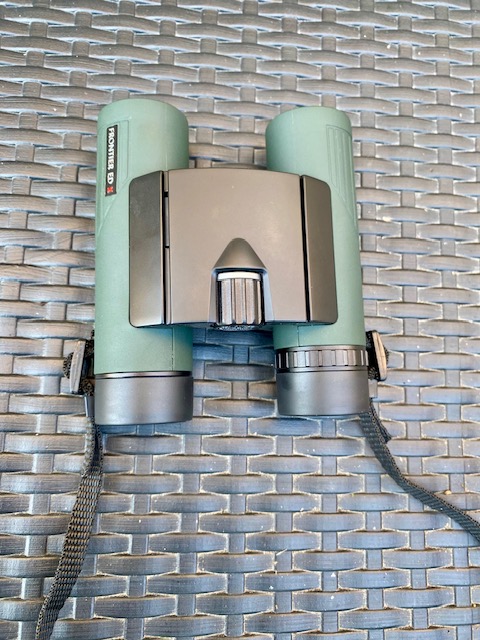
To be honest, I was sceptical about the specs of this binocular when I first perused them. An 8 x pocket glass delivering a field of view of 140m at 1000m? That was wider than a lot of full size binoculars I’ve tested, but it turned our to be absolutely true! More on that later.
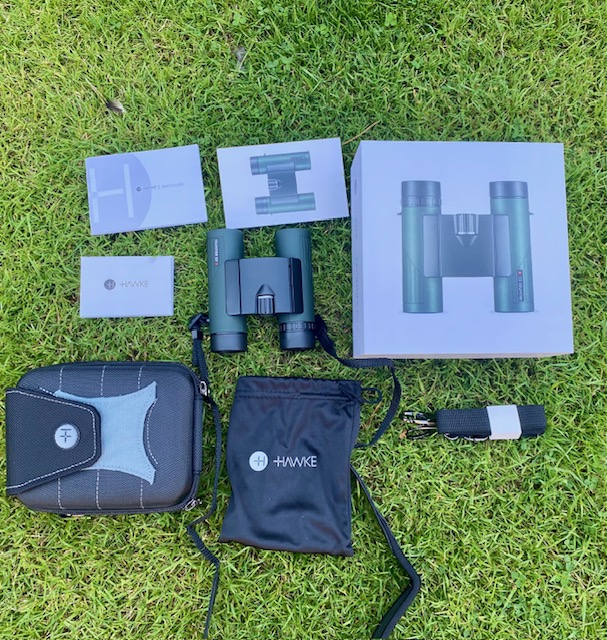
The Hawke Frontier EDX 8 x 25 comes in a very nice package. You get a lovely gift box containing a soft pouch, a zip closed hard case just like with their larger Frontier ED-X models.
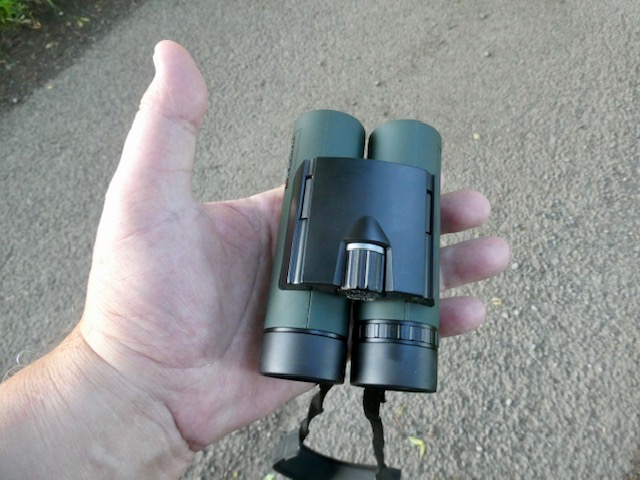
The binocular is very nicely built: a good step up from their Endurance ED 8 x 25 models. The chassis is constructed from strong but lightweight magnesium alloy and the overlying rubber armour is nicely textured to the touch.
The barrels are a little longer than normal for a pocket binocular but note how deeply recessed the objectives are! This helps keep stray light, dust and rain at bay. The anti-reflection coatings applied are immaculate with no streaks or other inconsistencies in evidence.
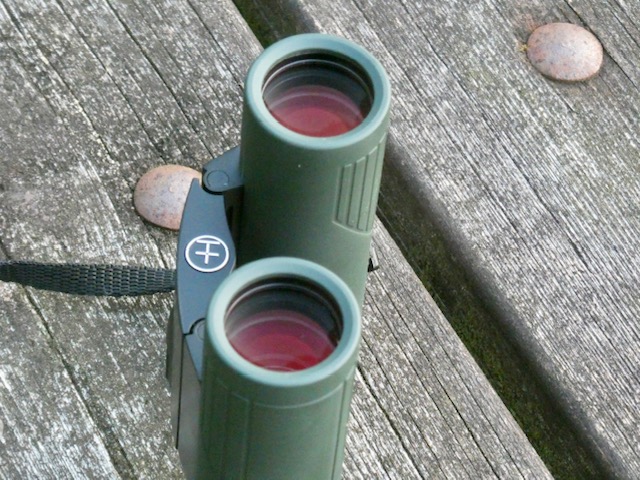
The focus wheel is deeply knurled and highly responsive, moving smoothly with no play or stiction, and taking 1.3 revolutions anticlockwise to go from its closest focus (a very impressive 1.55m) to infinity and a significant bit beyond. This is good news for those of us unlucky enough to have severe shortsightedness.
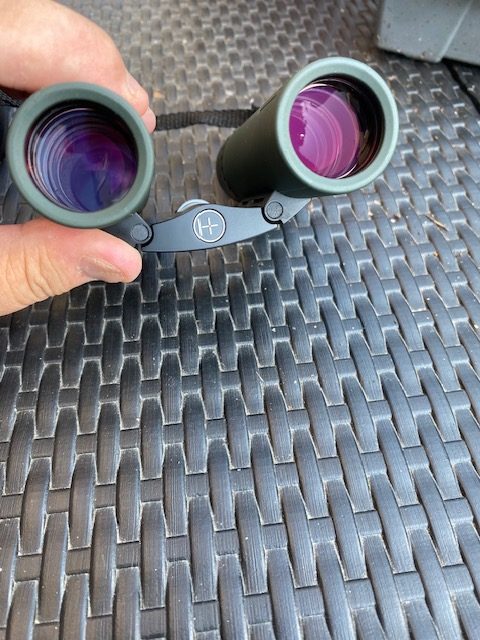
In the hand, the Hawke Frontier EDX 8 x 25 feels great. I can easily wrap my fingers round the barrels and can even use it effectively with one hand. Unlike most pocket binoculars, which usually offer only two positions to place the eyecups, the Hawke Frontier EDX 8 x 25 has three i.e. an intermediate position. Eye relief is also excellent for a pocket glass. I had no trouble seeing the entire field wearing my eye glasses when the cups were fully retracted.
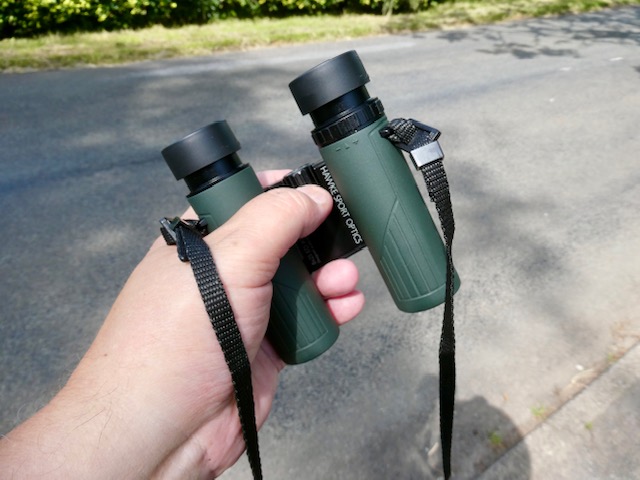
All in all, this is a very easy binocular to engage with, despite its small exit pupil size. One reason for this is the large eyepiece lenses which makes centring your eyes in the exit pupils that little bit easier.
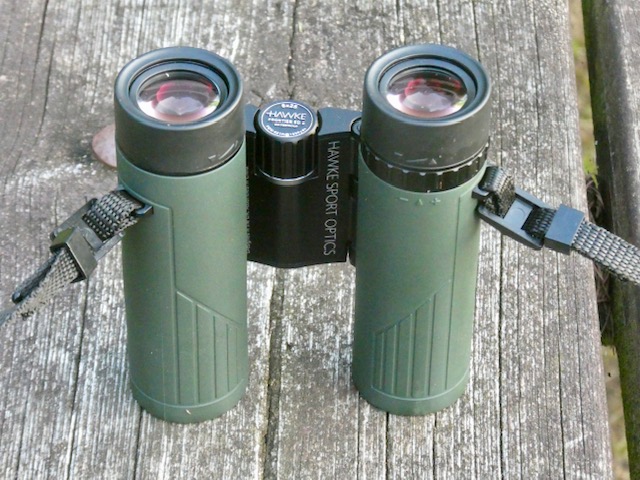
Optical Performance
The first really big surprise that I got with this binocular was how well it behaved when I aimed it at a bright light source. The Hawke Frontier EDX 8 x 25 showed no diffraction spike and only the merest trace of internal reflections! That’s extraordinary in my opinion, as it was a better result than any alpha pocket glass I’ve used in the past. This means it will perform superbly in low light situations, like observing cityscapes or harbour lights at night.
The next surprise came when I photographed the light emerging from the exit pupils of this small binocular:
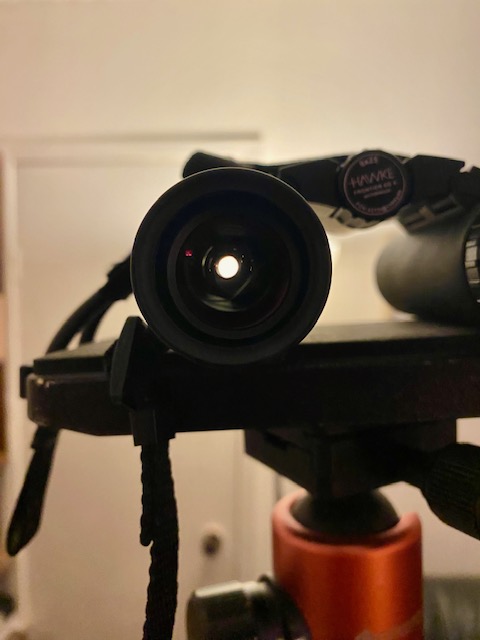
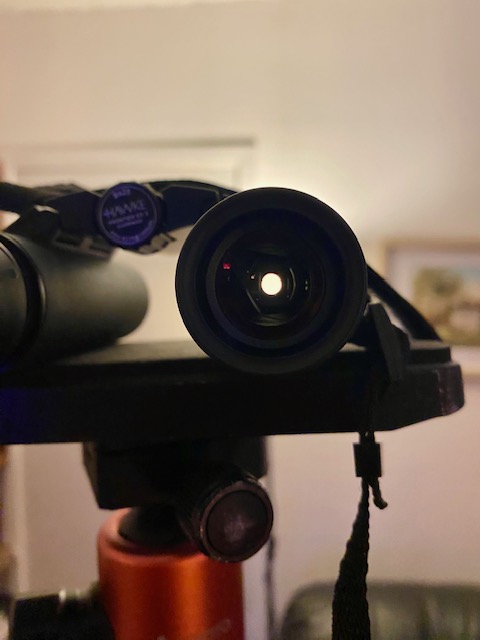
As you can see the results are excellent: perfectly round exit pupils, no truncation, and a nice dark hinterland around them! This is a good sign that the binocular will deliver glare free images in most lighting situations.
The view is outstanding!
Very sharp, bright and punchy with excellent contrast. Chromatic aberration is vanishingly low across the majority of the field, and only revealing a trace near the field stops. Pincushion distortion is also largely absent. The 8-degree field of view is a breath of fresh air compared with the overly tunnelled views presented by most other pocket glasses, especially at this price point. Colours are natural and vibrant. While the specifications don’t mention field flatteners, the view is sharp right out nearly to the very edge of the field, where some peripheral softness creeps in. That said, my 57-year old eyes can accommodate the entire field.
After dark, I was able to test the flatness of the field by centring the bright star, Vega, and moving it slowly to the edge of the field. I was delighted to see that the star remained tightly focused nearly all the way to the edge. It was only in the last 10-15 per cent of the field that I could see some bloating of the star image, but since I was able to focus this out, I knew it was mostly mild field curvature that had crept in.
Comparison with an Alpha Pocket Glass
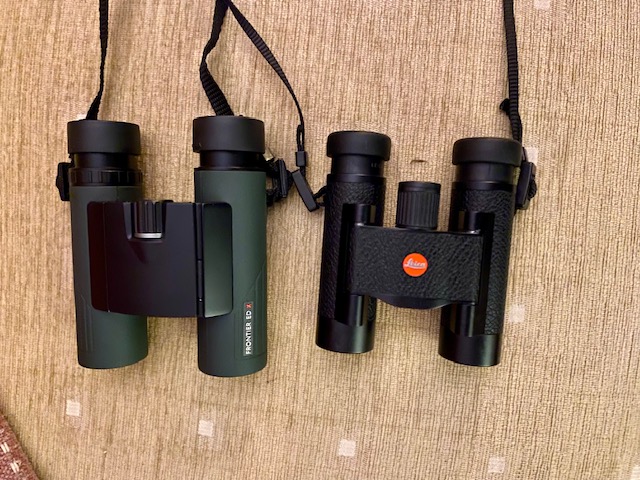
I spent a few hours comparing and contrasting the views produced by the Hawke Frontier EDX 8 x 25 and the Leica Ultravid BL 8 x 20. The latter retails for twice the price of the Hawke glass. I judged central sharpness to be a shade higher in the Leica, with more saturated colours. But there was no detail seen in the Leica that could not be seen in the Hawke. Glassing against the light was also slightly better in the Leica than the Hawke. That said, since you can glass comfortably glass using one hand, you can use the other to shade the objectives when looking very close to the Sun.
The Leica showed a modest diffraction spike when I turned it toward a bright street light after dark. The Hawke showed none. Internal reflections were equally well controlled in both glasses.
But there were many other ways the Hawke pulled ahead. The field of view in the Hawke is much larger – more than 60 larger in fact – than the Leica, and that alone creates a completely different viewing experience, much more reminiscent of that of a larger glass. The Leica shows much more pronounced pincushion distortion off axis compared with the Hawke. Ergonomically, the Hawke proved far nicer to handle than the smaller Leica Ultravid BL 8 x 20. The focuser on the Hawke is much smoother and more responsive than its Leica counterpart and is much easier to hold steady since you can more easily wrap your fingers round the barrels. All in all, the Hawke is the better glass.
Conclusions & Recommendations
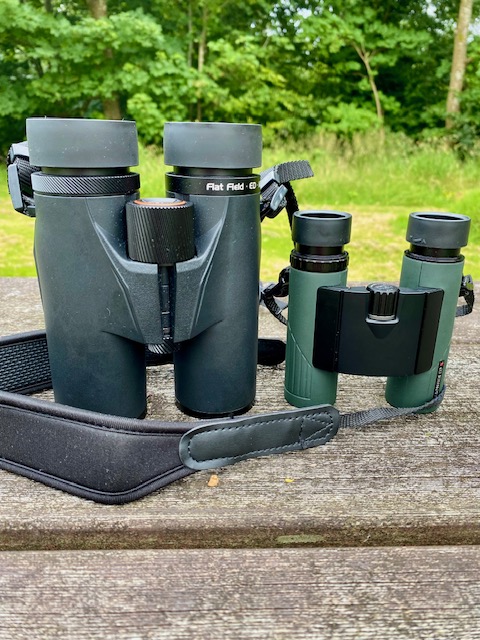
The Hawke Frontier EDX 8 x 25 totally surprised me. I was simply not expecting this level of optical performance from such a small binocular and at such a reasonable price. For sure these are the closest pocket binoculars that behave like 8 x 32s with their easy eye box and remarkably large and well corrected field of view. In fact, I liked the Hawke Frontier ED-X 8 x 25 so much, I also pulled the trigger on the 10 x 25(with its 6.6 degree true field)from the same series!
Could they replace a larger format binocular like the 8 x 42? Maybe for some but not for me; you see, no folding pocket binocular comes anywhere near the sheer brilliance, handling and micro-crystalline resolution served up by an alpha 8 x 42. No, they complement each other, with the smaller instrument being chosen only when sheer portability is of paramount importance.
Highly Recommended!
Read more on all manner of pocket binoculars in my book, Choosing and Using Binoculars.